In September 2024, Lalit Tyagi began to write about entrepreneurship and began by questioning his credentials. He had no funding announcement to offer. No big exit. He was not running one of the Indian startups whose founders regularly occupied the headlines. He had a company, a team, and some experience. For a moment, that seemed to him an insufficient reason to speak.
Then he wrote anyway. The resulting essay, “Enterpreneurship Journey,” is interesting precisely because of that hesitation. The founder and CEO of Polosoft Technologies was trying to make room for a business story whose central event was continuing to do business. Anyone waiting for the helicopter arrival would have to make do with cash flow.
“My company is bootstrapped,” he wrote. There had been difficult stretches as well as progress, and the company was still growing. His priorities were plain: profit, sustainability, and enough patience to keep working. In an account crowded with references to the glamour of startups, those ordinary words did most of the work.
Tyagi’s story runs through programming, sales, management, geospatial services, and telecom engineering. It also contains an argument about what deserves attention. A services company can have an interesting life without a funding round supplying the plot. The work, the colleagues, and the customers can supply one of their own.
A programmer changes the job description
Tyagi studied at Meerut Institute of Engineering and Technology from 1998 to 2002. His training was in computer science and engineering. His college record includes another detail: membership of the cricket team. Before the company meetings and telecom designs, there was a team of a different kind, with a rather clearer scoreboard.
He began his career as a programmer, then moved into sales, management, and operations. His professional biography describes a growing recognition that entrepreneurship suited his interests. It also records experience as an associate vice president before he took responsibility for sales, marketing, strategy, and operations at his own business.
That change of work matters to the shape of his career. Programming, selling, and running operations put different questions in front of a person. Does the software work? Will someone buy it? Can a team deliver what has been promised? Tyagi’s career moved across all three territories before Polosoft became the place where those responsibilities met.
He founded Polosoft in 2016. The company’s work spans software and engineering services, with geospatial and telecom capabilities that give the broad technology label some useful definition. Tyagi’s public professional profile places him in Delhi; the business has a substantial operating presence in Bhubaneswar. The founder’s location and the company’s working geography are different parts of the same story.
The map underneath the connection
Polosoft’s work becomes easier to picture when the acronyms acquire physical surroundings. GIS concerns geographic information. CAD concerns drawings and design. LiDAR provides measurements used to understand terrain and objects. Telecom engineering brings routes, fibre, poles, and permissions into the picture. A connection that feels effortless to its user can require a considerable amount of preparatory work.
An early Startup Odisha profile lists Polosoft’s offerings as software, web and mobile development, GIS and CAD services, and a hotel-booking product. It records 23 employees and identifies the United States as the target market. This is a historical snapshot rather than a current headcount, but it gives the young company a concrete scale and direction.
Tyagi also wrote about the technical work. In the December 2021 issue of GIS Resources, his article on LiDAR in forestry mapping considered what remote sensing could tell people about forests. Canopy heights, timber volume, and vegetation characteristics were among the subjects. The CEO’s name appeared beside an explanation of how measurements become information that people can use.
In November 2023, he turned to telecom design. His article described the place of geographic information in network planning and the opportunity for specialist design partners. Polosoft’s stated services included fibre-to-the-home design, high-level and low-level design, and permit design. The vocabulary is dry. The underlying task is pleasingly concrete: work out how a network can be built.
He emphasized delivery times and long-term partnerships, alongside the role offshore teams could play through skills and differences in time zones. Those were his explanations of the opportunity. They help connect the programmer’s technical beginnings with the sales and operations responsibilities he later assumed. A drawing has to be useful, and a promise has to survive the handover.
A startup, a shop, and a cash-flow statement
The 2024 entrepreneurship essay is where Tyagi becomes more personal. He notices that calling an enterprise a “startup” can make it sound fashionable, while calling it a business can make people imagine a shop. He finds the distinction odd. His concern is what happens after the attractive label has done its work.
“Business needs profit, sustainability, and cash flow,” he wrote. He questioned the attention paid to valuations and fundraising when companies could still close despite receiving investment. He also acknowledged that readers might disagree with him, or wonder whether funding would change his own behaviour. That concession gives the argument some air. He is expressing a preference, rather than claiming immunity to temptation.
His example of a company he admires is Zoho, for its bootstrapped growth. He also points toward services businesses that receive relatively little attention without funding announcements or a publicity machine. This is the company he wants his own account to keep: businesses whose daily activity offers more to discuss than their visibility might suggest.
The essay contains an aspiration beyond operating his own company. He wonders whether he might someday become an angel investor. It is a passing thought, framed as a possibility. It belongs beside his larger interest in India’s entrepreneurial future and his invitation for other founders to share what they are learning.
The detail that returns throughout is responsibility to a team. His argument for persistence includes the people a founder has to look after. That gives the discussion of patience a practical weight. Continuing involves colleagues, work, and obligations. It is a less cinematic account of entrepreneurship, though cinema rarely has to meet a monthly payroll.
“Business needs profit, sustainability, and cash flow.”Lalit Tyagi · September 2024
Instructions that leave room for Tuesday
Two months before publishing that essay, Tyagi had written a more methodical article about running a startup. Published in July 2024, it covered market research, a minimum viable product, hiring, customer retention, financial management, and measurement. It reads as a working checklist, with the customer and the team repeatedly coming back into view.
The more revealing part is the ending. After laying out the work, he cautions against trying to implement everything immediately. He recommends introducing practices gradually, gaining experience, and continuing at a pace the founder can sustain. The advice makes space for an actual working week, with its interruptions and unfinished tasks.
Put alongside the September essay, this is a consistent position: examine the business carefully, accept that improvements take time, and keep moving. It would be easy to turn that into a polished doctrine. Tyagi’s own writing is more conversational. He mixes financial fundamentals with asides, jokes, and an invitation for peers to answer back.
The people in the anniversary photograph
Polosoft received recognition in Odisha’s STPI Export Awards for 2018-19 in the non-STP exporting category, with Tyagi attending to receive the award. The moment belongs to the company’s early years: a business founded in 2016 being recognized for export activity within a few years of starting.
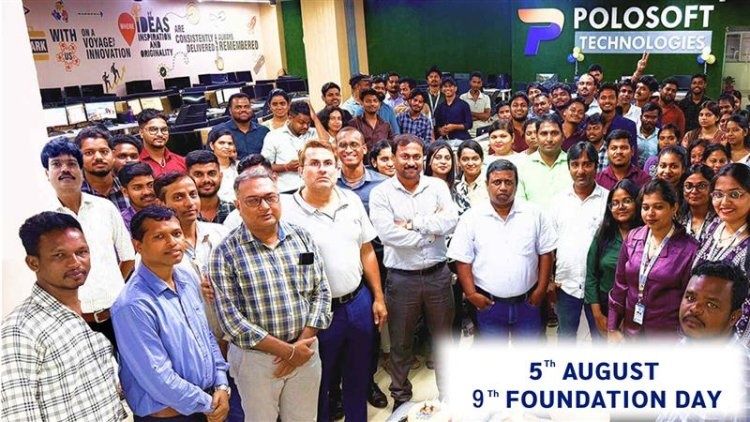
By August 5, 2025, there was another occasion to gather: Polosoft’s ninth Foundation Day. The celebration included team activities and cake-cutting. A group photograph places colleagues together in the office, filling the frame beneath the company name. The image offers a useful companion to the founder’s writing about responsibility: here are the people behind that word.
In his anniversary address, Tyagi thanked the team, clients, and partners. He credited the people who had contributed to the company’s work in GIS, LiDAR, CAD, and software services. The emphasis fits the earlier essay. In both accounts, the founder describes progress as something that requires other people to keep believing and participating.
An anniversary makes a neat number out of untidy working days. Nine years can fit on a cake or a caption. The photograph does something the number cannot: it gives the occasion faces. For a profile of a founder who wanted more everyday business stories told, it is an unusually appropriate illustration.
A new office, and work still ahead
In March 2026, Polosoft announced the opening of an office in Hyderabad. The inauguration included a traditional puja and rangoli decorations made by employees. Its stated purpose was to expand capabilities in digital services, geospatial solutions, telecom engineering, and related work. The expansion acquired the ordinary details of an office opening: a shared space, preparations, and colleagues making an occasion of it.
Tyagi’s more recent public activity also points toward telecom. He has advertised senior roles connected with international engineering delivery and US sales. A post about Connected America 2026 describes Polosoft’s interest in combining telecom infrastructure work with security and automation through Telesec AI. These are stated business directions, with their results still to be earned.
That distinction suits the account he began in 2024. He had been reluctant to write because he lacked the customary headline events. Yet the story already contained a change of profession, a company founded, technical work explained, and colleagues gathered for an anniversary. Hyderabad adds another place to continue it.
The closing invitation in his entrepreneurship essay was for fellow entrepreneurs to speak up about their own experiences. Tyagi had started by wondering whether his qualified, unfinished story deserved a hearing. He ended by asking to hear more of the same. There is something useful in that invitation: a business can still be in progress when its founder has something worth saying.
Follow the work
- Polosoft Technologies
- Lalit Tyagi on LinkedIn
- His entrepreneurship essay · September 2024
- His startup checklist · July 2024
- His telecom design article · November 2023
- LiDAR in forestry · GIS Resources, page 17 (PDF)
- Polosoft’s ninth Foundation Day
- The Hyderabad office announcement
- Watch Polosoft’s company YouTube channel