The scientists were there. So were the startups. The question was whether anyone would come to the party. In July 2019, the organizers of the new French Tech Paris-Saclay community were preparing a launch at La Terrasse Discovery +x in Saint-Aubin. The setting was convivial; the transport connections were less obliging. Busy entrepreneurs would have to make an effort. Nearly 250 people did.
Valérian Giesz, the Quandela co-founder who co-chaired the community's board, had wondered whether support for a label would translate into people showing up. More than 300 registered. The turnout gave him a concrete reason to believe the appetite was real. Even so, he acknowledged that the group still had to work out its business model. A room full of goodwill was a beginning.
Seven years later, La French Tech Paris-Saclay has a practical answer to what comes after the launch drinks. It connects entrepreneurs with people who can help them hire, find facilities, understand public support and reach commercial partners. Its specialty is the business growing around scientific and technological invention in Paris-Saclay, the Yvelines and the Essonne.
The organization is a nonprofit association, formally created in November 2019. Its constituency includes project holders, young startups and established scale-ups. Deep tech gives it a center of gravity, while its stated mission leaves room for other sectors. That combination matters: a company selling scientific instruments and one selling software can need the same introduction to a recruiter or a buyer.
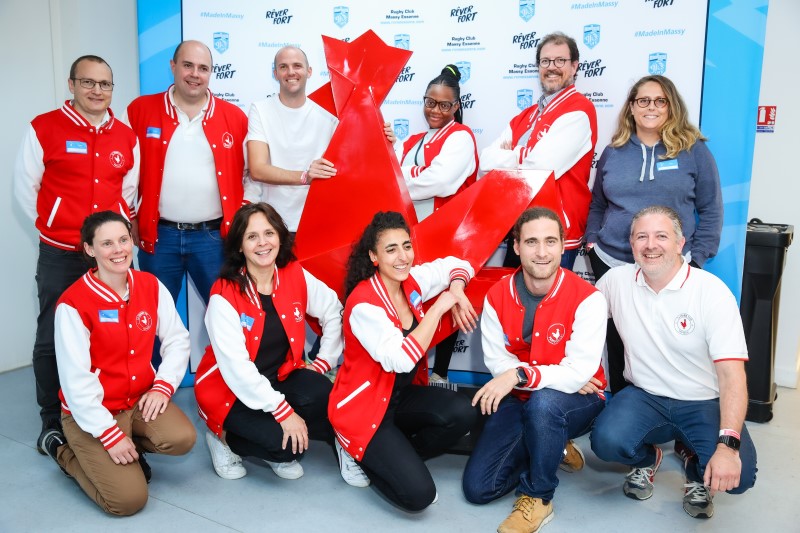
A quantum founder with a diary problem
Giesz's involvement came with a thoroughly recognizable question: how much time would this take? In his launch interview, he recalled asking about the commitment and being reassured that he would have help. He and fellow co-chair Arnaud Peltier, co-founder of WiN MS, joined a nine-person board spanning different disciplines and parts of the territory.
That origin explains the association's most useful expertise. It draws on people who have started companies in the place it serves. Peltier described founders encountering similar problems despite working in different fields. His image for their contribution was cement: the territory already had plenty of institutional bricks, and entrepreneurs could help join them together.
The current French-language team page lists a 12-member board and three operational team members. Cécile Chevalier, associated with Diagante and Exhalon, is president; Giesz is vice president. Ségolène Dufour-Genneson is general delegate. The page describes a wider community of more than 600 startups. That figure describes the surrounding community, rather than a verified count of paying subscribers.
The group received the Capitale French Tech designation in February 2023 and appears in the government's renewed 2026-2028 network. The label gives local work a national connection. The day-to-day proposition remains more intimate: people who know the territory can help other people find their way around it.
THE FOUNDERS’ JOB, IN ONE IMAGE“c’est le ciment !”Arnaud Peltier, 2019
“It’s the cement!” - translated from French
The useful door is free to open
French Tech Central is the clearest entry point. Its booking platform arranges individual appointments and thematic workshops with public-service experts and other partners. A founder can browse subjects including financing, international development, human resources, legal questions, scientific expertise and location. Meetings are offered by video or at the Playground in Palaiseau.
Access is free for startup founders and project holders with a connection to the territory; association membership is not compulsory. That is a meaningful design choice. Someone can arrive with a specific obstacle before deciding whether to join the broader network. The first step is choosing a topic or an organization and booking an available appointment.
For founders, the useful discipline is to make the request narrow. Bring a question about an upcoming hire, a financing process or a scientific capability. Describe the decision you need to make. This is an editorial recommendation drawn from the service's appointment format: a defined question gives an expert something concrete to answer.
The association's partner directory includes Bpifrance, INPI, Inria, the CEA, Business France and industrial companies. Those names explain the breadth of possible connections. Each partner retains its own responsibilities and processes. An introduction can clarify the next step; the founder still has to complete the application, negotiate the agreement or make the sale.
Free for eligible local founders and project holders.
Some startups need a laboratory key
The program Venez Start-upper Chez Nous tackles a particularly physical problem. Startups can seek temporary, flexible offices, laboratories, workshops and shared equipment at preferential rates. The association helps match demand with providers and offers personal assistance when the catalogue does not contain an obvious fit.
The provider side is unusually revealing. Hosts can receive help constructing an offer, guidance on pricing and a model contract, along with visibility to startups. The service addresses both ends of the transaction. A useful piece of equipment only becomes accessible when somebody can explain the terms on which another company may use it.
This is where the association's regional focus earns its keep. Laboratory access and workshop space require more than a list of email addresses. Geography, availability and the character of the facilities matter. The program promises preferential terms, with the actual arrangement depending on the offer; the published description supplies no universal laboratory rental price.
What the membership bill actually buys
The 2026 membership form lists €49 for student entrepreneurs, €149 for the startup tier and €399 for scale-ups or SMEs. It also lists €1,499 for intermediate-sized companies and €2,499 for large groups. Eligibility combines a technological or innovative business with a connection to the territory; the form sets size, fundraising or turnover conditions for its tiers.
Membership brings access to association events, community visibility, the directory and partner offers. The proposition is participation in an organized network. A founder deciding whether to pay can judge the relevant events, potential contacts and available services against a specific business need. The lowest price belongs to the student-entrepreneur category, so advertising every startup's entry ticket as €49 would be misleading.
There is also a separate partnership business. The French-language offer page advertises €1,500 excluding tax for support structures, €2,500 for service providers and €3,500 for investment funds. Its partner package is €7,500 and its premium package €20,000, both excluding tax. Depending on the package, benefits include visibility, startup scouting, events and learning expeditions.
These are published prices for access and services. They are not the association's revenue, operating budget or a funding round. They do show how different participants are asked to contribute: founders buy membership; organizations seeking sustained contact with startups can purchase broader packages. Investors appear here as network participants with their own offer.
Six companies take the next step
For more mature businesses, Scale Up Excellence adds a selective program. The association's 2026-2027 page names six local participants: Reekom, Up and Charge, Qolumbus, Axiscope, Kerys Software and ShareID. Twelve French Tech Capitales coordinate the national program, extending the pool of peers beyond the immediate region.
The offer includes coaching on public affairs and communications, masterclasses with Next40 or French Tech 120 CEOs, media training and access to public decision-makers. Three or four peer events a year in Paris are part of the published format. The emphasis is on visibility, connections and the organizational demands of growth.
The eligibility rules make clear who this particular product serves. Applicants must already commercialize a product or service and generate revenue, have fewer than ten years of existence, and have a team of 10 to 50. The page also specifies fundraising or turnover thresholds, growth and societal-impact requirements, plus membership of a participating Capitale.
A researcher with an early idea should therefore start elsewhere in the association's services. Selection into this cohort is a milestone for a business that has already progressed. It offers a more focused setting in which CEOs can work on problems that emerge after a first product reaches the market.
Read the small ads
For a less polished picture of the community, look at its June 2025 classified advertisements. Unveil Instruments wanted early adopters among biotechs, contract research and manufacturing organizations, and academic laboratories. Biophytech sought a commercial co-founder and prospective CEO. Zoe Care was looking for business angels. These are specific requests with identifiable audiences.
The same month's member-news roundup reported that Unveil Instruments had signed its first customer in April and finalized its minimum viable product in May. PuRE Carbon Capture reported the arrival of a test bench at Magny-les-Hameaux. These were updates published by the network about its members, and do not establish that the association caused the underlying achievements.
The contrast between an announcement and a classified ad is instructive. One tells readers what happened; the other gives them a way to help. Publishing both makes the association useful to someone looking for a pilot partner, a new role or a company to invest in. It also shows why a deep-tech community still needs the humble noticeboard.
A network earns its fee in the follow-up
Paris-Saclay already has specialist institutions. IncubAlliance supports company creation and incubation; the SATT Paris-Saclay works on technology transfer. The French Tech association joined those organizations and Université Paris-Saclay in the DeepTech Alliance launched in 2021. Their collaboration reflects the different tasks involved in taking research toward a business.
For a founder choosing where to spend time, those institutions are alternatives for particular needs and potential complements. Intensive incubation, a research-licensing discussion and a useful introduction require different arrangements. The association's place in this market is the shared network between organizations, with selected programs layered onto it.
Its early difficulty was the uncertainty around participation and how to sustain the organization financially. The launch turnout answered the first concern; today's membership and partnership offers show how the commercial proposition became more explicit. Neither supplies a reason to invent a dramatic corporate turnaround. The interesting development is the conversion of founder enthusiasm into repeatable services.
What can another community copy? Give entrepreneurs a role in governance. Make an initial expert conversation easy to access. Publish concrete requests alongside good news. Help facility owners describe usable offers. Reserve selective growth programs for companies ready to use them. These choices are visible in the association's activities, and each addresses a recognizable coordination problem.
Their usefulness depends on having relevant experts, responsive hosts and founders willing to follow through. A company outside the territory may fail a program's eligibility rules. A business needing immediate investment still needs an investor's decision. For the right local founder, though, the appeal is wonderfully ordinary: a better chance of leaving the next meeting knowing whom to call.