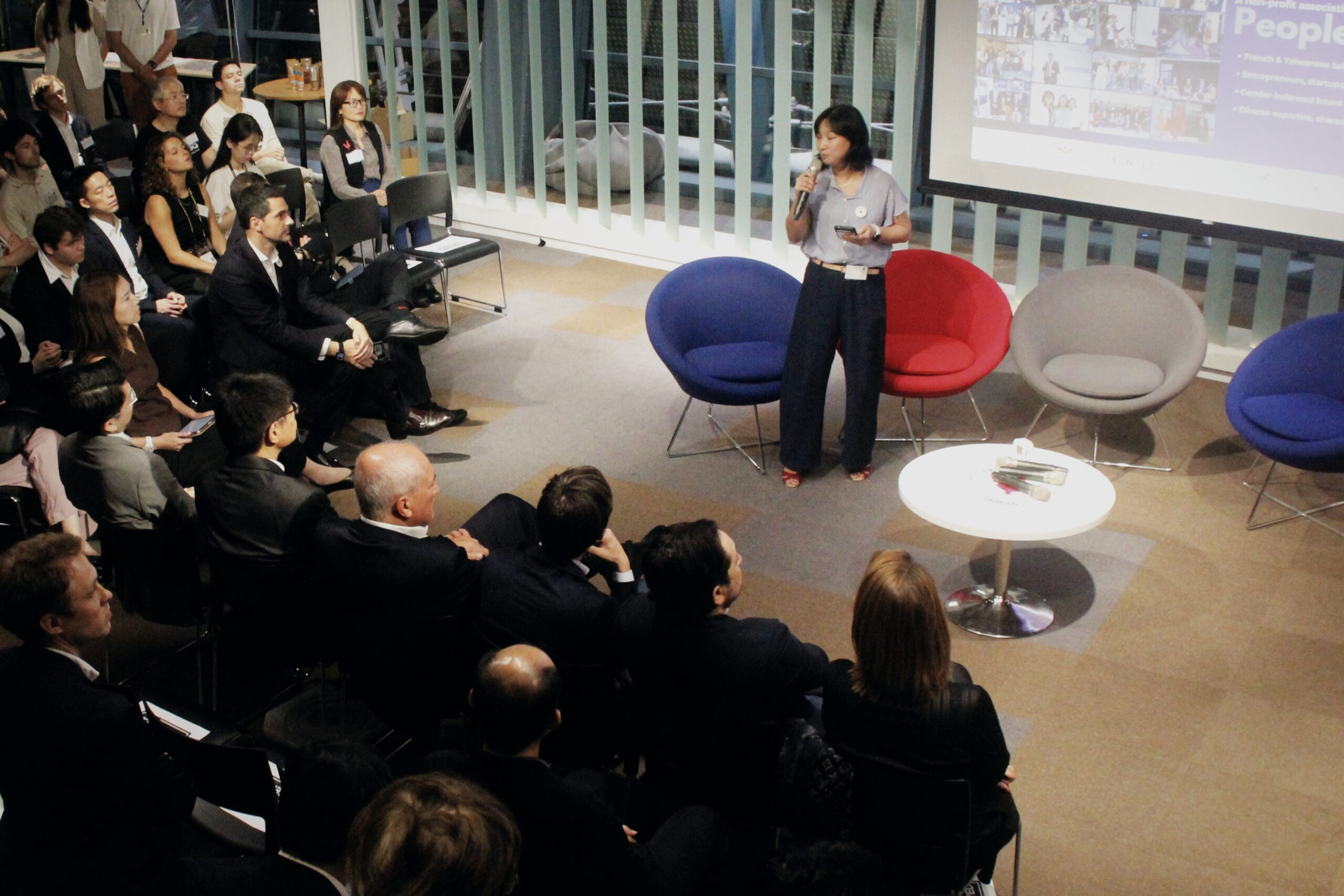
A semiconductor founder, a luxury-data entrepreneur and an industrial partner walk into Taiwan Tech Arena. At French Tech Night on June 4, 2026, that combination belonged on the agenda. The gathering marked ten years of France-Taiwan innovation cooperation, with a panel that moved across silicon photonics, advanced packaging, artificial intelligence and luxury technology. The common subject was how people from two business environments get something built together.
La French Tech Taiwan makes those encounters its business. The nonprofit community offers tailored introductions, networking and events for French startups exploring Taiwan and Taiwanese startups looking toward France and Europe. Around them sit corporate teams, investors, researchers and public institutions. The proposition is refreshingly tangible: somebody arriving with a promising idea needs to meet somebody who can help put it to work.
There is a temptation to measure a network by the size of its reception. This one is more interesting when you examine the guest list, the preparation and the next conversation. Its record includes a demo day inside a sporting-goods store, a gender-gap white paper and an innovation itinerary for young Taiwanese visitors to Paris. Each gives a different answer to the same question: what makes an introduction useful?
A label needs a local address
The community received the French Tech label in 2016. In a 2024 interview, Cerise Phiv explained that the French Office initiated its creation, while a local group of entrepreneurs and technology professionals carried the project. Institutional backing helped it establish offices at Taiwan Tech Arena. Its welcome guide dates that presence to 2018, placing the community alongside the organizations that visiting founders might want to find.
That location supports a particular role in the market. Business France offers international business-development services; the French chamber connects businesses; accelerators provide their own programs. French Tech Taiwan works among these organizations, with a specific interest in startup relationships between the two places. Its public directory sends readers onward to incubators, coworking spaces, specialist advisers and funding resources.
The people running it bring working knowledge from outside the association. Its team page lists co-presidents Cerise Phiv of Symaps.io and Ching-Hua Lin of DigiFashion Forum. Vice-president and treasurer Jonathan Drubay works on international cooperation at Quobly. Other board profiles span industrial technology, recruitment, fashion, consulting and energy. These affiliations matter because an introduction benefits from somebody understanding the question behind it.
The sporting-goods store test
For a concrete account of the work, go to Taichung. On December 4, 2019, French Tech Taiwan and Decathlon scheduled an Open Innovation Demo Day at Creativ’ Playground in Decathlon’s Nantun store. Registration was mandatory. After introductions, the agenda divided startup pitches into services, products and user experience, before setting aside time for demonstrations and networking.
The names were specific, too: Pickups, WUSA and Natex appeared under services; Tenniston, Koup, Scuba Companion, Fox-Tech and Graphene under products; Basepara and Uniigym under user experience. The categories gave the audience a way to understand what it was about to see. A sporting-goods company could consider proposals in relation to its own business, rather than listen to an undifferentiated parade of startup ambition.
That format is worth copying. Start with a company that has a reason to listen. Group presentations around recognizable needs. Leave room for people to examine the work and ask questions. A demo-day listing does not establish that a procurement contract followed. It does show how an organizer can make an encounter more purposeful before anyone reaches for a business card.
The money around this activity follows a community model. Corporate and institutional support help sustain the work, alongside volunteer contributions. The 2026 French Tech Night named Dassault Systèmes and L’Oréal Taiwan as sponsors and Business France as co-organizer. These are concrete examples of who helps put the gathering together. A founder’s own commitment includes preparation, attendance and the work of maintaining contact afterward.
Chips make the conversation specific
The 2026 calendar places semiconductors and deep technology prominently in that effort. French Tech Night’s startup showcase included SiPearl, Quobly, Quandela, NcodiN and other companies across computing, photonics, materials and industrial systems. It gave Taiwanese participants a concentrated introduction to visiting French technology businesses during COMPUTEX and InnoVEX, when those companies were already in town.
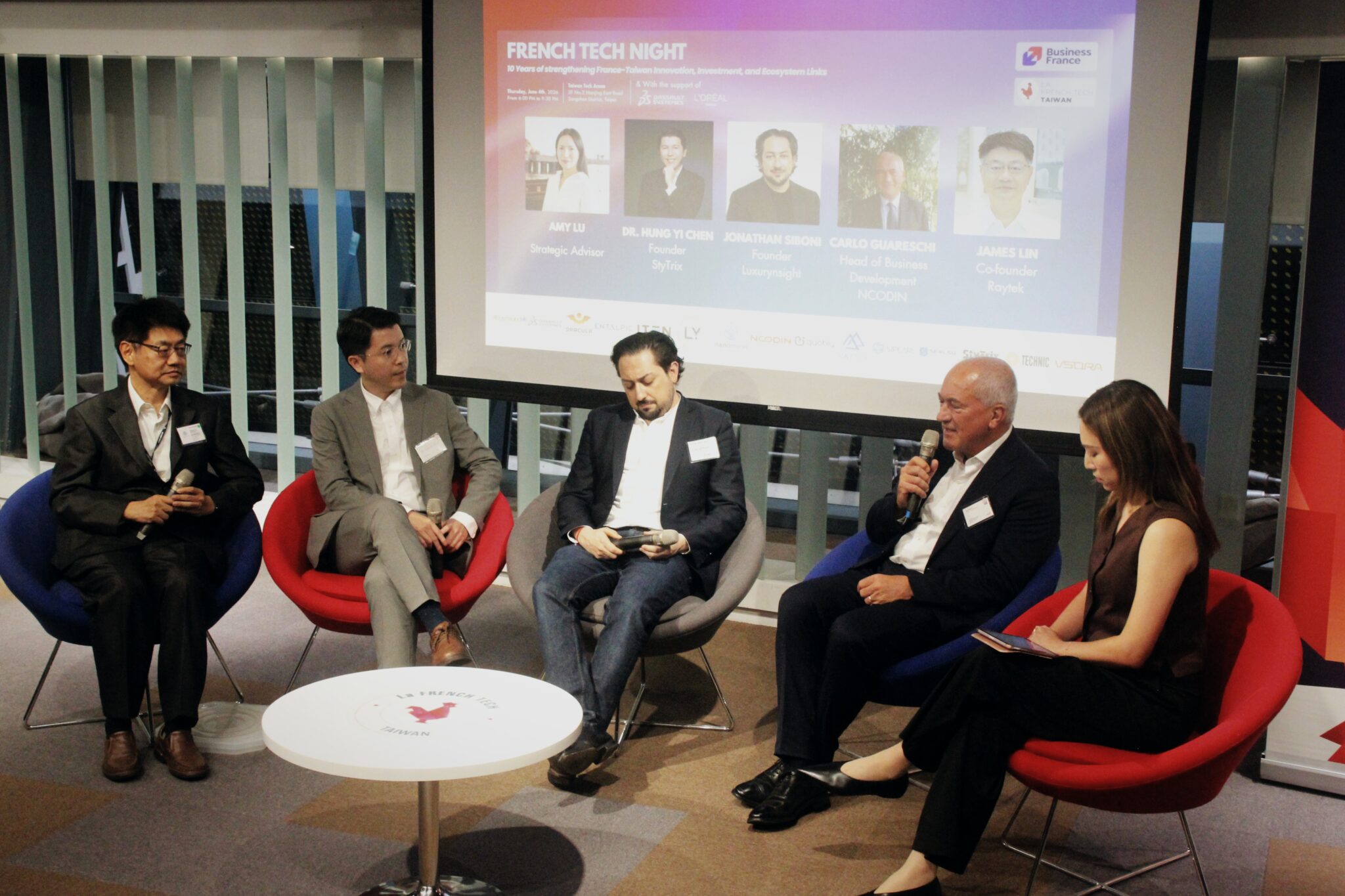
The event’s panel, moderated by Amy Lu, brought together Jonathan Siboni of Luxurynsight, James Lin of Raytek Semiconductor, Carlo Guareschi of NcodiN and Hunyi Chen of StyTrix. In the organizers’ account, the discussion addressed mismatched development cycles, communication styles and market expectations. Regular technical exchange and continuing alignment featured among the requirements for cooperation.
Those details put a useful limit on networking optimism. A community can help people discover each other. The participants still have to establish whether their timelines, capabilities and commercial interests fit. The first meeting may reveal that they do not. For a founder, learning that early can be more useful than collecting another enthusiastic but directionless contact.
The September 1 French Silicon Night program sharpened the focus further, listing speakers from the European Commission, CEA-Leti, SiPearl and ITRI, plus a keynote by ITIC president Karen Yu. Its provisional agenda combined policy, industry and startup presentations. The selection shows the community’s convening strategy: bring several parts of a technical relationship into one conversation.
There is room for a better-fitting bra
Yet the France-Taiwan connection also reaches well beyond chips. In a June 2026 interview published by the community, Cocoon Bravolution founder Shao-Hua Huang discussed her company’s work on bra-fitting recommendations and its preparation for VivaTech. She described revising the pitch deck, preparing concise demonstrations and contacting people ahead of the exhibition. Her aim included finding international partners for pilot projects.
“Beyond visibility, we want to become part of the broader conversation shaping the future of fashion and customer experience.”
Shao-Hua Huang · Founder, Cocoon Bravolution
The example gives the network a human scale. A founder with a defined customer problem is considering where another country’s brands and technology companies might help. French Tech Taiwan contributes visibility through the interview. Huang’s account also makes clear how much preparation belongs to the entrepreneur. Showing up at an international event is one item on a longer list.
Gender equity is part of the community’s own programming. Its 2024 white paper examines the gender gap in technology across Taiwan and France, with editions in English, Chinese and French. The organization also publishes a Women in Tech interview series. These activities give participants material to revisit after a discussion ends, and make the audience broader than those who can attend a particular evening.
Paris, with an itinerary
International exchange becomes especially concrete in Global Pathfinders France 2026. French Tech Taiwan took responsibility for designing and coordinating the Innovation & Start-ups pathway, working within a program whose listed organizers included the French Office in Taipei, Taiwan’s Ministry of Education and AICEE. The Paris program ran from June 7 to 22.
The published plan identified ten Taiwanese participants and more than 20 visits and meetings. It combined VivaTech with stops across the innovation landscape, including Station F, Bpifrance, Agoranov, Schoolab and Paris-Saclay. Adrien Malguy led the pathway in France, bringing previous experience working with Taiwan’s innovation community.
TAIWAN PARIS
June 7-22 · Innovation & Start-ups pathwayThe itinerary puts public policy, finance, research and entrepreneurship next to one another. For an emerging founder, seeing those institutions in relation to each other can help explain how a market works. The transferable lesson for an exchange organizer is to give every visit a place in a larger question. A sequence of impressive addresses needs a purpose.
Bring a question worth answering
For someone considering Taiwan, a useful starting point is the community’s resource collection. Its business-guide page offers a French-language guide edited by Business France Taiwan, covering the market, business practices and contacts. The ecosystem directory helps a visitor identify the kinds of organizations available. The contact form then allows inquiries about development in Taiwan, open innovation and other needs.
A practical way to use those resources is to arrive with a narrow request. Identify the product, the intended customer, the stage of development and the kind of partner needed. That is editorial advice drawn from the community’s activities: a targeted demo day and a technical panel both work because the participants have something specific to discuss. An introduction alone cannot supply an expansion budget or make a product ready.
There are other ways in. Volunteers can help coordinate events, produce video and photography, handle communications, develop partnerships or engage universities and talent. The invitation explicitly says, “French is not required!” And the geography is expanding beyond the capital: a May 22, 2026 meetup at Second Space in Kaohsiung included talks on AI and energy transition.
Ten years gives French Tech Taiwan a history, but the useful unit of its work remains small: a founder, a question and another person able to answer it. The next meeting earns its place on the calendar when those people know why they are there - and what they should do afterward.
Find your next conversation
Explore the official website, events, the business guide and the contact form.
Follow the community on LinkedIn and Facebook. Read its newsletters and founder interviews, or watch Women in Tech on YouTube.