The interesting part of a pharmacy delivery is not the drive. It is the trail. A bag leaves a counter, enters a car, reaches a door and produces a signature. Somewhere behind that simple trip sits a nest of obligations: timing, routing, proof, cost, privacy, records and the small matter of giving the correct package to the correct person. Kunal Vyas spent enough time inside that nest to stop seeing a delivery as a car on a map. He saw it as a system waiting to be made legible.
Vyas is an Orlando operator whose route into software ran through physician-group work, a Tampa HMO, pharmacy operations and ownership. He has said that pharmacy entered his working life at Citrus Healthcare, where the organization served about 30,000 members and had to solve the practical business of getting prescriptions to them. Later, as an independent pharmacy owner, the abstract problem became a daily one. Delivery could protect a customer relationship, but it could also consume money and leave a pharmacy exposed when its paperwork failed to match its promises.
This was not the usual founder fable in which an app appears during a shower and a market obediently assembles around it. The market was already there, waiting at home. The inconvenience had a route sheet. Vyas first built within the operation, then built for other operators. DeliverSTAT, the courier business he founded in 2018, gave him a working laboratory. RxMile turned the lessons into software.
The idea hiding in the route sheet
In a 2022 conversation, Vyas described RxMile as the all-in-one solution he had wanted for his own pharmacy: a way to synchronize deliveries, follow packages, retain customers and manage the awkward choreography between store, driver and recipient. The language is telling. He speaks like someone who had already paid for the failure modes. A missed stop is irritating. An unprovable stop can be expensive. A route planned without regard to refill timing repeats the expense next week.
“Built out of a necessity for me to serve my customers.”Kunal Vyas, at ThoughtSpot 2025
The product that emerged treated delivery as more than dispatch. RxMile connected to pharmacy-management software, generated routes, offered live tracking, captured electronic verification and kept an audit trail. Its patient-facing tracking did not require another app download. Its operational reports could show where delivery volume and cost were drifting apart. These are modest features individually. Together they acknowledge an unfashionable truth: the last mile is composed almost entirely of details, and details become expensive when they refuse to speak to one another.
The visible trip is short. The accountable chain begins before the driver leaves and continues after the door closes.
Vyas's practical obsession is cost. At ThoughtSpot 2025, he argued that delivery sits just behind drugs and payroll among a pharmacy's major expenses. His favored example was package density: a pharmacy delivering prescriptions one by one spends differently from one that synchronizes refills into fewer trips. The platform's job, in his telling, was not simply to make a driver arrive. It was to help the business understand what that arrival cost and whether the journey had created enough value.
Polite persistence
Software sold into pharmacies depends on trust, and trust moves more slowly than a demo. One small anecdote from ThoughtSpot 2025 captures how Vyas works. Heidi Pollock, an executive with Outcomes, introduced him as someone who had been persistent in contacting her on LinkedIn and consistently friendly in the process. They had spent years on calls and email before finally meeting in person at the conference. Their first handshake arrived after the integration work.
There is a clue here for anyone trying to sell a product into an established industry. Expertise earns the first hearing; steady follow-up earns the partnership. Vyas could explain the route because he had run the route. He could discuss pharmacy economics because he had owned the bill. Yet the relationship still required the ordinary labor of messages, calls and patient repetition. Enterprise software may be digital, but its doors often open by human persistence.
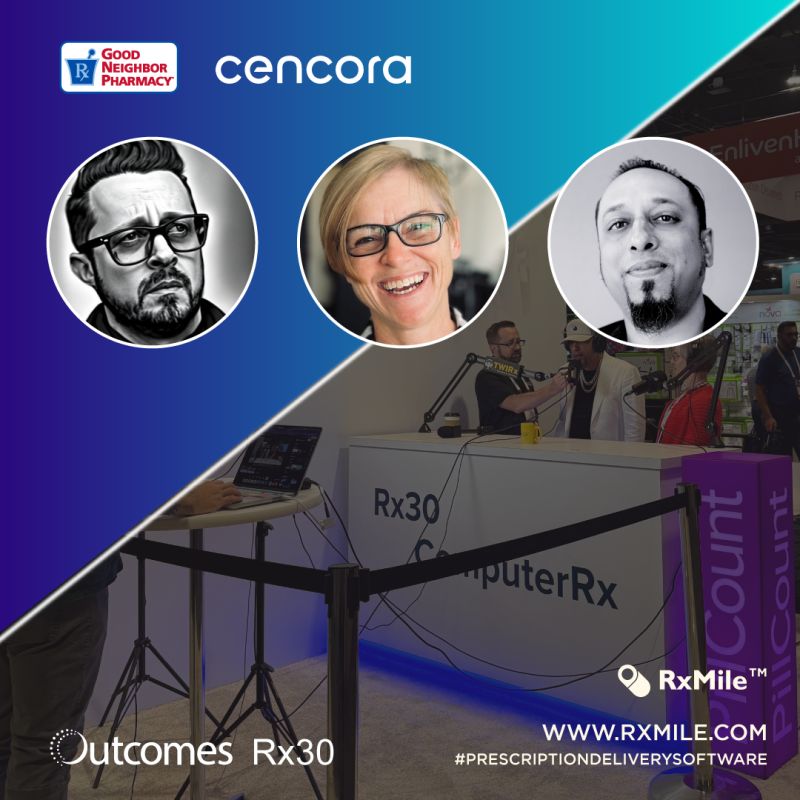
His politeness has shown up in less strategic settings, too. On the brisk 808 Podcast, host Bob Clark gave Vyas four questions and eight minutes. With the clock running, Vyas tried to ask the host about himself. Clark reminded him that the podcast was about the guest. Vyas explained that he was only trying to be polite. Then, asked why the show used the number 808, he landed the joke: “Because 808 is BOB.” The exchange is brief, but it loosens the tie on a career usually described through integrations and audit records.
A company built from adjacent views
Vyas did not arrive at RxMile from one job title. He had watched the same handoff from several sides. A physician group offered the view from care delivery. An HMO revealed population-scale operations. Pharmacy ownership made reimbursement, service and compliance personal. DeliverSTAT supplied the courier's view. RxMile gathered those adjacent perspectives into a single product. Founder-market fit, in this case, looked less like one credential than a stack of irritations collected over years.
That collection of views also explains why Vyas talks about independent pharmacies as a network rather than a set of isolated shops. The local pharmacy owns the relationship at the counter. Delivery extends that relationship beyond the store. Software can coordinate the extension without asking every shop to invent its own miniature logistics company. The ambition is infrastructure, but the unit of service remains intensely local: one package, one route, one doorstep.
His product choices follow that philosophy. RxMile can sit beside a pharmacy's existing management software rather than demanding that the entire store reorganize itself around delivery. A pharmacy can use its own drivers or connect with outside couriers. The customer can follow a package through a link. The employee can retrieve the delivery record later. In each case, the platform tries to meet a participant where the work already happens. This is less dramatic than replacing an industry, and considerably more courteous.
It also reflects Vyas's affection for the independent operator. He has repeatedly argued that local pharmacies already possess the distribution footprint and customer relationships that digital competitors spend heavily to recreate. His proposal is to add coordination, not erase the people behind the counter. Software becomes leverage for the shop that cannot employ a logistics department, a data team and a compliance specialist merely to send a bag across town.
“Delivery is kinda the glue, because it's kinda the new Netflix.”Kunal Vyas on changing customer expectations
The Netflix comparison is playful, but the point is sober. Once customers become accustomed to seeing an arrival time and following a package, opacity feels broken. A small pharmacy is judged against the interface of every large delivery service a customer has used. Vyas's bet was that independent operators should not have to surrender their customer relationship to match that convenience. They could borrow the visibility while keeping the local service.
The exit and the next route
In November 2025, RxMile announced that it had been acquired by RedSail Technologies. The fit was architectural. RedSail owns pharmacy technology businesses, including PioneerRx, and RxMile had already worked to integrate delivery into pharmacy-management workflows. Joining the larger company placed the last-mile layer closer to the systems where prescriptions and delivery requests begin.
Vyas marked the announcement at 11:11 in the morning, leaning into the symbolism of alignment. His public note thanked co-founder Ziad Elmalki, the team, early pharmacy customers and partners. It was a founder's exit post with unusual attention paid to the people who had tolerated the early versions. In later reflections, he compressed the lesson into a phrase: “Ego is a distraction. Stability is a strategy.” The remark suggests an operator more interested in securing the next position than polishing the mythology of the last one.
The acquisition did not remove him from the story. In 2026 he continued to speak about RxMile, DeliverSTAT and the infrastructure surrounding prescription logistics. On the Last2First podcast, he described the broader ambition of having prescription deliveries run through the platform. His LinkedIn posts returned to the teams behind the routes and the lessons that did not appear in an exit announcement. By August, he was hinting that more of his two decades in healthcare and logistics might become public conversation.
The useful thing to steal from Vyas is not a pharmacy feature. It is his sequence. Begin close to the work. Notice the failure that returns tomorrow. Build a private fix. Test it against real operations. Then ask whether the rest of the industry has quietly accepted the same nuisance. The last mile earned its name because it comes at the end. For Kunal Vyas, it was the beginning.