The midnight-inventory business
At two in the morning, a hospital bed is not a product category. It is a deadline. A hospice nurse may be coordinating a new admission, a family may be clearing space in a living room, and a patient may need oxygen, pressure relief or safer mobility before sunrise. The ordinary retail answer - your order will arrive in three to five business days - is absurd. DME Express built its company around that absurdity.
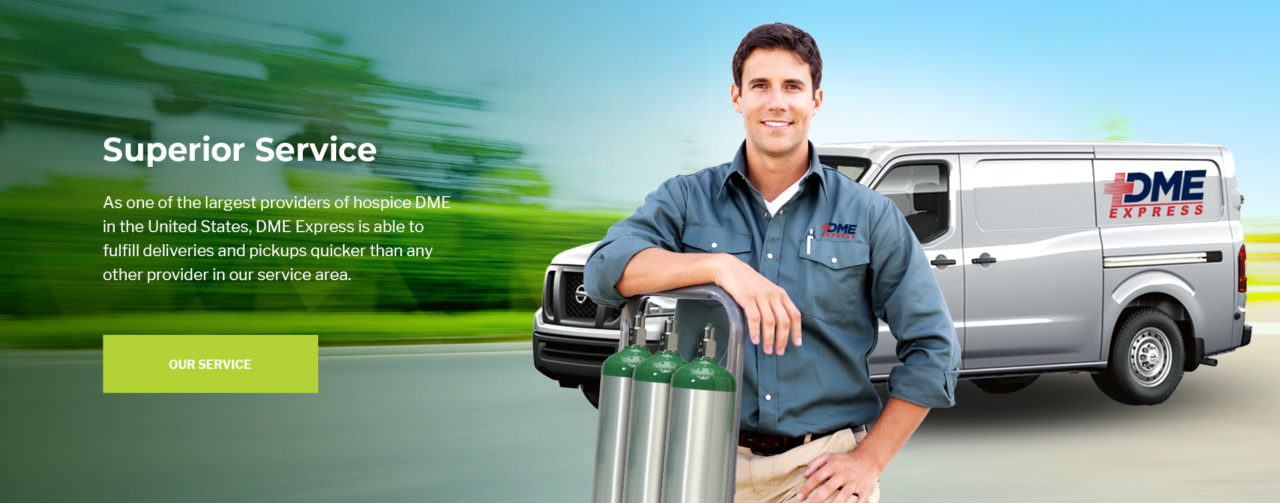
The Woodlands, Texas-based company rents and manages durable medical equipment for hospices and nursing facilities. Its catalog is familiar: beds, mattresses, oxygen concentrators, cylinders, suction units, wheelchairs, Broda chairs, walkers, bathroom safety equipment, bariatric gear and patient lifts. The business wrapped around the catalog is less familiar. DME Express says it operates more than 70 warehouses with more than 300 delivery technicians and serves about 20,000 patients a day.
Those numbers describe a logistics network, but the company is really selling certainty. Its disclosed contracts use a recurring per-patient-day structure. A hospice does not merely rent a bed; it gets access to ordering, delivery, pickup, tracking, invoicing and equipment management while the patient is under care. Hardware is the visible object. Availability is the billable idea.
The first thing that failed was the generic model
DME Express’s sharpest observation is almost impolite. Generalist equipment providers, it argues, often reserve their newest gear for traditional Medicare home patients and leave older stock for hospice and nursing-facility customers. Smaller operators may not hold enough specialty inventory for unpredictable, high-volume orders. Some charge extra for nights and weekends, precisely when hospice demand refuses to behave.
The company’s response was specialization. Founded in 2006, it focused on hospice and nursing facilities and designed the operating system backward from their worst day. It stocked extra equipment. It put warehouses near demand. It staffed after hours. It says it does not charge an after-hours delivery or pickup fee, including on weekends and holidays. In the lean-operations handbook, excess stock is a sin. Here it functions like an insurance policy with wheels.
“The clever move was not faster delivery. It was deciding that the customer’s ugliest exception should become the standard workflow.”YesPress analysis
A warehouse network wearing a software hat
If DME Express stopped at the loading dock, it would be a regional rental operation. The software layer makes it stickier. Hospice staff can order through a portal using equipment images and specifications. They can see order received, en route, driver arrived and order completed. They can track a driver’s location and estimated arrival, view spending and utilization, project monthly costs, approve an off-formulary item before it becomes an expensive surprise, retrieve invoices and connect the workflow with an electronic medical record.
None of those features is individually exotic. Together, they remove a procession of phone calls, spreadsheets and status checks from a clinical team’s day. That matters because the buyer is not browsing for fun. A hospice needs to admit a patient, control cost, document the equipment and reassure a family. The best feature may be the smallest one: knowing the driver is actually coming.
The physical and digital systems reinforce each other. A live ETA is only comforting if a technician and the right equipment exist nearby. A warehouse network is only manageable if dispatch can see orders, inventory and customer rules. DME Express’s competitive difference is the bundle: density, slack, service and visibility.
There is also a quiet procurement advantage. DME Express features equipment from established manufacturers across respiratory care, beds, mobility and patient handling. Buying at network scale can improve access to newer gear and specialty items that a small branch would struggle to justify alone. The customer still gets a local delivery, but the purchasing muscle sits behind the whole map. That is how a company can feel close to the bedside while behaving like a centralized supply chain.
How the machine got bigger
The company grew organically and by buying regional operators. Between the beginning of 2017 and July 2018, DME Express completed four add-on acquisitions. Three involved hospice equipment operations in Arkansas and northern Mississippi. The fourth was Advanced Therapeutics, a Maryland provider with Mid-Atlantic relationships and an operating history dating to 1995.
At the time of that deal, DME Express said it served more than 10,000 hospice patients across nine states and the District of Columbia. Advanced Therapeutics gave it a platform for Maryland, Virginia and nearby markets. The logic was repeatable: buy a respected local operation, keep the useful relationships and experienced staff, then add DME Express’s purchasing scale, technology and service routines.
By 2026, reported daily census had roughly doubled to 20,000. Public descriptions of its exact state footprint vary as locations open and the map changes, but the underlying expansion is plain. The network now reaches across the South, Mid-Atlantic and parts of the Midwest. New branches make national hospice accounts easier to serve; large accounts, in turn, make new branches less speculative.
That flywheel changes the sales conversation. A hospice entering a new city does not want to assemble a fresh vendor roster every time. A DME partner that already knows its formulary, approvals and reporting can follow it across markets. Meanwhile, each acquired operator brings local route knowledge and customer trust that cannot be downloaded from headquarters. Scale supplies the system; the branch supplies the street map.
The price of confidence
This model is capital hungry by design. DME Express says its warehouses hold tens of millions of dollars of inventory across more than 300,000 square feet. Beds and concentrators wait. Vans travel. Technicians cover nights. The cost is visible long before a customer makes the urgent call. That is the bargain: carry operational slack centrally so a hospice does not have to improvise locally.
The revenue side is recurring. Per-patient-day contracts convert an unpredictable series of equipment events into an ongoing service relationship. Customer dashboards and pre-approvals help hospices manage utilization, while DME Express can plan around census and route density. The company’s private financial results are not disclosed. A supplied company estimate places annual revenue at $62.4 million, but there is no public confirmation.
In March 2026, Palladium Equity Partners agreed to acquire a majority stake from WayPoint Capital Partners. WayPoint planned to remain a minority investor, while CEO and co-founder Mark Borneleit and the founding team would continue leading the business. The price and valuation were not disclosed. Palladium’s stated plan was straightforward: widen the geographic footprint, enhance service and pursue more acquisitions.
What a reader can steal
DME Express is useful beyond healthcare because it illustrates how to build a defensible service around ordinary objects. The bed is available elsewhere. So is the wheelchair. The hard part is making the right item appear, clean and ready, in the correct room at an emotionally charged moment - then collecting it promptly when care changes.
The spare-capacity playbook
- Pick a customer narrow enough that its exceptions repeat.
- Turn the worst exception - here, the midnight admission - into the default process.
- Bundle the commodity with visibility, approvals and reporting.
- Place inventory close enough that the service promise is physically credible.
- Price the relationship, not each frantic event.
The cultural implication is less glamorous. A 24/7 promise lands on dispatchers, technicians, customer-service staff and warehouse teams. DME Express describes its work as “delivering comfort” and its leadership emphasizes process improvement and qualified staffing. But always-on service demands scheduling discipline, retention and local managers who can distinguish urgent from merely loud. A slogan does not cover a weekend shift.
For hospice teams, the payoff is attention. Nurses and coordinators can spend less time hunting an order, arguing about an after-hours charge or discovering that a specialty mattress is unavailable. Families get one fewer piece of uncertainty on a difficult day. DME Express does not provide the clinical care, but it removes a physical obstacle that can keep care from starting smoothly.
Where the playbook stops working
Spare capacity earns its keep only under specific conditions. Demand must be urgent enough that customers pay for reliability. Contracts must recur long enough to support fixed inventory. Routes need sufficient density, or every warehouse becomes an expensive island. Equipment must be reusable and standardized enough to rotate between patients. The software has to lower coordination cost rather than add another screen.
Works when
Demand is urgent, recurring and geographically dense; the asset can be cleaned and reused; service failure costs the customer more than spare inventory does.
Breaks when
Orders are rare, routes are long, labor is thin, products become obsolete quickly or buyers insist on one-off pricing that never funds standby capacity.
Competition can attack from several directions: local DME suppliers with strong relationships, national hospice-equipment networks, post-acute providers with broader catalogs, or large hospices bringing the function in-house. DME Express’s answer is to be narrower than a generalist and larger than a local shop. That middle position is attractive, but it has to be rebuilt market by market.
The company’s most revealing product is therefore not pictured in its catalog. It is the empty shelf space beside the stocked bed, the extra technician on call and the dispatch record that says completed. In most businesses, slack looks lazy. In hospice, at two in the morning, it looks like competence.