Kunal Girotra borrowed a game from his son to explain his company. On family road trips, the game was “20 Questions.” For a February 2026 letter about Lunar Energy, the founder cut it to ten. Even a patient passenger has limits. The questions were simple: Why start this business? What does it make? Who buys it? Behind them sat a more demanding question: Why should running a house on electricity require the homeowner to become a systems engineer?
Girotra had spent years close to that problem. He joined Tesla Energy in 2015, worked across products, deployment and operations, and eventually led the energy business. In August 2020, he founded Lunar. His project would ask him to bring together the things customers tend to experience separately: equipment on a wall, controls on a phone, an installer at the door and a bill arriving at the end of the month.
There is an appealingly domestic scale to the ambition. Energy debates can drift toward enormous numbers and distant infrastructure. Girotra keeps returning to the house. Someone still needs to cook dinner, charge a car and keep the lights on. A successful energy transition has to survive contact with an ordinary Tuesday.
Before the battery, the factory
Girotra grew up in India and earned a master’s degree in chemical engineering at Stanford. His early work included research and development at Samsung Electronics and process engineering at ThinSilicon. Those jobs put him in the business of making physical technologies work beyond the laboratory. A promising prototype and a repeatable manufacturing process are related achievements. They are separated by a considerable amount of work.
That background gives his later career a useful continuity. He did not arrive at home batteries through an app idea that happened to need some hardware. He had already worked on the difficult passage from technical possibility to production. At Tesla, the scope broadened to the customer’s house: the product had to be deployed, connected and operated. Engineering met the appointment calendar.
In August 2023, an IEEE fireside chat traced his route from process engineer through Tesla to entrepreneurship. The framing matters. His story offers a version of the founder’s apprenticeship built from successive operational responsibilities. The useful experience includes what happens after the design is finished, when other people must manufacture it and install it in places the designer does not control.
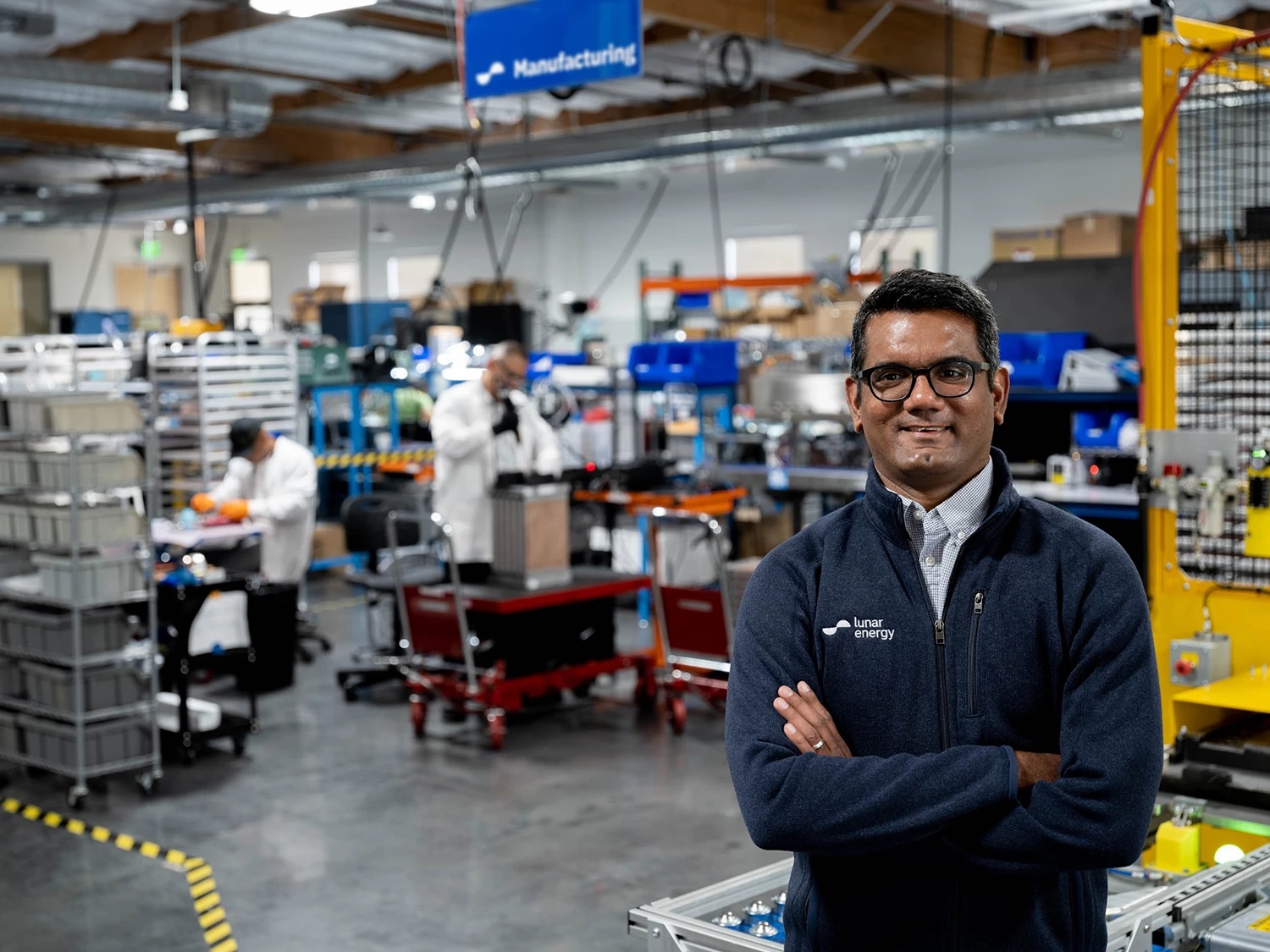
Leaving Tesla also changed his relationship to the problem. Within an established company, a leader works with an existing product family and organization. Founding Lunar meant choosing the boundaries of the company itself. How much of the house would it take responsibility for? Which disciplines needed to sit together? Those decisions precede the equipment, yet the equipment eventually reveals them. The shape of a business can end up quite literally attached to a customer’s wall.
Two quiet years, then $300 million
Lunar became public in August 2022 with $300 million raised across two rounds led by Sunrun and SK Group. It had nearly 250 employees globally, with teams in Mountain View and London. For a company introducing itself, it brought a substantial amount of luggage. The money had gone toward people, development, manufacturing and the acquisition of British energy software company Moixa.
Sunrun co-founder Lynn Jurich chaired Lunar’s board at its emergence. The relationship gave Girotra a connection to an established residential solar business, alongside the industrial backing of SK. The company’s introduction therefore contained a practical answer to a practical question: who might help bring this equipment into homes?
In his own introductory essay, Girotra described the freedom of generating solar electricity, storing it and using it throughout the home. He also laid out the less romantic requirements: research infrastructure, a supply chain and manufacturing capacity. The list is revealing. The desired experience is simple; the organization required to deliver it is quite busy.
The trouble with a wall full of boxes
When Lunar unveiled its system in June 2023, Girotra’s concern was the relationship between its parts. A battery, inverter, household controls and software had to behave coherently. He put the intention plainly: “What we need is an ecosystem solution.” A homeowner ought to be able to ask a household question and get a household answer.
Will the house keep running during an outage? Which appliances should take priority? How much electricity is available? Each question crosses a boundary between devices. If the equipment answers in separate dialects, someone else has to translate. Often, that someone is the installer. Sometimes it is a customer with several apps open and a declining enthusiasm for the future.
Girotra’s approach places more responsibility on the manufacturer to make those connections work. That is an organizational choice as much as a design choice. The company takes on more complexity in the hope that the household encounters less of it. Its success has to be measured where the equipment is used, rather than where it is demonstrated.
“What we need is an ecosystem solution.”
Kunal Girotra, June 2023
A British detour with a Japanese education
Lunar’s software story did not begin with an empty editor. The Moixa acquisition brought an existing energy management business into the company. In August 2022, ITOCHU described a Japanese network of more than 35,000 residential storage units using Gridshare, and announced a capital and business alliance with Lunar. Software already had a job to do in real homes.
The geography is part of what makes Girotra’s company interesting. A California hardware venture could draw on British software experience and a Japanese deployment network. Different markets brought different operating conditions. The acquisition gave Lunar a foundation for coordinating many small energy resources, alongside the work of developing its own physical system.
This is a particular kind of founder’s judgment: deciding which capabilities to build and which experienced people to bring inside. Girotra chose to develop the hardware from the ground up while acquiring a software team. That choice made the company’s starting point uneven in a useful way. New equipment could meet software with a working history.
The house has a schedule of its own
In a May 2026 conversation with Molly Wood, Girotra showed the system in Lunar’s working showroom in Mountain View. The visit included a breaker being flipped and the app responding. It also reached the wonderfully unabstract subject of leaving an oven on during an outage. A household’s priorities become rather clear when dinner enters the demonstration.
The episode explored modular battery blocks, energy optimization and the coordination of homes as distributed power plants. Those subjects can sound remote until the owner has to decide what keeps running. A useful interface gives that person some command over the trade-offs. Convenience, in this setting, includes understanding what the system is doing when the grid disappears.
The showroom is an appropriate stage for Girotra’s argument because it lets technical claims encounter visible consequences. There is a switch, a device and a response. The distance between those things is where much of the product lives. Nobody buys a refrigerator hoping to discover a rewarding new administrative responsibility. Home energy has much the same audience.
A funding number that needs unpacking
On February 4, 2026, Lunar announced $232 million in financing. The figure combined a $102 million Series D led by B Capital and Prelude Ventures with a previously undisclosed $130 million Series C led by Activate Capital. Reading the components matters: the announcement described two rounds, rather than a single $232 million round.
Lunar also reported 650 megawatts of devices under management across multiple continents. Its 2025 California customer figures included an average $338 in additional savings from optimization and $464 in earnings for virtual power plant participants. These are company-reported averages for particular customers and programs. They describe results already observed, with outcomes tied to how and where a system operates.
Devices under management across multiple continents, reported by Lunar in February 2026. This is the software fleet, including third-party devices.
The distinction is useful for understanding Girotra’s business. Selling a Lunar battery and managing an energy device are different activities. The software can reach equipment beyond Lunar’s own hardware. That gives the company two connected routes into the energy system, with different customers and different measures of progress.
Texas adds another question
In April 2026, Lunar announced a partnership with Octopus Energy in Texas. The offering combined a fixed-rate electricity plan with a home battery and energy management, without an upfront hardware cost. It addressed a sequence of decisions that customers would otherwise have to coordinate themselves: choosing equipment, finding installation and selecting an electricity plan.
That step extends Girotra’s original concern about fragmented experiences. Even well-integrated equipment can arrive through a complicated purchase. A partnership can simplify the route into the home as well as the machinery inside it. The product becomes entangled, usefully, with the way electricity is sold.
There is a human dimension to that coordination. People encounter home energy through a succession of specialists, each responsible for a particular piece. A founder promising a simpler experience must persuade those specialists to work within a shared one. Girotra’s choice to use installation partners gives those businesses an explicit place in Lunar’s plan. It also makes their day-to-day experience consequential. A system that is clear to the homeowner must make sense to the person who installs it, explains it and answers the next question.
His aspiration remains wider than one market: make the home battery an ordinary household appliance and give homes an active role in the grid. Getting there requires many less photogenic accomplishments, from installations to reliable daily operation. Girotra has built a career near those details. The family game asked for twenty questions. His company’s work is to leave the homeowner with fewer.
Follow the current
- Lunar Energy ↗Company website and product information
- Kunal Girotra on LinkedIn ↗His public professional profile
- Ten questions with the founder ↗Girotra’s February 2026 letter
- Watch: Girotra with Josh Dorfman ↗Supercool · YouTube interview
- Listen: A Tesla vet tries to master the VPP market ↗Volts · March 18, 2026
- Listen: The battery that pays you back ↗Everybody in the Pool · May 14, 2026
- Read: Lunar’s home electrification approach ↗Canary Media · June 21, 2023