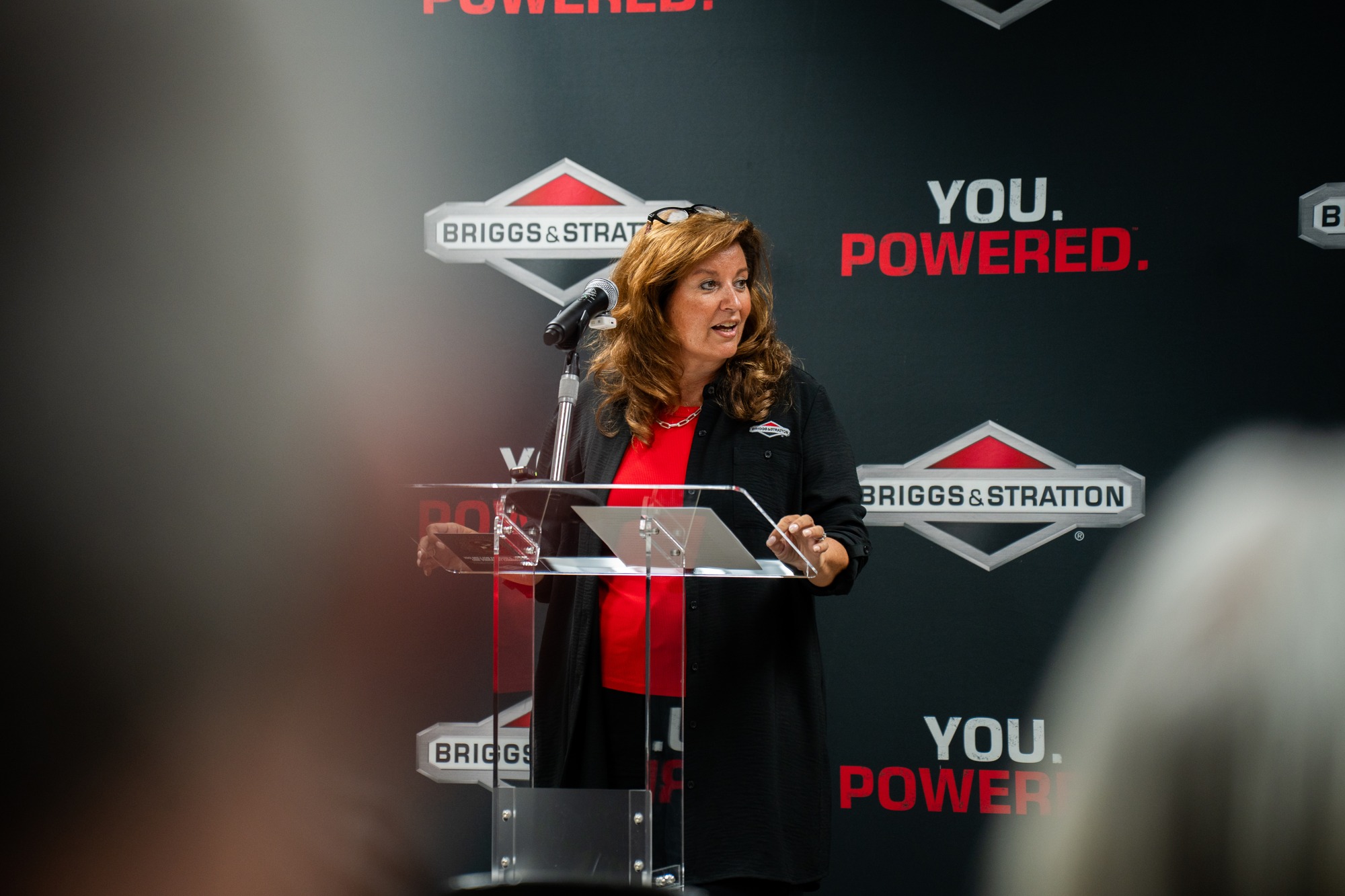
At the Briggs & Stratton plant in Poplar Bluff, Missouri, the number being celebrated was almost too large to be useful: 100 million engines. The facility had been producing them since 1989. By the summer of 2026, its accumulated work had acquired eight zeroes and an occasion for speeches. Kristina Cerniglia, the company’s chief executive, was there to mark it.
The occasion suits a career spent bringing industrial numbers into focus. An engine count has a human scale once you put it beside the people who build the engines, the years spent making them and the businesses waiting to use them. Cerniglia’s working life has moved between those two views: the figure on the page and the activity that makes it possible.
She came to the chief executive’s office through finance. Her earlier employers made aircraft engines, tools and industrial equipment. Briggs & Stratton added the outdoor power business to that education. The products changed. The underlying problem remained familiar: how to turn money, material and work into something a customer will pay for.
The long way through the numbers
Cerniglia earned a finance degree at Bentley University. She spent nine years in financial roles at United Technologies before moving to Stanley, the business that would become Stanley Black & Decker. Her time there ran from 1997 to 2014, including service as vice president and corporate controller from 2010.
That is a substantial stretch of a career to spend inside manufacturing. Corporate finance involves reporting what has happened, but the assignment also puts a person close to decisions about what should happen next. An acquisition must be integrated. A plan must be funded. The attractive version of next year must eventually meet the accounts.
By June 2014, Hillenbrand had selected her as its next senior vice president and CFO. She joined that August, reporting to chief executive Joe Raver. The company specifically sought industrial experience and knowledge of global financial management, reporting and acquisition integration. Her appointment followed a global search.
Hillenbrand was itself changing. Its businesses extended beyond its established Batesville operation into process and material-handling equipment. Cerniglia’s remit covered planning, analysis, tax, treasury, investor relations and internal audit. Strategy was explicitly part of the assignment. The list is a reminder of how much of a company a CFO is expected to understand before offering an opinion.
- 2014Hillenbrand
CFO - 2018Littelfuse
Board director - 2022Briggs & Stratton
CFO - 2024Briggs & Stratton
CEO
Earning a place beside the decisions
At Hillenbrand, one of the challenges was getting finance and information technology treated as participants in the business’s direction. Cerniglia described the task as showing “what good looks like.” The phrase is appealingly practical. It asks for a demonstration before it asks for recognition.
Her team worked on working-capital efficiency and a database bringing procurement information together across the company. Budgeting, forecasting and reporting also received attention. In 2019, she was recognized in the Indianapolis Business Journal’s CFO of the Year awards. The work being honored concerned the plumbing of an industrial business, where a useful improvement may arrive without much ceremony.
There is something quietly revealing about a procurement database in a leadership story. Purchasing information scattered across businesses is difficult to compare. Bring it together and the conversation can change. It is the sort of work that becomes interesting precisely because other people can do something with it.
A separate piece of recognition came through Hillenbrand’s supply-chain finance program. In 2018, the company was a finalist in the Supply Chain Finance Awards. Its technology provider, PrimeRevenue, reported that the program had enabled Hillenbrand to reach 130 percent of its cash-flow goal.
That figure belongs to a specific program and period. It illustrates the territory Cerniglia was working in: the movement of cash through a company and its suppliers. A financial arrangement has operating consequences. Cash released from one part of the business creates choices elsewhere. The interesting work is in understanding those connections before the consequences arrive.
A second view from the boardroom
In December 2018, Littelfuse appointed Cerniglia to its board. The company made circuit-protection, power-control and sensing technologies. Its announcement emphasized her experience as a public-company leader and the contribution her financial and industrial background could make to its growth strategy.
A board seat adds a different kind of responsibility. An executive runs an organization from within; a director helps oversee one. The two positions ask different questions of the same experience. Cerniglia’s Littelfuse directorship has continued alongside her move into the top job at Briggs & Stratton.
Her Hillenbrand chapter ended in April 2022. In announcing the transition, chief executive Kim Ryan credited her work in finance and IT and her part in the company’s industrial transformation. Eight years is long enough for an appointment’s promises to become a record that colleagues can assess.
By June, Briggs & Stratton had announced her arrival as senior vice president and CFO. She joined a manufacturer under KPS Capital Partners ownership, following the 2020 acquisition of substantially all of the former company’s assets. The new appointment placed her inside another business undergoing change, with a familiar combination of industrial products and financial responsibilities.
“My colleagues inspire me.”
Kristina Cerniglia, on becoming CEO, July 2024
The word that disappeared from her title
In February 2024, Cerniglia became interim chief executive. On July 31, the appointment became permanent. The progression mattered: she had first taken responsibility for the finances, then for the business during a leadership transition, then for its continuing direction.
The company’s board backed her appointment. Chairman Michael Psaros pointed to progress during her initial period in charge and supported her continuing the growth strategy. Cerniglia’s own announcement placed employees and customers at the center of her plans. Her public language emphasized the people around her rather than treating the appointment as a solitary achievement.
The role widened her brief to the company’s strategic, operating and cultural agenda. Briggs & Stratton’s current leadership description puts day-to-day operations within that responsibility. It is an expansive job description, especially for someone who spent much of her career in a function expected to account for the results.
The distinction has practical weight. A CFO can examine the implications of competing plans. A chief executive must help decide which plan the organization will pursue, then keep people working toward it. Her earlier career provided experience with the consequences of decisions. The CEO appointment made the decisions themselves a broader responsibility.
A very large number, built one engine at a time
Poplar Bluff offered a visible expression of that responsibility in July 2026. The plant’s 100 millionth engine had been produced in June. At the celebration the following month, Cerniglia spoke about the people and culture behind the milestone. The setting brought the industrial business back to its most tangible unit: an engine somebody had made.
The facility employed 542 people at the time of the announcement. Its production represented roughly one-fifth of the nearly 500 million engines Briggs & Stratton said it had made in the United States since its 1908 founding. Those are company production figures, accumulated across generations of work.
1989 to June 2026
Reported July 2026

A CEO inherits that accumulated work without having performed most of it. Celebrating it creates an opportunity to recognize the distinction. The milestone predates Cerniglia’s leadership by decades. Her presence belongs to the next part of the plant’s story, with the obligation to keep a working business useful to the people around it.
What comes after the anniversary
The current business stretches across engines, turf equipment, batteries and energy systems. Its products are designed, manufactured, marketed and serviced in more than 100 countries. That variety makes the job larger than preserving a familiar engine name. Different customers need different forms of power, backed by a business that can support them.
In September 2026, the company announced an expanded Google Cloud partnership for its supply chain. Planned applications included handling changes in volume, exceptions and safety stock. Employees had built more than 25 low-code agents. The announcement came from the company’s technology leadership; the relevance to Cerniglia’s career is the continuing connection between information and industrial decisions.
Her personal details add a little levity to those responsibilities. A white cap in her office reads “Cash Is Queen.” She lives in downtown Milwaukee. Her father, Bob Monaco, led Pratt & Whitney’s government engine unit. The family connection gives her early industrial surroundings a particular resonance without explaining away the decades of work that followed.
Milwaukee also supplies a practical setting for the company’s community commitments. In 2026, Briggs & Stratton’s Summerfest partnership included hands-on STEM programming through The Hovercraft Project. Its equipment donation helped maintain the festival grounds. Keeping the grass ready for a music crowd is a pleasingly literal way for an outdoor-equipment company to participate in civic life.
Cerniglia’s career has brought her progressively closer to responsibility for the whole enterprise. The finance graduate became a controller, a CFO, a director and a chief executive. At each stage, the frame widened. At Poplar Bluff, it was wide enough to take in a factory’s decades of production, then settle on the people still doing the work.