A car dealership is several regulated businesses wearing one logo. The service bay has lifts, chemicals, waste oil, and OSHA obligations. The showroom produces advertisements that must survive legal scrutiny. The finance office handles credit, disclosures, and intensely private customer data. Human resources sits across all of it. One missed training, one unlocked document, or one sloppy deal jacket can turn an ordinary Tuesday into an expensive lesson.
KPA has spent since 1986 packaging that anxiety into a business. The Westminster, Colorado company sells Vera Suite, a cloud platform that tracks inspections, incidents, training, corrective actions, permits, safety data, HR work, cybersecurity safeguards, advertising, sales, and finance compliance. Then it adds something most software companies avoid: people who drive to the customer. KPA says more than 150 in-house consultants support the operation, which conducts about 30,000 site visits and more than one million trainings a year.
This is vertical software in work boots. The customer is not merely the compliance director who buys the system. It is the technician scanning a safety document on a phone, the general manager watching overdue tasks across six rooftops, the HR lead documenting a termination, and the finance manager trying to prove that a customer signed the right disclosure.
The unusual move was getting smaller
For years, KPA expanded beyond dealerships. It served manufacturing, energy, construction, distribution, and other hazardous industries. Acquisitions added configurable EHS software. KPA Flex became the industrial flagship, while Risk Management Center served brokers and their clients. By 2024, the company described a 400-person team helping millions of workers.
Then came the plot twist. In January 2026, KPA separated the general industrial operation into a new company called Novara. Flex became Novara Flex. Risk Management Center went with it. KPA returned to a dedicated automotive strategy and appointed 22-year company veteran Wayne Curtis as CEO. Rather than stretching one brand across every hazardous workplace, it chose the narrower customer it knew first.
That decision says something about the limits of horizontal software. A generic incident form is easy to copy. Knowing what a California dealer should look for in an advertisement, how an FTC Safeguards audit meets a dealership's IT reality, or which sign belongs beside a particular machine is harder. KPA kept the part of the portfolio where industry detail and field labor matter most.
“We serve over 15,000 client locations, and that requires a nuanced understanding of federal, state, and local regulations.”
Wayne Curtis · CEO, KPAOne screen, every rooftop
Vera Suite is the organizing layer. In 2025, KPA upgraded its dashboard so leaders at multi-location groups could compare training completion, open issues, inspections, and incident activity across stores in real time. That is a mundane-sounding improvement with an important consequence: the same safety failure can no longer hide as ten separate local anecdotes.
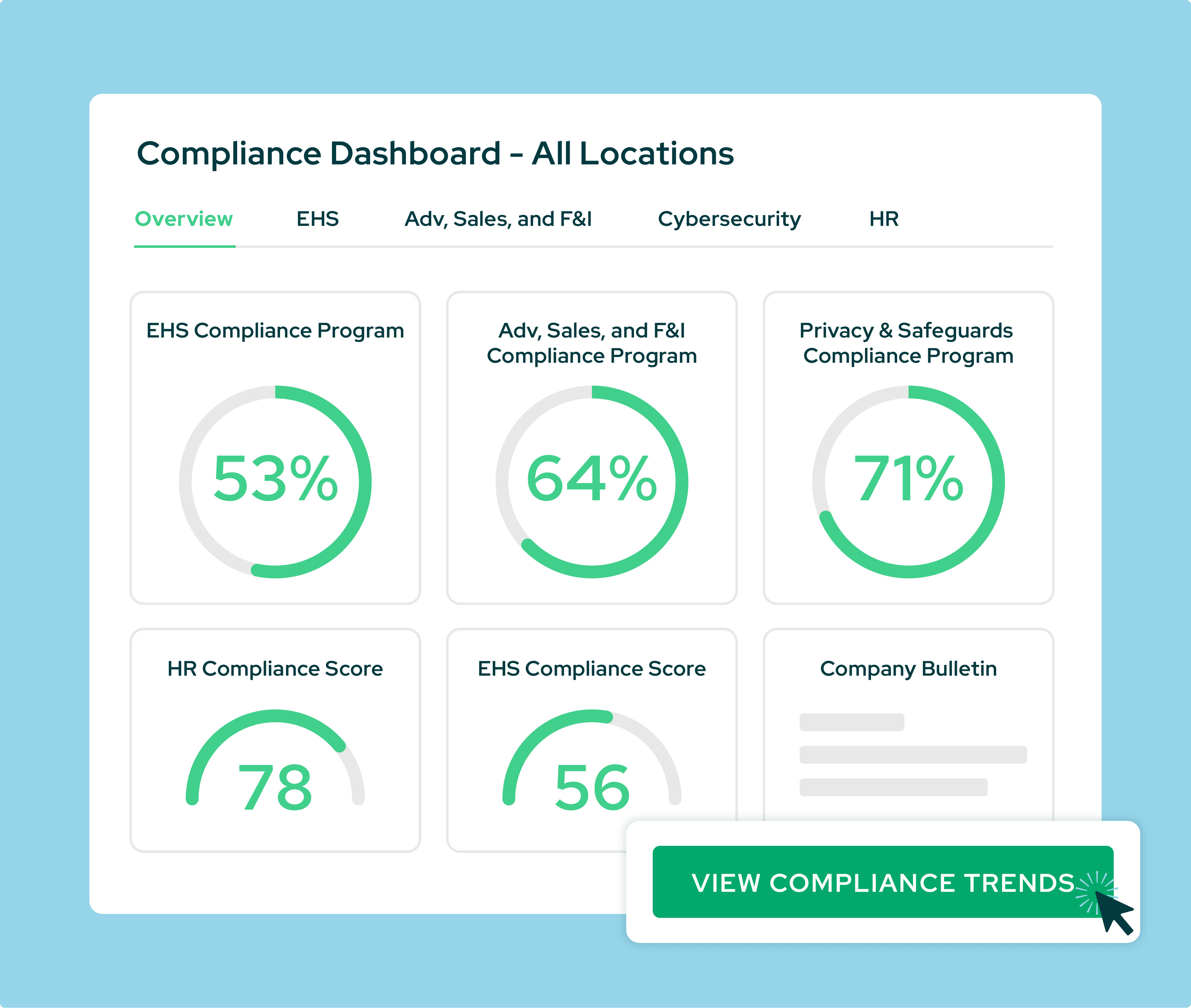
The product's four main lanes mirror the odd anatomy of the dealership. EHS covers audits, chemicals, equipment, injuries, and environmental work. Privacy and cybersecurity cover consumer information and safeguards. Advertising, sales, and F&I cover disclosures, deal jackets, red flags, and state-by-state requirements. HR covers policies, training, and workforce documentation. Dealers can buy Core or Pro versions, bundle all four, or assemble a custom program.
The important unit is not the form. It is the closed loop. A consultant photographs a missing sign. The system assigns the finding. A manager gives it to facilities. Someone fixes the problem and closes the issue. The record remains when an insurer, lawyer, or regulator asks what happened. LAcarGUY executive Chris Simpson described doing exactly that across 13 stores and roughly 60 managers.
What failed first was the old patchwork
KPA's best customer stories begin with administrative entropy: paper to sift through, spreadsheets to maintain, separate records at separate locations, and training that is difficult to prove. Growth makes the mess visible. Foundation Automotive, which was acquiring stores rapidly, needed a way to onboard each location into the same audit and training routine. LAcarGUY wanted one curriculum and a defensible record across a large management group.
In one revealing industrial example from KPA's pre-split era, precast concrete company Atlantic TNG was not even committed to going digital. What changed its mind was configurability. It began with nonemergency maintenance and purchase requests, then expanded into concrete-test archives, plant inspections, scorecards, and checklists. Another customer, Alterra, rejected an alternative it found “clunky” and chose KPA after seeing how much it could tailor. Those customers now belong to the historical Flex story, but the lesson survives the corporate split: adoption starts when the tool matches work people already do.
The numbers are customer-reported, not a controlled study, but they show what the platform is meant to change. LAcarGUY says its compliance status rose from about 90% to 95% and that the program saved thousands. An unnamed multi-rooftop luxury group says training completion, previously in the 70-80% range, reached 97-99%; audit scores averaged 90-95%, with one perfect audit.
The moat drives to work
The compliance market offers no shortage of alternatives. A large dealer group can employ lawyers, safety managers, trainers, and security specialists internally. It can stitch together point products. Automotive specialists such as ComplyAuto, Dealer Safeguard Solutions, Ethos Group, and Mosaic Compliance Services compete for pieces of the same budget. Broader EHS platforms including Cority, VelocityEHS, Benchmark Gensuite, and Sphera are familiar names for companies whose main problem sits on the industrial side.
KPA's answer is coverage without assembly. The field consultant sees the operation; Vera Suite records what that person finds; the course library teaches the response; the dashboard lets leadership check whether the response happened. The software creates recurring revenue, while the service layer makes the software harder to replace with a generic form builder. It is an expensive machine to construct because consultants must be hired, trained, scheduled, and kept current on rules that change by state.
Partnerships fill gaps the company does not need to own. Reynolds and Reynolds supplies state-specific LAW F&I document libraries. 700Credit brings credit-report compliance tools. Mavsign addresses fraud and liability around off-site deliveries. Botdoc supports encrypted exchanges of customer files. Together, these deals pull KPA closer to the daily transaction without asking Vera Suite to become a dealer-management system, credit bureau, contract library, and messaging network all at once.
That boundary matters. KPA sits beside the systems that sell, finance, and service cars; it is the evidence layer that asks whether those systems are being used lawfully and safely. The distinction is easy to miss until a dealer operates in several states. Then a rule change in one jurisdiction, a recurring incident at three rooftops, or a training gap in one job role becomes the kind of pattern a central compliance team needs to see before it becomes a claim.
The price is a conversation
KPA does not publish current dollar amounts. Pricing is custom, based on rooftop count, modules, service depth, and add-ons such as deal-jacket audits, California-specific work, environmental plans, or security tools. The last crisp public number is ancient by software standards: in 2011, then-CEO Vane Clayton described a thorough environmental and safety service for one dealership at less than $600 a month. Treat that as archaeology, not a quote.
The model is recurring B2B software plus recurring expertise. Providence Equity Partners took a majority stake in 2018, with prior investor CIVC retaining a minority position; the price was not disclosed. KPA then continued an acquisition trail that had already brought in Automotive Compliance Consultants and Auto Advisory Services. ComplyNet arrived in 2023, adding privacy, cybersecurity, advertising, sales, and F&I depth. The acquisitions help explain why the suite feels more like a federation of specialist knowledge than a tidy single-purpose app.
Make every finding visible, name one owner, attach a due date, connect the relevant training, and keep proof of closure. Review the pattern across locations monthly. That operating habit works even before a software purchase.
The machine still needs an owner
KPA is strongest when risk is distributed across many sites and no single employee can hold every federal, state, and local rule in their head. It is also useful when a dealer wants outside eyes. Software can remind someone to inspect a lift; a consultant can notice that the routine itself is weak.
It is a weaker fit for non-automotive operators now that the industrial products live at Novara, and for small businesses that want instant self-serve pricing. More important, it cannot rescue a management team that treats every finding as somebody else's job. A dashboard shows the open issue. It does not move the solvent drum, rewrite the ad, or make a reluctant manager finish training.
That is why KPA's 2026 narrowing makes sense. Its differentiator is not that it digitized a checklist. Plenty of vendors can do that. It is the combination of dealer-specific rules, software that spans the building, courses built for the people inside it, and consultants who return often enough to see whether anyone listened. KPA spent 40 years learning that compliance is not a document. It is a loop - and loops only work when somebody closes them.