A Ghanaian founder running a Minneapolis health plan for the people American benefits design forgot - shift cooks, line workers, the 75 million who clock in by the hour.
He keeps a single source-of-truth document on his desktop. When the day fragments into a hundred urgent things, he opens it. Two to four priorities. The rest waits.
River Health charges thirty-five dollars a month. For that, a Taco Bell shift manager in suburban Ohio gets unlimited virtual primary care, behavioral health add-ons starting at fifteen, prescription delivery to the apartment, and a network of more than a thousand partner clinics if the screen isn't enough. The pitch is dull on purpose. Hourly workers do not need a wellness brand. They need a doctor before the shift starts at six.
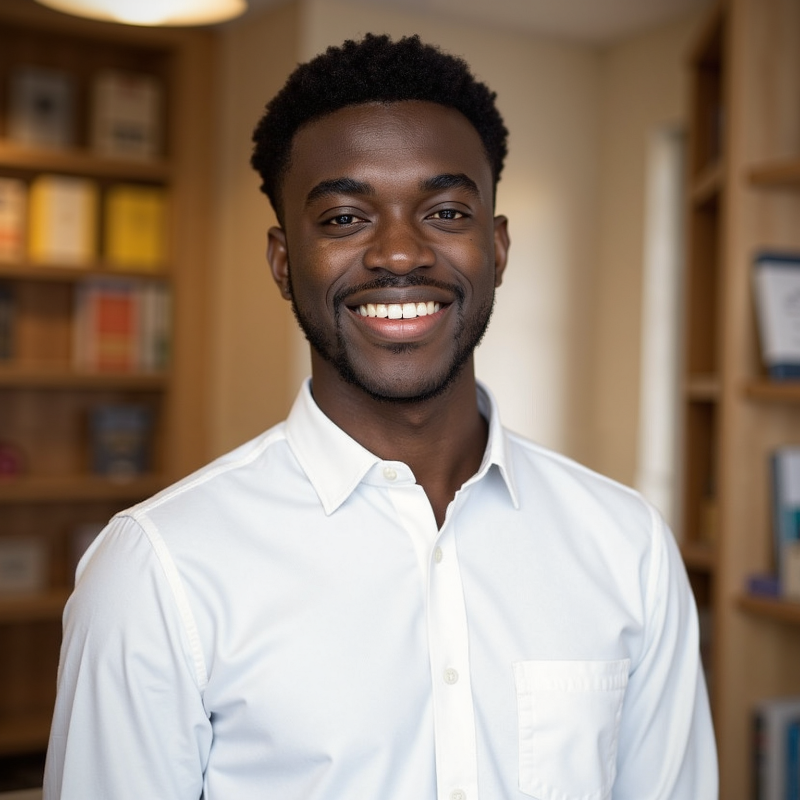
Kobby Amoah co-founded the company in 2019 and shipped the first product the year after. He runs it from Minneapolis, which is not where most digital health founders set up shop, which is part of the point. The Twin Cities have insurers, a teaching hospital culture, and a venture community small enough that the partners answer the phone. He moved River there after a local health-tech accelerator and never moved it back.
The company picks its customers carefully. Raising Cane's. Taco Bell. Restaurant operators with thousands of hourly employees who fall into the same canyon - too much income for Medicaid, too little disposable cash for the exchange. Standard plans can eat thirty percent of an hourly wage. River's pitch to a regional franchisee is closer to the cost of a streaming bundle.
None of this is the part Amoah finds interesting. The part he finds interesting is the member who hadn't seen a doctor in four years and finally booked a visit because the app made it small. "Seeing our members have the confidence to see a provider with River," he has said, when asked what keeps him in it. Founders are supposed to talk about TAM. He talks about confidence.
River is a small company aimed at a very large empty space. The point of the chart below is that the empty space is not a rounding error.
Source: River Health, Twin Cities Business. Estimates illustrative.
Amoah grew up in Ghana. He has said, more than once, that his mother was his biggest cheerleader. The next stop was Wartburg College, the small Lutheran school in Waverly, Iowa, where he studied pre-med and economics. The geographic jump from Accra to a town of fourteen thousand is the kind of detail that founders usually skip. He doesn't.
From Wartburg he went to MIT, not for a degree but for the Global Founders' Skills Accelerator, the idea-stage program known as GFSA. The idea he brought was Obaa, a mobile electronic medical records system aimed at pregnant women in rural Ghana - connect them by phone to doctors who would otherwise be a day's travel away. The Davis Foundation funded it. The Clinton Global Initiative funded it. He was named a Resolution Project Fellow and a Harambe Pfizer Fellow before most of his Wartburg cohort had finished a first lease.
A short stint as a senior consultant at Merrill Lynch sat in the middle. He has not said much about why. Read the resume forward and it looks like an aberration. Read it backward and it looks like a founder figuring out how money actually moves before going back to building things.
The trigger for River was not a market-sizing exercise. At Obaa, he and the other contractors were 1099s, which meant they bought their own insurance off the ACA marketplace. He hated it. He thought it was confusing and overpriced for what it delivered. He thought millions of other Americans must hate it for the same reasons. He was right.
Software developer; later public-health intern at Franklin General Hospital.
Co-founded mobile EMR for developing countries. Davis Foundation. Clinton Global Initiative. Resolution Fellow. Harambe Pfizer Fellow.
Senior Consultant. Brief detour into capital markets.
The ACA marketplace frustration becomes a product.
Virtual primary care + behavioral health on a flat monthly fee.
Seed funding. Expansion in Minnesota with Allina Health and CVS.
Ask him about his support system and three names come back. The pattern is worth noticing - one family, one peer, one outside operator. No board members. No celebrity investors.
"Biggest cheerleader growing up." A founder who grew up in Ghana and ended up in Iowa learns to keep that voice close.
The other half of the company. The person who gets the unfiltered version of the question.
The program director who took the River team through Techstars and stayed in the loop after.
A reading list is a kind of self-portrait. His leans toward focus, structure, and the very long middle of building anything worth building.
Daniel Gilbert
James Martin
First Round Capital
Julia Galef
Tim Harford
Two spellings, one person. His LinkedIn URL is /cobbyamoah. His company email is kobby@. He answers to either.
He moved River there after a Twin Cities health-tech accelerator. The pitch he gives to founders: the talent is real, the rents are not coastal, and the insurance industry is a short drive away.
A CEO mantra he repeats often - on any given day, only two to four things matter. The rest is theater. He writes them down.
His first company sent mobile EMRs to rural Ghana. His second sends prescriptions to American line cooks. Same idea, different uniform.
When asked who carries River day to day, his answer is the NPs. He has gone out of his way, in writing, to say so.
Resolution Project Fellow, Harambe Pfizer Fellow, CGI U 2015, MIT GFSA. The early-twenties resume reads like a constellation.
The bet is that the American benefits stack got the unit economics wrong for an entire class of worker, and that a flat-fee, virtual-first plan with a sane pharmacy experience can sit underneath a national restaurant chain and earn its keep. The bet is also that a founder who built EMRs in Ghana and lived through the ACA marketplace as a contractor has a better gut for what hourly workers actually need than a benefits broker who has never clocked in. He is betting on his own history.