Profile / Issue No. 023
Cal Newport
The Georgetown computer scientist who taught a distracted world how to do less, better - without ever logging in.
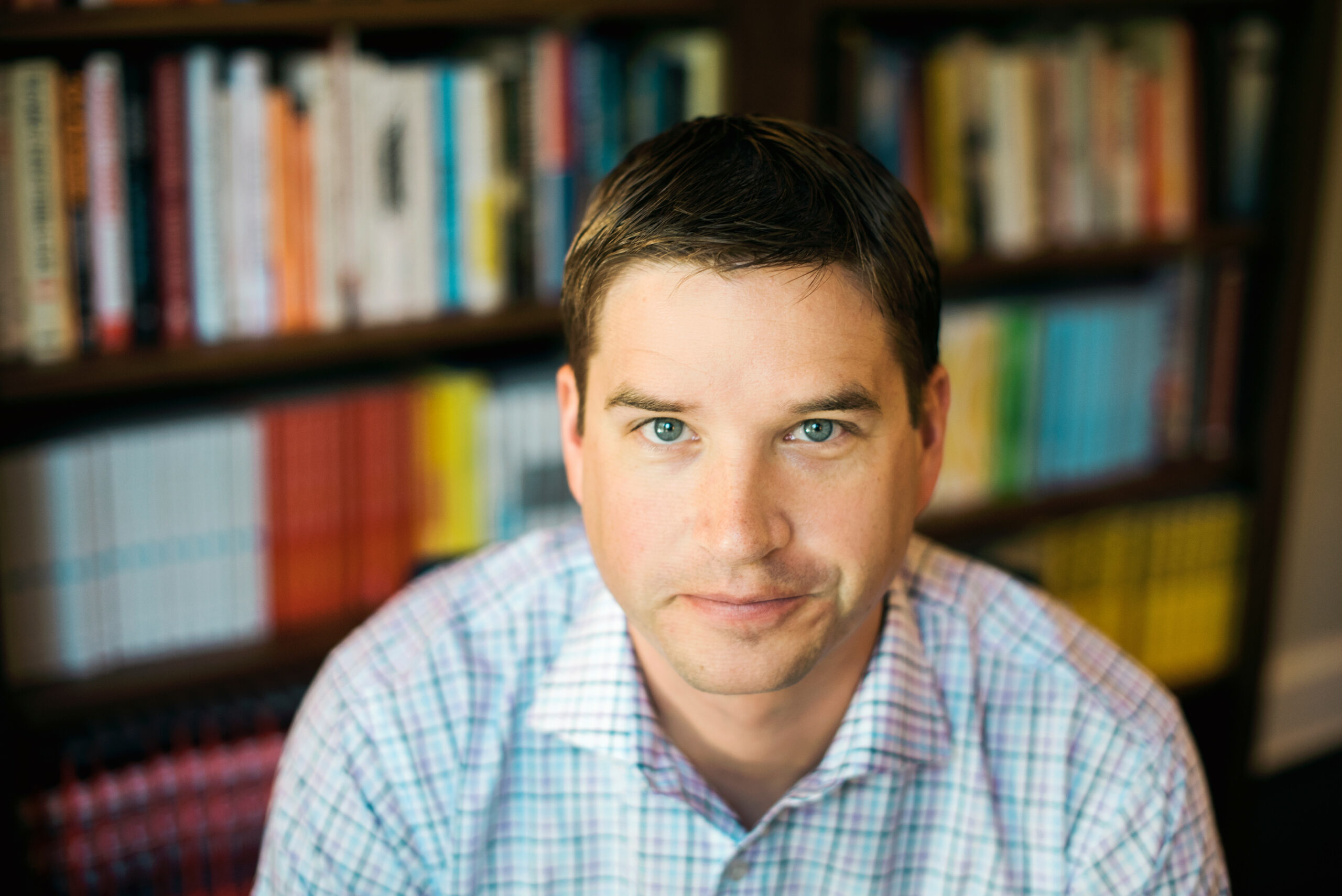
Photo - Penny Gray
The Georgetown computer scientist who taught a distracted world how to do less, better - without ever logging in.
On a Tuesday afternoon in Healy Hall, Cal Newport closes a notebook of handwritten lemmas about distributed algorithms, walks home, and writes a paragraph for The New Yorker about why your inbox is broken. The two activities feel, to him, like the same activity. They both require a long unbroken stretch with nothing buzzing. That is the entire thesis of his life.
Newport is a tenured Provost's Distinguished Associate Professor of Computer Science at Georgetown University, promoted to full professor in 2024. He is also a contributing writer for The New Yorker, host of the Deep Questions podcast, and the author of eight books. The latest, Slow Productivity: The Lost Art of Accomplishment Without Burnout, landed on the Best Books of 2024 lists at The Economist and NPR, and took home a SABEW Best in Business award. His back catalog has sold more than two million copies and been translated into more than forty languages.
He has never opened a social media account. He decided that in 2004, while he was still a Dartmouth undergrad, and he has held the line ever since. No Twitter, no Instagram, no TikTok, no LinkedIn, no Facebook. There is a Study Hacks blog he has run since 2007 and a YouTube channel where his podcast episodes are posted. That is the whole footprint. The TEDx talk he gave on the subject - Quit Social Media - has been viewed nearly six million times by people who, mostly, did not.
The trick of Newport's career is that he proves his case by living inside it. He argues that knowledge workers are stuck in a culture of pseudo-productivity, mistaking visible activity for actual output, and then he writes books that take years to plan, hand-edits them in libraries, and refuses to perform busyness for an audience. The books arrive. They sell. The lectures continue. The papers on distributed computing keep getting published. The point is made.
Newport's adult work is a single, four-book argument about attention in the digital age. The first three he calls the Technology and Society trilogy. The fourth is the cure.
Rules for Focused Success in a Distracted World. The book that put a name on what most knowledge workers had stopped doing.
Choosing a Focused Life in a Noisy World. NYT, WSJ, Publishers Weekly and USA Today bestseller.
Reimagining Work in an Age of Communication Overload. The case that the hyperactive hive mind is a choice, not gravity.
The Lost Art of Accomplishment Without Burnout. Three principles, drawn from how the actual greats worked.
"Human beings, it seems, are at their best when immersed deeply in something challenging."
- Cal Newport, Deep WorkNewport built the framework after months poring over the working lives of Galileo, Isaac Newton, Jane Austen and Georgia O'Keeffe. They had no Slack. They had output that lasted centuries. The principles are deliberately boring.
Quality drops the moment your active workload exceeds your attention. Subtract first. Add only what survives the subtraction.
The greats had slow seasons, fast seasons, and long stretches of nothing visible. Knowledge work is not a factory shift.
The only thing that compounds is good work. Volume that no one will remember is a tax on the volume that someone will.
Calvin C. Newport was born June 23, 1982, in Pennington, New Jersey. His grandfather, John Newport, was a Baptist minister and theologian. The family conversation at dinner ran to questions about meaning, not metrics.
He left for Dartmouth in 2000 and graduated in 2004 with a computer science degree and a publishing contract. How to Win at College came out the year he finished it. The advice was practical, unromantic, and unmistakably his: pick your hard things, then guard the time it takes to do them well.
From Hanover he went to MIT, where he completed his Ph.D. in 2009 under Nancy Lynch, one of the founding figures of distributed computing. His thesis sat squarely inside the field, not adjacent to it. The productivity writing was running in parallel - a blog called Study Hacks, started in 2007, that he has never abandoned.
Newport joined Georgetown as an assistant professor of computer science in 2011, was granted tenure in 2017, and was promoted to full professor in 2024. He is a founding faculty member of Georgetown's Center for Digital Ethics. His research has continued in distributed algorithms throughout, with peer-reviewed papers that have nothing to do with productivity.
It matters to the argument. When he says deep work is possible, he is not selling a course. He is describing the calendar of a tenure-track scientist who also happens to publish a book every couple of years.
Publishes How to Win at College before he has graduated from it.
Launches Study Hacks blog. Still publishing weekly two decades later.
Earns Ph.D. in computer science at MIT under Nancy Lynch.
Joins Georgetown as assistant professor of computer science.
Publishes So Good They Can't Ignore You - the book that dismantled "follow your passion."
Publishes Deep Work. Gives the TEDx talk "Quit Social Media."
Tenured at Georgetown.
Publishes Digital Minimalism. The 30-day declutter goes viral without him.
Launches the Deep Questions podcast.
Publishes A World Without Email.
Publishes Slow Productivity. Promoted to full professor.
"Pseudo-productivity is the use of visible activity as the primary means of approximating actual productive effort."
- Slow Productivity, 2024Before Slow Productivity arrived, knowledge workers had a feeling but not a word. The feeling: that the day was full and the work was thin. The word Newport gave them was pseudo-productivity - the use of visible activity as the primary means of approximating actual productive effort.
He traces the habit back to the factory floor. On a production line, motion equaled output, and a manager standing on a mezzanine could measure the operation with their eyes. We took that mental model into offices that don't manufacture anything physical, and then we wired it into Slack, and we have been performing the play of work ever since.
Newport's prescription is not a productivity hack. It is a permission slip. Slow Productivity tells you that the cathedral was built by people who had no quarterly review, and that the only thing the great knowledge workers of history obsessed over was the quality of the one thing in front of them. The rest is theater.
He has been making variations of this argument since 2007, when Study Hacks went live. The audience has changed; the position has not. He liked it before it was contrarian and he likes it now that it has become a small movement with its own quiet language - "deep work," "digital declutter," "shutdown ritual," "slow productivity." The vocabulary moved into the room. He never left the room.
The proof is in the catalog. Eight books across two decades, each one written under the same constraints he is recommending to you. No tweets. No threads. No "personal brand." Just the next book, the next paper, the next podcast question, the next semester at Georgetown.
Decided in 2004, as a Dartmouth undergrad, never to open a social media account. He has not.
His first book came out before his first diploma did.
His grandfather, John Newport, was a Baptist minister and theologian.
For Slow Productivity, he studied the actual daily schedules of Galileo, Newton, Jane Austen and Georgia O'Keeffe.
His Ph.D. thesis was on distributed algorithms. He still publishes in the field.
Married to Julie Newport. Three sons. Most of his readers do not know any of their names. That is on purpose.
Distributed algorithms. Computer Science, Ethics and Society. Office hours that actually start on time because there is nothing on the calendar that doesn't belong there.
A contributing writer on technology, work and attention. Long pieces. No threads. No takes. The kind of essay that survives the news cycle that produced it.
Reader mail, answered weekly since 2020. The format is older than the medium. The audience keeps growing anyway.
"Clarity about what matters provides clarity about what does not."
"If you don't produce, you won't thrive - no matter how skilled or talented you are."
"Do fewer things. Work at a natural pace. Obsess over quality."