Consider a button. In a designer’s file, it has one shade of blue. In the component library, another. In a product released three months ago, it still has the old label. Each version has a perfectly reasonable owner. The customer gets whichever version survives the journey. Knapsack has built a business around this small, expensive disagreement.
- Connect design decisions to the code people actually ship.
- Let product teams prototype with existing components.
- Give AI tools access to the same tokens, components, and instructions.
A design system is supposed to settle these arguments: reusable parts, rules for using them, and a common vocabulary. But the rules often live somewhere different from the work. Knapsack connects those places. Its customers are enterprises whose products, brands, and delivery teams have outgrown the comforting fiction that everybody already knows what everybody else means.
The agency that kept building the same thing
Co-founders Chris Strahl and Evan Lovely arrived here through Basalt, their design systems agency. They helped large organizations build the infrastructure behind reusable interfaces. Repeated client work produced internal tools; those tools became Knapsack, founded in 2020. Strahl became CEO, Lovely CTO. The service business had exposed a problem that could be addressed repeatedly with software.
In a 2024 retrospective, the founders recalled a formative choice: defining a component with a JSON schema. That sounds like plumbing, and it is. A schema makes the component’s expected information explicit. A shared picture tells people what something resembles. A shared specification gives them something more precise to build against. Knapsack’s product grew around that distinction.

Six months to change the workflow
One retailer in Knapsack’s published case studies had a system that served its primary website but struggled to support other channels. Teams improvised elsewhere. The company chose Knapsack over a custom build, connected brand documentation with engineering workflows, and established its new documentation site in six months rather than the estimated twelve.
Reported implementation savings: $1M+. A comparison with the planned custom build, not Knapsack’s subscription price.
The same case reports 15% faster time-to-market and more than 2,500 users. Those results helped persuade leadership to consolidate global design system efforts around the team using Knapsack. That is an organizational change as much as a software purchase: useful evidence gave the system’s owners more authority.
A pharmaceutical customer illustrates what broke first. Despite a year of tooling investment, design and engineering remained disconnected. Knapsack describes an initial two-week migration from Supernova, Confluence, Storybook, and custom tools, followed by enhanced documentation within 60 days. The connected pipeline joined Figma and Tokens Studio, Git, Knapsack, and Adobe Experience Manager.
Knapsack reports that analytics-team QA time fell by more than 30%. Its estimate of over $10 million in annual external-agency savings is a projection. The distinction matters. Both stories suggest a practical diagnosis: owning tools and connecting work are separate accomplishments.
The prototype is already code
Open Knapsack and the promise becomes concrete. Teams can organize components, compare design and code specifications, document usage, and manage design tokens: named decisions about color, spacing, typography, and other styles. Its Figma plugin exports variables for import. Dynamic documentation connects to source material so maintaining the guide need not become a second implementation project.
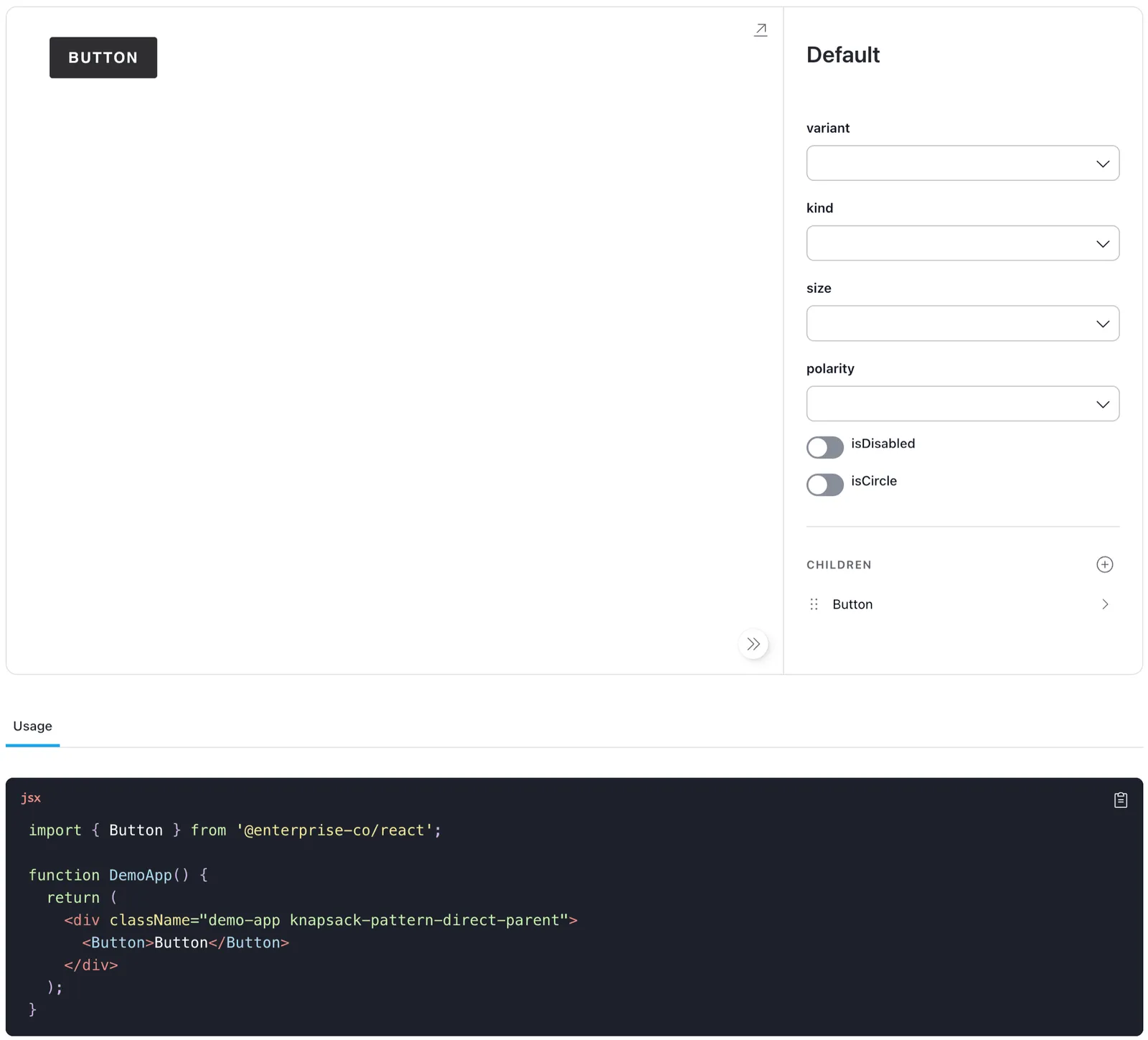
The more interesting feature is composition. Designers and product managers can assemble interfaces from production components, adjust properties and themes, and test interactions using existing code. This brings constraints into the discussion early. A polished mockup can postpone an awkward question about implementation. A working component makes that question harder to avoid.
Knapsack competes with combinations of tools and with an enterprise building its own platform. Storybook is an alternative for component development; Supernova and zeroheight occupy neighboring design system territory. Knapsack’s proposition is a broader shared workflow for technical and nontechnical contributors. Its newer AI tools can also use Storybook as a data source, making the competitive boundary pleasantly untidy.
The commercial arrangement fits that ambition: annual subscriptions, sales conversations, contributor seats, and implementation help. Published Basic, Core, and Pro plans start at minimums of five, ten, and twenty users. The purchase includes decisions about integration, permissions, and adoption. A team looking for an instant, self-serve experiment will encounter a more involved buying process.
Now give the machines the instructions
In October 2025, Knapsack announced a $10 million Series A led by Builders VC, bringing its stated funding total to $20.8 million. It also described an Intelligent Product Engine organized around ingestion, AI connectivity, and assisted composition. The same announcement reported 2.6 times annual revenue growth.
“Knapsack is the foundation for teams who want to create in code from day one.”
Chris Strahl / October 2025
The observable bridge is its MCP server. Authenticated AI clients can retrieve a workspace’s tokens, components, and documentation. Current positioning goes further, emphasizing evaluation against company standards. September 2026 releases added a design system package bundler for evaluation and improved the component properties returned through MCP. These are concrete steps toward making existing decisions legible to machines.
Start with one expensive handoff
The lesson a reader can copy is modest. Follow one frequently reused component from design to release. Count the translations, approvals, and repairs. Connect that workflow, then measure whether rework declines. Knapsack’s IBM iX partnership, including work for National Grid ESO, offers another route: pair the platform with an experienced implementation team.
The approach needs maintained components, agreed ownership, and people willing to use the shared system. Connecting contradictory instructions will not settle the contradiction. Even Knapsack’s own careers page makes iteration explicit: “Prioritize shipping, not perfection.” The useful ambition is fewer repeated arguments. If the machines are going to join the team, they will need the decisions in writing, too.