In 2010, a friend persuaded Kim Balle to help organize a Startup Weekend in Denmark. Balle had recently graduated from Copenhagen Business School with a computer science degree. He was interested in entrepreneurship, but interest is a solitary occupation until someone gives it a room. That weekend supplied the room. Looking back, he described the encounter with unusual simplicity: “it was a feeling of coming home.”
There is something pleasingly inconvenient about that beginning. The future co-founder of Global Startup Awards entered the startup world by helping other people get together. His own account puts belonging at the center. The business would come later, along with the machinery required to keep introducing strangers across borders.
By May 2026, Balle was in Malta for an edition of the awards whose finalists represented 65 countries. He also announced that the next global finale would return to Denmark in 2027. Between those two homecomings sits a career spent working out how an invitation can travel.
A weekend acquires a passport
Awards ceremonies lend themselves to a familiar photograph: a trophy, a handshake, several people wondering where to put their other hand. Balle’s project grew around the people on either side of that photograph. Founders mattered, alongside investors, accelerators, community organizers, and the people who made introductions before anyone had a reason to applaud.
The Nordic Startup Awards began in Denmark in 2012. In 2015, Balle and fellow co-founder Peter Kovacs brought regional competitions under the Global Startup Awards brand. The geography widened, but the organizing question stayed recognizable: who already knows the people worth bringing into the room?
Helps organize a Startup Weekend in Denmark
Nordic Startup Awards begins
Regional competitions gain a common global brand
Announced return of the global finale to Denmark
By June 2016, the network extended into Central Europe and Southeast Asia, with India on the agenda. The Nordic finale that year took place in Reykjavik. The itinerary explains something about Balle’s ambition. Copenhagen could be a starting point without becoming the compulsory destination for every useful conversation.
His earlier projects had already crossed some unconventional thresholds. He was involved in Islamabad Startup Weekend in 2012 and Startup Weekend Borgen, a 2013 event at Christiansborg, the Danish parliament. That second setting put a 54-hour exercise in developing ideas inside a building associated with rather longer discussions.
An early letter from Balle set out a specific regional ambition: closer cooperation could help the Nordic startup scene stand alongside London and Berlin. Talent and technology needed to circulate. The awards would recognize the organizations working alongside companies as well as the companies themselves. There was room in the picture for people whose contribution rarely came with a founder title.
The useful people already live there
Expansion brought a practical problem. A competition devised in Denmark could provide a framework; it could hardly arrive in every country knowing whom to call. Balle’s answer was to work through regional partners. The person with the local relationships became part of the structure.
In 2016, as he worked on expansion into India with entrepreneur Jerric Lyns John, he described both the differences between the Indian and Nordic environments and the appetite for cooperation he encountered among founders. He traveled between Denmark and India for stakeholder meetings. An international network, it turns out, still requires people to arrange a meeting.
The proposed Indian competition was divided into five regions. That detail is revealing. Even a country can be too large and varied for a single convenient label. Local knowledge becomes more useful as the map gets bigger, and an award category cannot substitute for understanding the place where a company operates.
There is an editorial choice inside this model, too. Deciding whom to invite helps determine which companies become visible. A founder outside the habitual centers of attention needs a route into the conversation. The regional partner supplies a possible first introduction; the wider competition gives that introduction somewhere to go.
Behind the applause, a database
For Balle, the work extends well past the evening when winners are announced. Global Startup Awards runs a progression through national, regional, and global stages. Applications, evaluation, and public engagement turn a celebration into an ongoing process. The result depends on the quieter work between the invitations and the envelopes.
His background offers a clue to why this interests him. He helped create IoT-People, a forum bringing researchers, companies, and startups together, and worked as a partner in Nordic IoT Cluster. In those roles, too, the task involved getting people with different kinds of expertise into contact. Technology and introductions have kept turning up in the same career.
The awards developed their own software. Its present-day name, XO Engine, suggests rather more mechanical certainty than the messy business of finding promising people. Yet a shared system gives scattered activity a usable form. A nomination can become a company profile, and a local encounter can remain accessible after everyone has gone home.
This is also where the distinction between a nomination and a company matters. One is an entry in a process; the other is an organization building something. Balle’s work moves between the two. A database can help people find each other, while the value of the introduction still has to be earned outside it.
In 2020, he laid out plans for an innovation agency serving companies and government institutions. Independent projects had already included Top 100 Saudi Innovative Brands and Arctic Future Challenge. An awards network had supplied people, software, and communication channels that could be used for other assignments. The challenge was making that wider capability understandable to a prospective client who might reasonably assume an awards organization mainly knew how to organize awards.
A camera joins the conversation
Balle has pursued the same questions through a second medium. He owns DROBE.media, a content agency whose work includes brand films, smaller social videos, and strategy. Its client list has included Denmark’s Ministry of Foreign Affairs and Porsche. The agency has also produced video material for Global Startup Awards regions.
That overlap makes practical sense. A competition creates stories, but a stage has a limited number of seats. Film lets an introduction travel farther. DROBE’s freelance-based production model also fits Balle’s recurring preference for assembling the people a particular task needs.
In 2025, he took the interviewer’s chair for Down the Rabbit Hole, the GSA Stars podcast. The launch brought together Pleo co-founder Jeppe Rindom, Accelerace’s Peter Torstensen, and Alliance VC partner Stine Mølgaard Sørensen for live recordings. More than 100 guests attended the audience recording.
“understanding the weight behind them”
Kim Balle, on looking beyond entrepreneurial wins
His explanation for the series focused on the choices and sacrifices hidden behind funding announcements and exits. The title gives him permission to stay with a subject after the neat answer has expired. An awards host gets to announce the result. An interviewer gets to ask what happened before it.
By global finalists in Edition 11, May 2026.
The next introduction involves capital
In March 2025, Balle published his case for GSA Ventures. He pointed to 16 unicorns among the awards’ alumni, including both winners and finalists, and said the network had encountered half at very early stages. He also argued that a company could create substantial value without ever reaching a billion-dollar valuation.
Those are Balle’s claims about the alumni network, rather than evidence that an award caused those companies to succeed. The more interesting part of his argument concerns access. Years of encounters with founders might help the organization recognize companies and connect them with people able to support their next stage.
His venture ambition gives the competition a further question to answer: what follows recognition? Winning produces a moment. Building a company requires the next customer, partner, or investor. A network that remains useful after the ceremony has a reason to keep its address book current.
Balle also announced an XO Association intended to support stakeholders encountered through the awards, working with MeOut Group and Global Innovation Initiative Group and pursuing project tenders. Across these activities, his instinct appears consistent: find another way for the relationships to do useful work.
Malta, then home
The 2026 finale placed that idea in a particularly literal setting. Held on May 7-8 as part of the EU-Startups Summit, it brought the awards into an existing gathering of founders and investors. MeOut Group, the investor behind Global Startup Awards and parent company of EU-Startups, enabled the collaboration.
The final edition figures were 71,671 nominations, 181 global finalists, and 13 global winners. The event also included a GSA Breakfast Club co-hosted with IT Park Uzbekistan. Alongside the public ceremony sat a smaller gathering designed for the sort of introductions Balle has been organizing since the beginning.
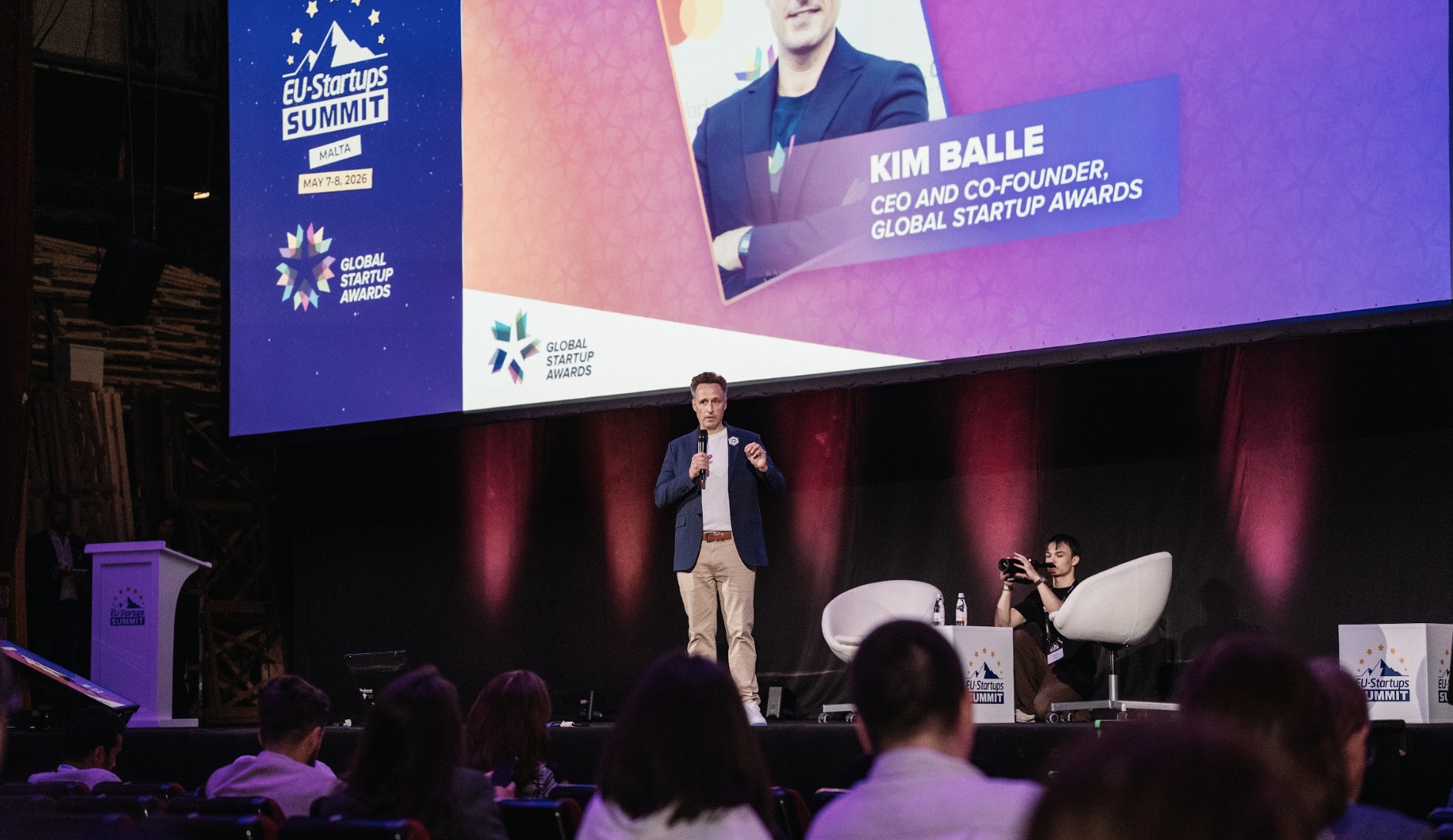
Onstage, he announced the 2027 return to Denmark. “it is time to bring it home for the next edition,” he said. Home now meant something different from the room he had found in 2010. The gathering could return to its starting country with relationships accumulated elsewhere.
That is the thread running through Balle’s career. He keeps building occasions for people to encounter one another, then adding ways to continue the conversation. A weekend becomes an awards program. Regional partners make it travel. Software remembers the participants. A camera asks them to tell their stories.
The trophy is an agreeable object to take away. Balle has spent the years around it working on something less photogenic and potentially longer lasting: having someone worth calling when the next difficult part begins.
Keep the conversation going
Follow Kim Balle on LinkedIn, explore Global Startup Awards, or visit xo.company and DROBE.media.
- Balle’s account of finding his startup community Essay · 2020
- Why GSA Ventures? Essay · 2025
- Watch: Nordic Startup Awards interview with Kim Balle Video · 2020
- Listen: Down the Rabbit Hole GSA Stars Podcast
- The regional network and its next chapter Interview · March 2026
- The Malta finale and Denmark announcement May 2026