Khristian Gutierrez and Bob Youakim leased a parking facility. For two people with investment-banking backgrounds, it was a useful way to complicate a spreadsheet. They wanted to understand the business they were trying to improve, and operating a facility brought them into direct contact with its customers. Before Passport could become municipal software, there was the rather less abstract matter of somebody needing somewhere to leave a car.
The detail suits Gutierrez, who is known around the business as KG. His career has carried him from Wells Fargo Securities in New York to government technology in Charlotte, through a departure from the company he co-founded and a return to lead it. Parking supplies the continuity. He has spent much of his working life trying to understand what happens around a transaction that most of us would prefer to finish and forget.
Paying for a space takes a moment. Running the system behind it takes considerably longer. There are permissions, rates, enforcement, appeals and records, each attached to people who need an answer. Gutierrez built his career inside that gap between the small action a driver sees and the large operation a city must maintain.
From Spanish at home to finance in New York
Gutierrez was born in New Jersey and grew up mainly in Florida. He describes a Dominican upbringing, speaking Spanish at home and English at school, with limited resources and considerable family expectations. His parents’ sacrifices gave him a sense of obligation that he now connects to his responsibilities for employees and stakeholders. The opportunity to move forward came with an expectation that he would do something with it.
His account of that upbringing has a practical sequel in his hiring philosophy. He wants to develop people for their potential and direction of travel, rather than simply their credentials. He has written about being the youngest person at a table, the public-school graduate, or the first-generation kid among people with more conventional pedigrees. His advice includes making room for whoever comes next.
At the University of Florida, he earned an undergraduate business degree and a Master of Science in Finance, completing his formal studies in 2010. Investment banking followed. At Wells Fargo Securities, he worked in New York as an analyst. Then, in the summer of 2011, he left the bank to join Youakim at Passport as a managing partner. The next subject to master was parking.
A city is a customer with a long memory
The early company saw room to improve the mobile-payment experience. Its own history describes applications that were difficult to use and a market with few principal competitors. It also describes a change in direction, away from parking hardware toward software. Gutierrez arrived during that early period of rethinking what the business should become.
His responsibilities soon reached well beyond finding somebody willing to buy an app. He oversaw product development for the Toronto Parking Authority and led the deployment of Passport’s first transit mobile-ticketing program in Columbia, South Carolina. These were specific operating assignments: build something for a public institution, then help get it into use. A sale was one step in a much longer relationship.
A conceptual view of the operations Passport connects.
Government buyers must account for public money, follow procurement procedures and keep services working. Customer references therefore carry unusual weight. Gutierrez has described recommendations from existing city customers as an early sign that Passport’s product was finding its market. Someone who had already lived with the system was willing to put their own reputation behind it.
For a former banker building a software business, that is a useful definition of progress. A reference letter lacks the theatre of a launch event. It does, however, come from somebody who has had time to discover whether the thing works.
The detour through bankers’ boxes
Gutierrez spent a decade as Passport’s chief revenue officer before leaving in 2021. In January 2022, CivicEye announced him as its CEO. The setting changed from parking operations to software for law enforcement and prosecutors. The underlying problem remained familiar: institutions doing complicated work with digital infrastructure that needed improvement.
At CivicEye, he talked about physical papers carried into courtrooms in bankers’ boxes and the need for agencies to exchange information across jurisdictions. Those boxes make a useful companion image to the parking facility. In both cases, the software opportunity began with an existing workflow, already full of human effort, that could be examined up close.
CivicEye announced a $12.4 million Series A in 2022, led by Cercano Management with participation from Relevance Ventures and existing investors. Gutierrez was recruiting for a business expanding its national customer base while concentrating much of its executive operation in Charlotte. In early 2024, he moved into an advisory role as Joshua South took responsibility for leading the company as president.
- 2011Leaves Wells Fargo for Passport
- 2022Becomes CivicEye CEO
- 2024Returns to Passport as CEO
- 2026Passport joins Arrive
Returning to a company that had grown up
Passport announced Gutierrez’s appointment as CEO on March 7, 2024. Youakim returned to an operational role as executive chairman. Gutierrez succeeded interim CEO Brian Mooney, bringing a founder’s long connection to the company into the work of running it day to day. By then, Passport served more than 800 cities and private operators across North America.
The business he returned to connected parking, enforcement and payments. Cities were using mobile tools more widely, while the work of managing compliance remained a substantial concern. His next chapter involved strengthening client relationships and developing tools around those needs. It was a return to a familiar company with a broader operating brief.
In writing about the following eighteen months, Gutierrez described the return as a test of the company’s culture. He emphasized candid discussion, mutual respect, direct feedback and consistent decisions. His account allows for a leader to step back, ask a better question, or let somebody else lead when that person is better placed to do so.
He also acknowledged that service technology can disappoint in practice even when it sounds sensible in a meeting. In his writing about growth, he described learning from tooling that landed differently with customers than expected. The lesson he draws is to make technology investments more deliberate about the human experience. Anyone who has ever endured an efficient new process that made their afternoon longer will recognize the problem.
The people who know the old system
Gutierrez’s writing about modernization pays attention to the people who maintain existing systems. Long experience produces knowledge, routines and professional pride. Replacing software changes all three. His approach calls for understanding those attachments and involving the people affected, since adoption and implementation determine whether a technical improvement becomes useful.
“It’s a mistake to dismiss the ‘old ways.’”
Khristian Gutierrez, on modernizing public-sector systems
He has been equally specific about what he admires in city leadership. After Boston’s curb-management upgrade, he praised officials who stayed involved through the transition: shadowing frontline staff, holding regular checkpoints, communicating with residents and departments, and owning problems. The details he singled out included the first permits approved and the first successful appeals. Those are milestones a resident can actually experience.
At the 2025 International Parking & Mobility Institute conference, he joined officials from Oak Park, Denver and Omaha to discuss parking compliance. The session brought together policy, enforcement and user experience. It is an appropriate setting for his interests: a room where people responsible for different parts of a shared problem can compare what actually happens.
A company with graduates
In Charlotte, Passport’s influence extends into businesses founded by its former employees. Gutierrez joined WFAE’s Charlotte Talks in April 2025 alongside StreetFair CEO Teddy Fitzgibbons and reporter Symone Graham to discuss the local startup economy. The company had become a place where employees could learn what building a business required.
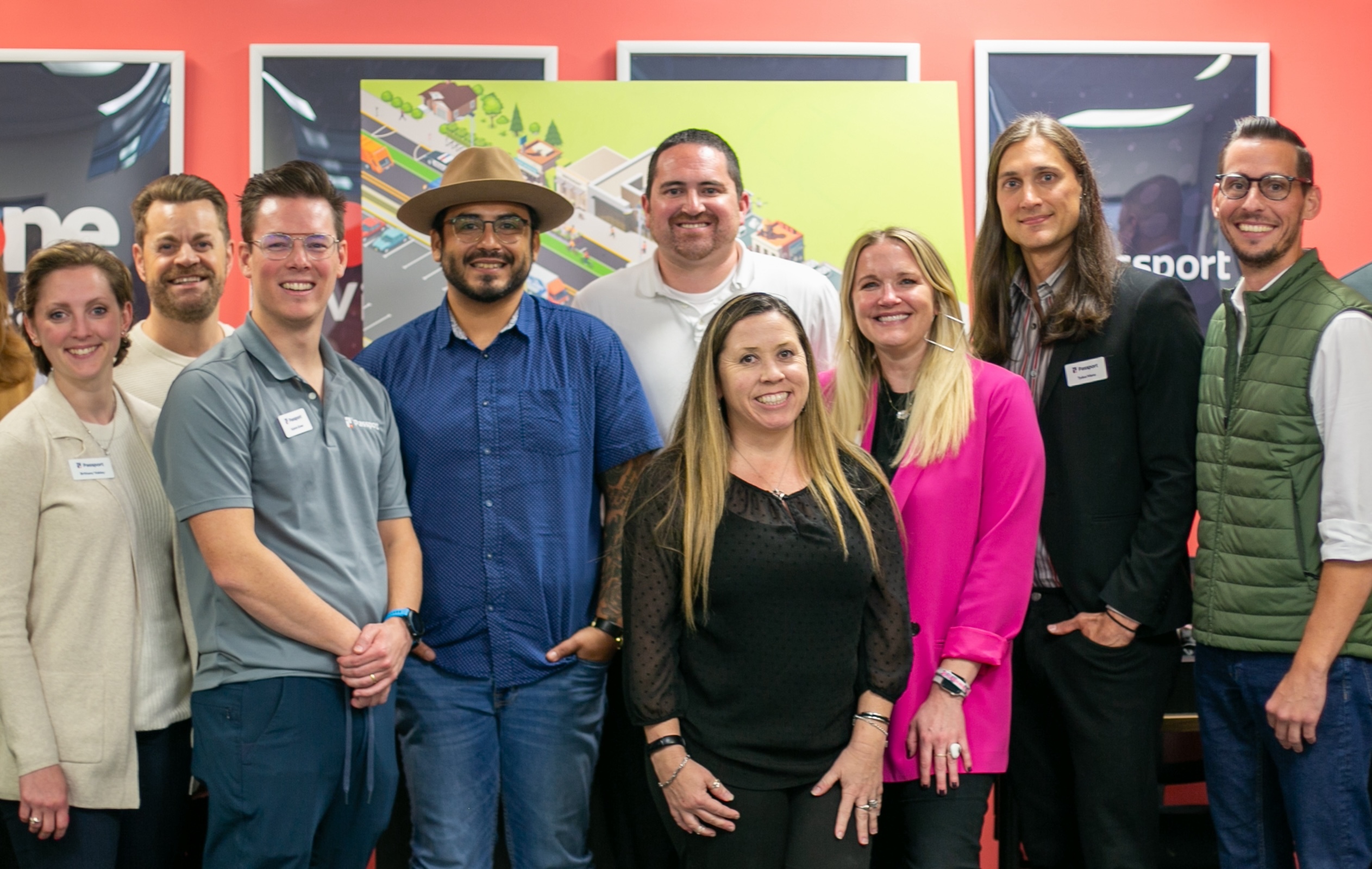
Alumni ventures include DebtBook, Subsalt and SkillPop. Gutierrez has described an environment where employees see sales, product, implementation and finance, and take responsibility for substantial problems. The resulting network is known locally as the Passport Mafia. Fortunately, its public record is more concerned with introductions and company formation than with ominous restaurant reservations.
His interest in connection has a lighter outlet, too. Passport’s industry basketball-bracket tournament has run since 2013, welcoming colleagues, customers, partners and families. Gutierrez is a Florida Gators supporter and seems willing to concede that choosing by mascots or jersey colors can work. An industry built around rules can still accommodate a rather unscientific selection process.
The next arrival
On October 1, 2026, Arrive completed its acquisition of Passport. The combination brought Passport’s compliance and payment operations into a broader mobility business whose brands include EasyPark, Flowbird, RingGo, ParkMobile and Parkopedia. The announcement connected the deal to real-time curb management and the infrastructure needed for autonomous mobility, while committing to continued service for existing customers.
Gutierrez and Youakim also see a local consequence. The sale placed capital in the hands of employees, founders and investors who could support Charlotte’s next businesses. For a company already associated with an alumni network of founders, an acquisition creates another way for experience and resources to circulate through the city.
The parking facility remains a good place to begin understanding Gutierrez. Leasing it put the founders in contact with a working business and its customers. His later career has enlarged the circle: city staff, courtroom workflows, employees learning to lead, founders starting again. The scale has changed. The useful question is still close to the ground: what does the person doing the job need next?
Continue the conversation
- Passport · Company website ↗
- Khristian Gutierrez · LinkedIn ↗
- Parking Happiness · September 2024 conversation ↗
- Urban Loop · September 2020 conversation ↗
- Charlotte Talks · Startup entrepreneurship ↗
- Gutierrez · Writing on culture and change ↗
- Arrive · October 2026 acquisition announcement ↗
- Charlotte Business Journal · After the acquisition ↗