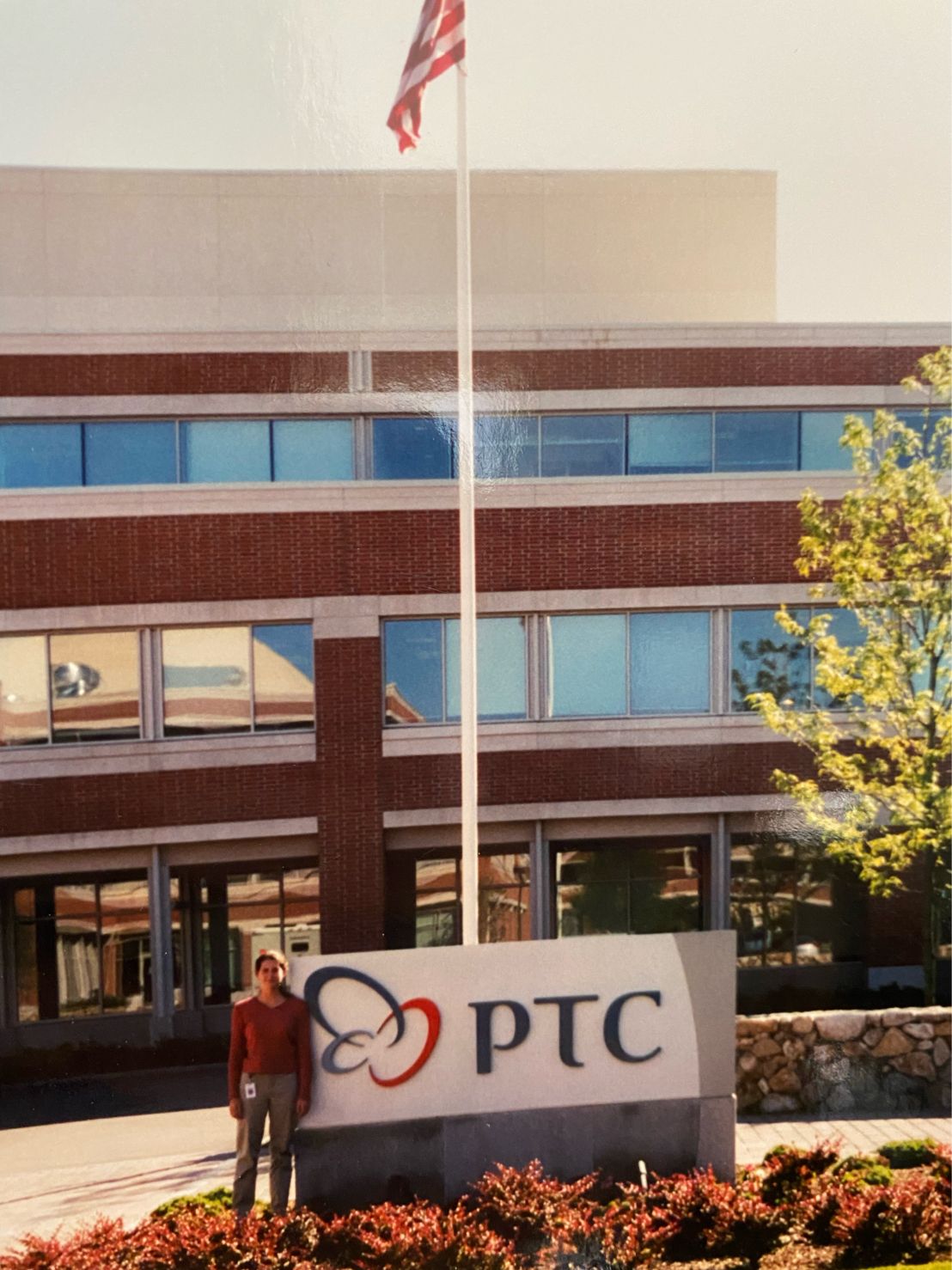
In a photograph from 2001, Kendra Seaman stands beside a PTC sign while the office building rises behind her. The composition has an accidental honesty. The institution is enormous; the new employee is a small figure at its gate. She had moved across the country, knew nobody there, and, as she later wrote, felt ready to take on the world. The picture is not a triumphal portrait. It is better than that. It catches the instant before experience starts doing its slow work.
Two decades later, Seaman selected that same snapshot to mark her departure from PTC. By then, the company was not merely a line on her résumé. It had been one of her first jobs after college, then the setting for a long return engagement. Across two stretches she had spent more than ten years there. The young woman by the sign had become a leader in program management, transformation, customer success, field strategy, alliances and channel operations.
The obvious story is one of advancement. The more revealing story is one of translation. Seaman has repeatedly taken work that exists as an executive ambition and converted it into roles, routines, decisions and deadlines. Her present work at Calix, in go-to-market chief-of-staff leadership supporting the CMO, is the latest variation on that craft. The title sounds close to power. The practice is close to everything that power sets in motion.
The first draft of an operator
Seaman started at PTC in April 2001 as a group leader. In 2004 she moved to Stefanini EMEA as a program manager, followed in 2007 by an IT service-management program role at Northeastern University. Those early jobs established the recurring grammar of her career: groups, programs and systems. None is glamorous language. All three determine whether a company can keep its promises after the meeting ends.
She also earned a master's degree at Northeastern, specializing in leadership and recording a 4.0 GPA. The educational detail fits the professional one. Her career is not principally about inventing a product in solitude. It is about coordinating people who possess different information, incentives and definitions of urgent. Leadership, in that environment, is less a speech than a shared operating rhythm.
In 2014, Seaman returned to PTC as a PMO manager in technical support. The return matters. Going back to an early employer can be sentimental, but her second chapter was architectural. She moved from technical-support PMO work to directing the Global Transformation Office, then into customer-success program management. Next came field strategy and planning, strategic alliances, and finally channel strategy with chief-of-staff responsibilities.
There is a useful progression hidden in those titles. Technical support shows where a system hurts. Transformation work asks how the system should change. Customer success tests whether the change matters outside the building. Field planning confronts the distance between headquarters and reality. Alliances introduce another company's priorities. The chief-of-staff role gathers all those tensions onto one desk.
“Proud of the courage and appreciative for the opportunity.”Kendra Seaman, reflecting on her 2001 move
Order without the chill
Operations people are often praised with words that could also describe shelving: organized, stable, reliable. Seaman's recommendations add warmth to that vocabulary. One former direct report recalled entering PTC's Global Transformation Office and finding an organized, customer-focused PMO built around defined standards. The memorable part came next. Seaman helped this colleague map a route into people management, then made sure the plan survived her own handoff to a successor.
That small administrative act says more than a grand philosophy might. A development plan is easy to promise and easier to lose when reporting lines change. Preserving it required foresight, documentation and care for a future in which Seaman would not be the central character. Good operations leave useful things behind.
Another colleague described her as someone who “cuts through ambiguity” while remaining a “transparent and empathetic leader.” The pairing is important. Ambiguity can be eliminated brutally, by forcing a quick answer and calling every objection resistance. It can also be reduced through trust: make the choices visible, name the tradeoffs, let people understand what happens next. Seaman's public record points to the second method.
Her professional study has followed the same broad shape. She earned the Project Management Professional credential in 2014, a customer-success credential in 2018, Prosci change-practitioner certification in 2021, Yale School of Management training in inclusion and diversity in 2022, and a Project Management Institute credential in organizational transformation in 2023. Taken together, they form a practical syllabus for moving an organization without treating its people as movable furniture.
Credentials alone do not reveal how someone behaves when a plan begins to wobble. Recommendations do. Across a dozen public accounts, the same qualities recur: clear standards, customer focus, personal support and calm movement toward a defined future. This is consistency seen from several chairs around the table. It suggests that Seaman's methods are not a private system that works only when she explains it. Colleagues can recognize the structure, work inside it and describe what it gave them.
The restaurant, the broadband network and the common problem
At the end of 2021, Seaman left PTC and joined Toast as senior director of its executive PMO. Toast sells technology to restaurants; its world runs on fast service, distributed customers and countless small moments when software either disappears into the work or interrupts it. After years inside an enterprise-software company, Seaman was now operating within a business whose technology meets a dinner rush.
Her Toast chapter lasted through early 2023. She then joined Calix as sales PMO director and chief of staff to the chief revenue officer. Calix makes cloud, software and access systems for broadband service providers. The nouns changed again: fiber, subscriber experience, managed Wi-Fi, network operations. The underlying operating problem remained familiar. A platform company has to align product, sales, service and customers around a promise that is technical in construction and human in use.
By May 2026, her role had broadened into chief-of-staff and strategic-program responsibilities. Her supplied current title, GTM Chief of Staff to the CMO, places her at the junction of market strategy and execution. Go-to-market plans are especially fond of clean arrows. A message leads to interest; interest becomes pipeline; pipeline becomes revenue. In practice, every arrow crosses departments, systems and opinions. The chief of staff tends the crossings.
The role also completes a long loop in her career. Early program work asked whether tasks were sequenced and owned. Customer-success work asked whether buyers obtained what they were promised. Alliance and channel roles asked whether partners could carry that promise beyond the company's walls. Go-to-market leadership brings all three questions together. The language may be campaigns and pipeline, but the operator still listens for dependencies: what must be ready, who must agree, and where a bright idea is likely to meet a stubborn system.
Seaman's route to that seat is instructive because it did not begin in brand language. It began with program work and technical-support operations. She learned organizations from the inside out, where friction accumulates and customers feel it. That background changes the questions available to a marketing organization. Who must do what for this promise to be true? Which team receives the hidden work? How will anyone know the change has taken hold?
The glamorous unit of business is the announcement. The durable unit is the handoff.
The photograph has aged well
When Seaman posted her farewell to PTC, 569 people reacted and 170 commented. The scale is less interesting than the tone. Former colleagues wished her luck, asked her to stay in touch and remembered her as positive company. Her own message was grateful rather than forensic. She called the people family, credited the experience with knowledge and growth, and returned to the courage of the woman in the old photograph.
“Knowing not a soul, and ready to take on the world!” she wrote. A younger professional's confidence often imagines the world as a thing to conquer. An experienced operator learns that the world is mostly a set of interdependencies. People need context. Decisions need owners. Customers need an outcome rather than an org chart. A plan needs a cadence. Someone's development goal needs to remain visible after the manager leaves.
This is why Seaman's career is best read sideways as well as upward. She has crossed functions that companies too often isolate: support and strategy, process and people, the field and headquarters, revenue and marketing. Each move supplied another view of how decisions travel. Her skill appears not as possession of every answer, but as an ability to make the unanswered questions manageable.
The 2001 photograph contains no prophecy about Toast, Calix or a future chief-of-staff title. It simply records a willingness to arrive. Twenty-five years later, the through line is clearer. Seaman goes toward complicated organizations, learns their machinery and helps the people inside them move together. Ambiguity never disappears. Under a practiced operator, it can at least be given a meeting time, an owner and a next step.