In telecommunications, a “god box” was a piece of equipment with an ambitious job description. It promised to do things that previously required several machines. The nickname carried a warning: combining functions was easy to propose, considerably harder to deliver. Michael Hatfield had heard the objection before. In 2009, introducing another networking company after Cerent and Calix, he answered with a small professional confession.
“Every box I’ve ever done has been a god box.”
Michael Hatfield, 2009
There is a career in that sentence. Hatfield kept working where technologies met: copper and fiber, different transmission speeds, packet traffic and optical transport. His companies built equipment for the unglamorous business of getting information from one place to another. The internet may appear weightless on a screen. Someone still has to arrange the machinery.
Follow his work and another set of connections appears. The engineering graduate became a business founder, then a supporter of student entrepreneurs. The entrepreneur and his wife helped fund a theater named for his parents. The companies have their milestones; the theater has 602 seats. Both deserve a place in the biography.
The rack was getting crowded
Hatfield graduated from Rose-Hulman Institute of Technology in 1984, studying electrical engineering and mathematical economics. He later earned an MBA in finance at Indiana University in 1987. The combination gave his education two practical vocabularies: how systems function, and how businesses account for them.
His early career included management roles at Ameritech and DSC Communications. At Advanced Fibre Communications, he was an early team member and vice president of marketing. These were jobs close to the decisions network operators make about equipment, capacity and services. They also placed him among people who would turn up in later startup chapters.
His account of the product history starts with integration. At AFC, copper and fiber belonged in the same conversation. At Cerent, which he co-founded and served as chief operating officer, equipment combined different optical transmission speeds. A separate speed no longer necessarily called for a separate machine. For a customer, the attraction was quite literal: fewer pieces to put together.
The $6.9 billion chapter
On August 26, 1999, Cisco announced an agreement to acquire Cerent. The proposed exchange of 100 million Cisco shares valued the transaction at approximately $6.9 billion at the previous day’s closing price. Cisco completed the acquisition on November 1. Even among the numbers associated with internet infrastructure, that one gets attention.
The product behind the transaction is more revealing than the price. Cerent’s optical transport platform let service providers accommodate newer data services alongside traditional voice traffic. Cisco described a system that could respond to changes in network traffic in minutes instead of days. The value proposition involved making an existing network more adaptable while keeping it useful.
That distinction helps explain the territory Hatfield worked in. Network operators already had infrastructure, customers and obligations. A new product had to enter that working arrangement. Elegant engineering would have to meet the awkward facts of equipment already installed and services already being delivered.
A company needs more than a founder
Calix, founded in 1999, took the question into the access network: the part connecting subscribers to a service provider. Hatfield was its founding CEO. The early C7 platform could handle copper and fiber connections, allowing a carrier to move selected subscribers toward fiber without treating the whole network as a clean sheet of paper.
By an early 2003 announcement, Calix had shipped more than 500 platforms to more than 50 American local exchange carriers. The company also announced $50 million in new funding. This was equipment finding customers, with a business to finance and an organization to run around it.
Hatfield’s CEO tenure ended in December 2002. Carl Russo took the job, and Hatfield became chief strategy officer. The two had a connection through Cerent, where Russo had been president and CEO. At Calix, Hatfield’s next responsibilities centered on technology and business development.
There was also a limit to what integration should promise. In discussing the C7, Hatfield acknowledged that replacing a standalone product did not require matching every feature it offered. His formulation began, “We only want to do what’s necessary”. The rest of the thought concerned the particular place in the network. Even a machine with a grand nickname needed a sensible boundary.
Calix’s public offering came in March 2010, years after the leadership handover. Its initial offering price was $13 a share. The sequence matters: founding, product development, a change of leadership, then the public-market milestone. A founder’s work can precede the photograph most people remember.
Blue Planet leaves the box
Hatfield co-founded Cyan in October 2006. The team included Steve West, Eric Clelland and Rick Johnston, with experience stretching across other communications companies. Johnston had also been part of Calix’s founding team. This was another startup assembled from people who already knew the industry’s practical difficulties.
In January 2007, while details were still scarce, Hatfield declined to make much of the new venture publicly. By September 2009, Cyan was introducing its Z33 and Z77 packet-optical platforms. The company reported more than 20 customers. The Z77 supported up to 2.5 terabits per second of capacity per chassis.
Those specifications describe the equipment’s capacity. Cyan’s software addressed how an operator would understand and control it. A management system displayed the relationship between network layers in three dimensions. Packet and optical systems, often handled separately, could be viewed together. The recurring integration question had acquired a screen.
Conceptual illustration of the product approaches, not a network wiring diagram.
The next development loosened the relationship between software and the company’s own hardware. Blue Planet, introduced in 2012, could work across equipment from different vendors. Early deployments included locations without Cyan hardware. Its approach also accommodated older devices, giving operators a way to begin changing network control without replacing everything first.
Hatfield had moved from combining functions inside equipment to helping coordinate equipment across a network. The commercial question widened too. A software platform could be useful beyond the installed base of the company’s own boxes. That was a consequential change for a business whose history began in optical systems.
Another leadership transition accompanied this period. In May 2012, Cyan chairman Mark Floyd became CEO. Hatfield remained president, overseeing solution strategy and work across development, engineering, product management and marketing. Floyd brought experience with international operators and scaling businesses. Hatfield continued in a role close to what the company was building.
On May 9, 2013, Cyan began trading on the New York Stock Exchange. Hatfield joined Floyd and colleagues at the opening-bell celebration. In August 2015, Ciena completed its acquisition of Cyan and appointed Hatfield senior vice president to lead its Blue Planet division. The new unit combined software activities from both companies.
The division’s remit included software development, product management, marketing, support and sales. It was a substantial organizational chapter after the startup and the listing. The work still concerned giving network operators more control across physical equipment and virtual functions, now inside a larger company.
602 seats, and a family name
While these companies were developing, another project opened in Terre Haute, Indiana. Hatfield Hall began welcoming audiences at Rose-Hulman in 2002. Michael and Deborah Hatfield funded it through a $14 million gift. They named the building for his parents, Larry and Pat, whose portrait hangs near the alumni center.
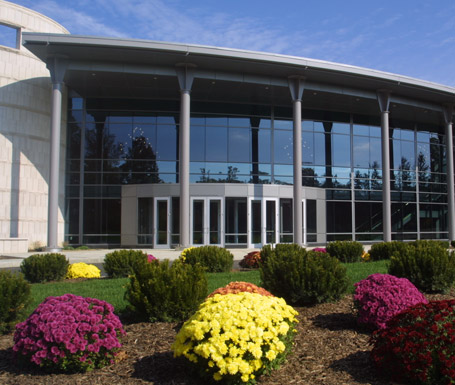
The building includes the theater, alumni facilities and offices. Students perform there; visiting artists do too. In a career often described through company names, transmission standards and acquisition figures, the hall supplies an unusually accessible point of entry. Anyone can understand the usefulness of a place to sit and watch a performance.
His connection to Indiana’s business community also took a financial form beyond Rose-Hulman. The Indiana Venture Center launched in 2003 with $3 million in funding from Hatfield, an MBA alumnus. The gift supported a venture center in the state where he had completed both his undergraduate and graduate education.
A different seat at the table
By May 2024, Hatfield was encouraging more alumni to bring concrete, investment-worthy startup proposals to the Sawmill Angel Network. Rose-Hulman’s Sawmill Society brought alumni and students into the same entrepreneurial community, with funds supporting projects as they moved from ideas toward prototypes and possible businesses.
His invitation was direct: “We know that the ideas are out there.” It put an experienced founder on the receiving side of a familiar transaction. Someone else would have to explain the product, the customer and the case for putting money behind it.
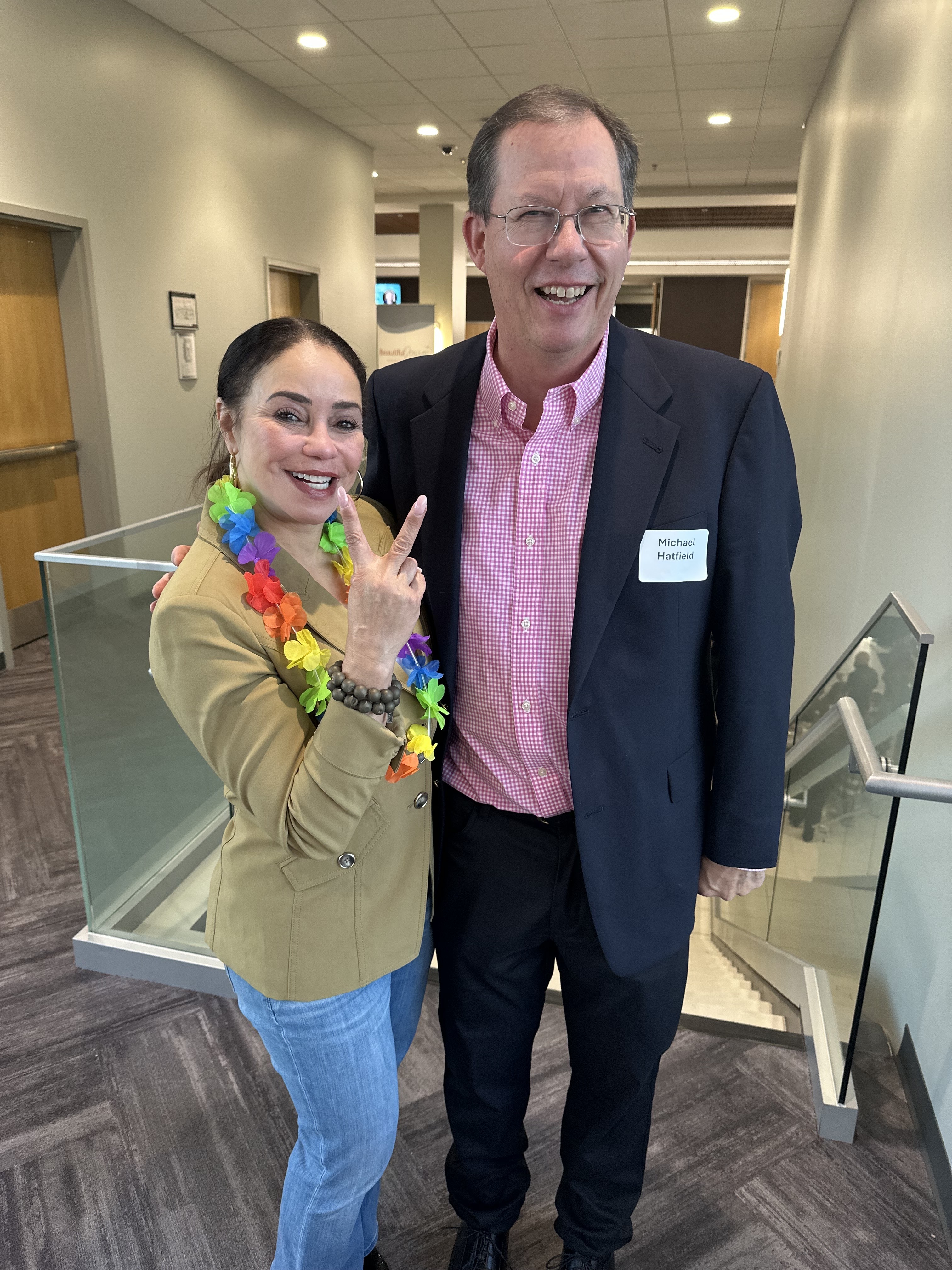
That December, he interviewed founder Chere Cofer at the Invest In Women Founders Summit in Indianapolis. The event paired entrepreneurs with experienced executives for conversations in front of potential investors. Hatfield’s task was to help another founder make her business understandable.
The photograph of them afterward has the cheerful informality that a corporate headshot usually edits out. Cofer wears a colorful lei and raises two fingers; Hatfield smiles beside her, his name on a badge. After a career spent combining equipment and organizing companies, here he is participating in a much smaller connection: a founder, an interviewer and an audience deciding what might happen next.