In February 2014, Ken Ogata was looking inside a battery. Using silicon nanowires and nuclear magnetic resonance techniques, his Cambridge research team followed the reactions that occur when silicon meets lithium. They were trying to understand a material that could hold considerably more lithium than conventional anodes, but changed as it worked. The ambition was practical: a clearer picture of those reactions might give engineers more control over battery design.
Ogata, the study’s lead author, wanted design to become “much more systematic, and less trial and error.” It is a revealing phrase to carry forward through his career. A dozen years later, he is co-founder and CEO of TeraWatt Technology, where the unit of attention has widened from reactions inside a cell to the organization required to manufacture cells. The subject remains batteries. The troublesome variable increasingly has a job title.
The early research used a model system that could accommodate silicon’s expansion over repeated cycles. It gave the team a way to map how the material transformed during operation. Repetition was present from the beginning: the battery had to survive another cycle, and the scientist needed to understand what changed.
“The next battleground will be mass production.”
Ken Ogata
Cambridge made the world feel smaller
Ogata studied materials engineering at the University of Tokyo, then pursued his doctorate at Cambridge. There, an encounter with battery researcher Clare Grey helped turn his interest toward lithium batteries. His academic work had involved silicon nanotechnology. Batteries offered a way for that knowledge to meet an increasingly consequential industrial problem.
He stayed in research, then moved into the battery industry in 2014. His explanation for leaving the university was straightforward: academic research and practical manufacturing were separated by a distance he wanted to cross. Working closer to development and production would let him see the machinery behind commercialization.
Cambridge also changed his sense of what a career could contain. Among his contemporaries, starting a company felt ordinary. He later described the importance of the people and environment around a prospective founder. Entrepreneurship had become something a person in the next room might do.
That observation helps explain his later approach to geography. When setting up TeraWatt, he and his fellow leaders put development and production in Japan, with fundraising and business development in Silicon Valley. He wanted Japan’s manufacturing skills alongside the scale and pace of the American business environment. The company was organized across borders from its beginning.
A company with a previous life
TeraWatt’s independent life began on January 1, 2020, when SERES transferred its battery technology division into the new company. Ogata became co-founder and CEO. The engineers from the former division continued their work as TeraWatt employees. SERES kept a minority, non-controlling stake, while its chief technology officer, Yifan Tang, became a co-founding advisor.
This origin matters. Ogata was taking responsibility for a working technical group, with accumulated experience and an existing development program. An independent company could pursue battery applications beyond the automotive business of its former parent. It also had to make its own commercial case.
The launch announcement described solid-state battery development. TeraWatt’s present public language centers more broadly on next-generation lithium-ion cells and their manufacture. Those descriptions belong to different moments in the company’s development; the launch was the start of an independent organization, rather than a guarantee that every later product would have the same design.
- 2014Cambridge research on silicon battery reactions
- 2020Independent company launches from SERES division
- 2024First mass production facility begins preliminary operation
- 2026Energy-company alliances; product leadership expands
A number needs a production line
By its 2022 Series B announcement, TeraWatt was reporting cells with a capacity of 6,800 milliamp-hours and a gravimetric energy density of 416 watt-hours per kilogram. The company said those cells had passed UN38.3 and the safety test items in IEC62133-2, with testing performed by UL Japan.
Energy density describes how much energy a battery stores relative to its weight. For an aircraft or a vehicle, that relationship has obvious appeal. Ogata’s company was targeting longer driving range, greater drone payloads and flight times, and emerging electric aircraft applications. The number was a development milestone. Producing it economically and repeatedly would require a different set of accomplishments.
Temasek led that funding round. Existing investors including Khosla Ventures, JAFCO and Scrum Ventures participated again; Coral Capital and Daikin joined. Kazuma Yamauchi was identified as co-founder and finance and strategy lead. Ogata’s technical project had acquired the financial and organizational apparatus needed for its next stage.
In June 2023, the Development Bank of Japan invested to support larger pilot products and a large-scale pilot-production facility. Its stated priorities included logistics, productivity and quality control. These are excellent words for a factory and rather unfortunate ones for a cocktail party. They are also where a battery business begins to earn its keep.
A development milestone, not a measure of factory output.
The handoff becomes the job
Ogata’s diagnosis is that next-generation cells require new processes and equipment, making the traditional separation between researchers and production engineers a liability. At TeraWatt, he has put those disciplines into a single team. Recruiting the people capable of doing this work was difficult, he has said, but helped strengthen the company’s competitiveness.
His argument has an economic edge. Customers will expect improved batteries to withstand ordinary price competition. A premium product sold into a small niche would answer a different question from the one he wants TeraWatt to address. His stated destination is high-performance manufacturing at low cost and substantial volume.
“The next battleground will be mass production,” he says. It is a compact description of the problem that drew him out of university research. A new cell design changes what the factory must do. The factory’s limitations, in turn, must influence the design. Organizing those conversations is part of the engineering.
Software joins the workshop
TeraWatt’s internal software platform, TeraSpace, extends that approach across its development and manufacturing sites. Ogata describes a system that connects disciplines and processes that are usually separated. Battery engineers, manufacturing specialists and software and AI engineers work within the same organization, rather than treating the software as something to install once the difficult physical work is finished.
The platform is intended to process data across development and production concurrently. Its usefulness depends on an intimate relationship with the machines: which data to capture, when to capture it, and how changes in the cell or process should change the measurements. A beautifully arranged dashboard would be poor compensation for measuring the wrong thing.
Ogata’s longer ambition reaches beyond the factory. He has discussed following battery data through use, subsequent applications and recycling. That is an aspiration for how the platform might support the battery’s lifetime. It makes the manufacturing record part of a longer story about what happens to a physical product after it leaves its maker.
design↔Process
engineering↔Production
validation
TeraSpace connects data across development and manufacturing sites.
September was a beginning
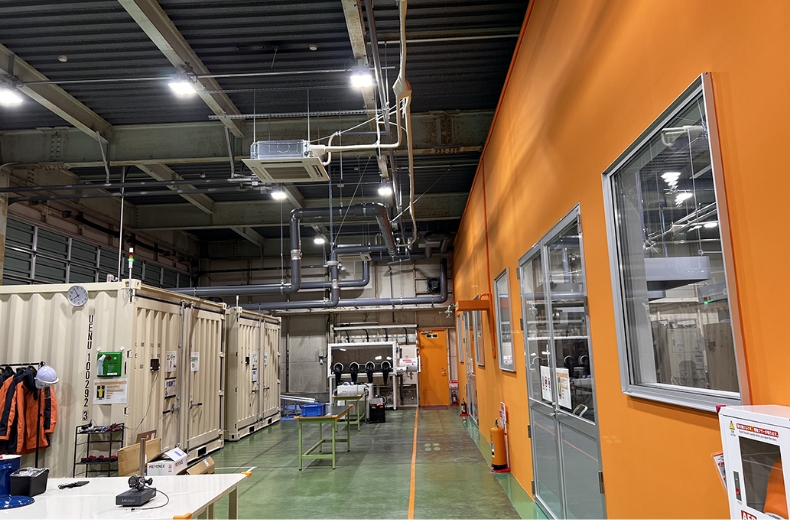
TeraWatt began preliminary operation of its first mass production facility in Japan in September 2024. Before that opening, it had been manufacturing and validating commercial-size cells at two existing sites for customers in Japan and overseas. The new facility connected that earlier development work to a larger production setting.
The distinction between opening a facility and completing commercialization is essential to Ogata’s story. The company’s October announcement placed customer engineering validation after the start of operations. It described commercial battery sales as planned for 2026 and beyond, with further investment intended to expand output toward gigawatt-hour production. Those were the next steps it set out, rather than a statement of achieved capacity.
Another milestone followed on April 21, 2025: the Shizuoka facility received ISO9001:2015 certification. The announcement concerned its quality management system, covering lithium-ion battery manufacturing and audit. It records an organizational accomplishment in how work is managed; it does not measure a battery’s energy density.
For a founder concerned with repeatability, quality management belongs in the main narrative. It is the paperwork-shaped counterpart to the machine on the floor. Customers eventually need both.
The next conversation is with the power companies
In April 2026, JERA announced an investment and collaboration with TeraWatt. The planned work included a stable supply of cells for grid-scale storage, energy services and improvements across the battery value chain. Ogata’s prospective customers and partners now included companies accustomed to thinking about power systems as infrastructure.
Kyuden International also formed a capital and business alliance with TeraWatt. Together they intended to explore battery storage business opportunities and expansion from Japan into global markets. Ogata described the relationship in terms of accelerating real-world deployment. An alliance creates a route to that work; the work still has to happen.
The Series C final close brought these energy-sector relationships into the financing story. For Ogata, they added expertise in how batteries might be used as well as resources for manufacturing. The question expands again: how should a cell be made, qualified, supplied and put to work?
In June 2026, TeraWatt appointed Sunho Kang as Head of Product and Technology. Kang brought experience at Samsung SDI, Apple and Volkswagen Group of America. His remit included product development, commercialization and manufacturing scale-up. Ogata was adding leadership for the same stretch of territory that had interested him since leaving academic research.
Making the next one
Ogata received the Minister of State for Science and Technology Policy Award at the 22nd Japan Venture Awards. He appreciated its practical effect: recognition made the business easier to explain to people outside the technical field, including financial institutions and suppliers. Even a battery company needs a way to make its work legible.
The arc of his career runs from understanding a reaction to building the conditions under which a product can be repeated. It takes in researchers, production engineers, finance specialists, software developers and energy companies. Each addition brings a different test of the original idea.
There is something pleasingly unsentimental about the destination. A factory has little use for a persuasive anecdote when the next batch arrives. Ogata’s ambition has to survive that encounter, over and over. The next battery will ask the question again.
Follow the work
Research, conversations and the next chapter.