A battery can lose its usefulness through a crack too small to notice. Jin-Myoung Lim has spent part of his career giving that crack his attention. In a 2017 paper, he and his collaborators examined why a nickel-rich cathode material fractures as lithium leaves it. Years later, he is helping build a company around producing cathode particles with a different structure. Between those two points lies a rather practical ambition: make the material better, then make enough of it.
The scale change is considerable. One end of Lim's work concerns atoms, strain and the boundaries between tiny particles. The other concerns investors, equipment, production throughput and a pilot facility in Carrollton, Texas. A good battery material has to survive both worlds. The microscopic world is unforgiving. The purchase order can be quite demanding, too.
Lim co-founded ACT-ion Battery Technologies, the venture incubated within Hunt Energy Enterprises. He previously carried the CEO and CTO responsibilities together. In August 2026, Mark McGough became CEO, while Lim moved to full-time chief technology officer. The change gives his story a useful present tense: the researcher who helped bring a manufacturing technology toward market is now concentrating on its technical development and scale-up.
The trouble inside the particle
Lim's doctorate is in mechanical engineering from Seoul National University. That background helps make sense of a battery research record concerned with what materials do as well as what they contain. Chemistry determines the reactions available to an electrode. Mechanics asks what happens to its structure while those reactions proceed. Repeated charging and discharging make the distinction rather less academic.
The January 2017 study, on which Lim was first author, examined a nickel-rich material commonly abbreviated NCM811. The collaborators included Taesoon Hwang, Duho Kim, Min-Sik Park, Kyeongjae Cho and Maenghyo Cho. They connected crack generation to uneven structural changes and directional contraction in the primary particles making up a larger particle. Their analysis combined computational approaches with the physical problem of how a material weakens.
That work gives a concrete starting point for reading his later career. A cathode may promise substantial capacity and still deteriorate in use. How its components change shape matters. The fracture problem puts an awkward condition on the pursuit of more energy: the structure that stores it must endure the repeated business of giving it back.
A surface worth paying attention to
After Seoul National University, Lim held postdoctoral appointments in chemistry at the University of Texas at Austin and in materials science and engineering at Northwestern University. The departments changed; battery materials remained a recurring subject. His published collaborations span lithium-ion and sodium-ion systems, among other forms of energy storage.
At Northwestern, his research included work with Mark Hersam and colleagues on graphene coatings. A 2020 study with Kyu-Young Park, Norman Luu and other collaborators explored a scalable method for wrapping active cathode particles with thin conductive graphene. The aim was to approach the capacity of the active material while reducing the amount of inactive conductive material needed in an electrode.
There is a pleasingly economical idea here. A battery electrode has ingredients that store energy and ingredients that help it function. Space and weight spent on the supporting ingredients cannot simultaneously belong to the active material. Improve the way those supporting ingredients work, and the balance can change. A very thin coating can have a surprisingly consequential job description.
Lim also appears on patent records involving conformal graphene coatings and electrode materials. These are collaborative inventions, with university and industrial colleagues named alongside him. The record reflects a career moving between explanation and application: understanding a material's difficulty, then investigating a method that might lessen it.
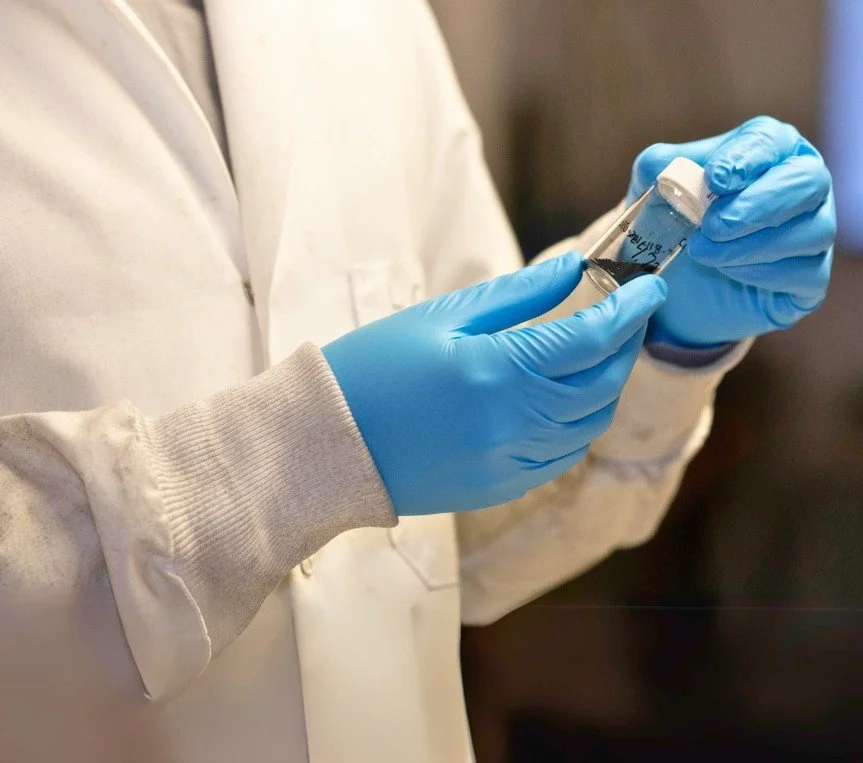
The laboratory meets the investment committee
By 2021, Lim was a senior engineer at Hunt Energy Enterprises, leading a battery venture and contributing to business and technology development for other renewable energy ventures. His work also included external investment assessment and due diligence. The same career now required attention to experiments and to whether another business's technical proposition held up.
His responsibilities included managing more than $1 million in annual internal research and development projects and serving as a co-principal investigator on a $2.1 million Department of Energy program. Those figures describe work entrusted to him at that stage. They also show how early his role joined scientific detail to budgets and institutional partnerships.
He was studying business as well. In 2021, he was an MBA candidate at Quantic School of Business and Technology, specializing in entrepreneurship. The combination is easy to romanticize, but its practical use is straightforward. A manufacturing venture needs someone to understand the experiment, the expenditure and the customer conversation. Lim's responsibilities were already putting those questions in the same room.
ACT-ion's technology development dates to 2019 within Hunt. Its later emergence as a separate company belongs to that industrial setting. The origin matters because this venture began with access to an energy technology organization and grew through collaboration with a national laboratory. Its path to market has involved several institutions, each bringing a different part of the work.
Four jobs in one process
The collaboration with Argonne National Laboratory produced Hydro4Crystal, a continuous hydrothermal manufacturing platform for single-crystal battery materials. The platform received a 2024 R&D 100 Award. Its proposition brings several operations together: crystal formation, lithiation, doping and surface coating. Manufacturing has its own version of tidying the desk, although the desk here is a chemical process.
The distinction between a material and a way of making it is central to Lim's venture. An improved particle alone leaves questions about processing time, equipment and expense. ACT-ion is pursuing a manufacturing route alongside the particle design. Its single-crystal cathode materials and surface engineering are intended to improve battery performance while making production more economical.
The company has demonstrated its platform across several cathode chemistries, including lithium iron phosphate, lithium manganese iron phosphate, nickel manganese cobalt oxides and lithium- and manganese-rich oxides. That flexibility means its process development can address more than one material family. It also makes the technical task more demanding: a platform has to earn its usefulness across different requirements.
Hydro4Crystal received the award through ACT-ion's collaboration with Argonne National Laboratory.
Lim's public response to that recognition looked forward to scaling and commercialization. An award supplies recognition; an operating process has another set of obligations. The next chapter asks whether the manufacturing approach can produce material consistently, support customer testing and meet the economic purpose that brought the venture into existence.
The distance between funding and a factory
ACT-ion announced a $7.5 million pre-Series A round in February 2025, led by BASF Venture Capital. Hunt Energy Enterprises, Mirae Asset Capital, Arosa Capital Management and LG Technology Ventures participated. The company identified a pilot facility and validation by industry partners as uses for the funding.
A $4 million extension announced that September brought the round to $11.5 million. Kyobo Life Insurance Group and KB Investment led the extension. For Lim, their participation also offered access to South Korea's battery ecosystem. The stated spending priorities included completing and commissioning the Carrollton facility, commercial validation and securing offtake agreements.
Those priorities make the financing story more interesting than a number alone. Build-out, commissioning, validation and sales agreements are different tasks. A pilot plant gives a process room to operate at a larger scale. Customer validation asks whether the resulting material works for someone else's requirements. An offtake agreement concerns who will buy it. Each stage has its own paperwork, and chemistry cannot sign all of it.
In September 2025, ACT-ion announced its lease in Carrollton. Lim described the pilot plant as the place where the company's vision would take physical form. The choice of location reflected logistics, support for innovation and the ability to attract staff. His language had moved from material behavior to the conditions necessary for an operation to grow.
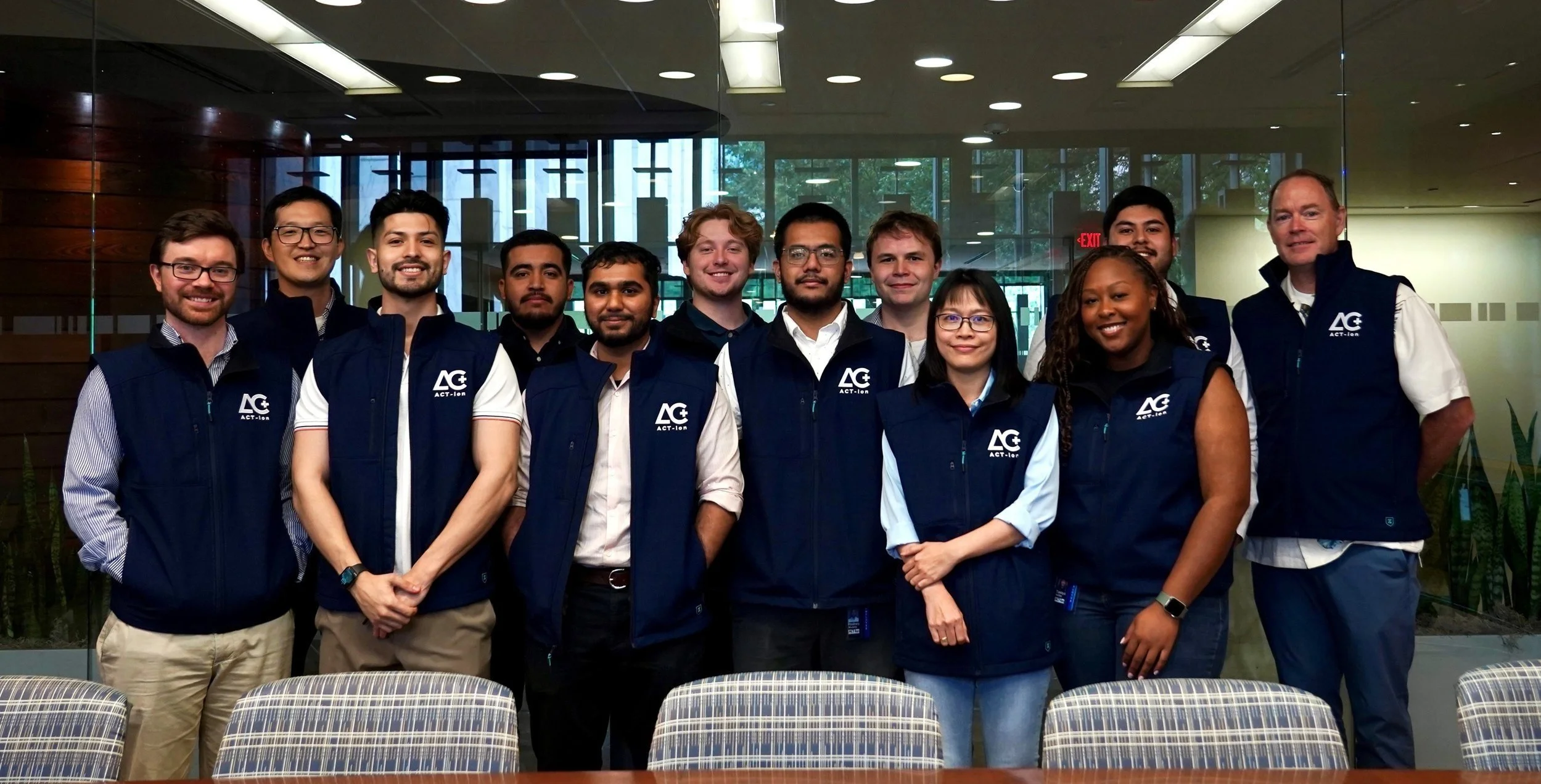
A narrower title, a larger technical assignment
The August 2026 leadership change followed the establishment of the pilot manufacturing facility. McGough took responsibility for commercial scale-up, customer qualification, partnerships, capital formation and manufacturing expansion. Lim retained technology development, process scale-up and product innovation. The division of responsibilities places the founder's technical work alongside a dedicated commercial leader.
“I can focus on strengthening our technological edge while supporting our broader market expansion.”
Jin Lim · August 2026
That statement is a useful expression of his present aspiration. It points to a role grounded in making the process and the materials work as the company expands. Having led the venture through earlier stages, Lim now has a full-time technical remit at a stage when production questions become increasingly concrete.
His career makes the small and large scales difficult to separate. The cathode particle must perform inside a battery. The manufacturing platform must perform inside a business. The team must bring both into a domestic supply chain that the company wants to strengthen. Each depends on the others, even when they appear on different pages of a presentation.
The crack studied in 2017 and the factory work of 2026 belong to different projects and different moments. Read together, they reveal a continuing concern with the material realities of energy storage. Lim has examined how an electrode fails, worked on how its surface can help, and helped develop a process for making cathode materials. The answer has grown to factory size. The particles still get the final vote.