A round frying pan is an object most people accept without negotiation. Keith Mirchandani helped build a business around a square one. Introduced by Tristar in 2015, Copper Chef gave a familiar kitchen utensil corners, a collection of accessories and a demonstration ready for television. There was something to show before anyone had to explain very much. In the consumer products business, that is a useful opening move. Dinner, after all, already has enough instructions.
The pan offers a way into Mirchandani’s career. He has worked where objects meet persuasion: choosing a product, giving it a recognizable identity, showing people how it works and getting it into their homes. The catalogue has wandered from microwave accessories to fishing products and kitchen appliances. Across those changes, a practical question keeps recurring. What would make an ordinary task sufficiently easier that someone would buy a new thing to do it?
Before the corners, a microwave
Mirchandani was born in Mumbai, then called Bombay, and moved to the United States at two. He graduated from Rutgers University in 1988 with a B.A. in marketing, then worked for a direct marketing company in Virginia. His early commercial success included Microcrisp, a device for browning food in a microwave. It addressed an unglamorous disappointment familiar to anyone who has expected an appliance to produce a result it could not quite manage.
He founded Tristar in 1992. The beginnings were modest enough for his garage to serve as an office. Later, his public biography would include Harvard Business School’s Owner/President Management Program. But the microwave accessory is the more revealing early detail. It puts the customer’s task ahead of the founder’s biography. There is no need to invent a new desire when someone already wants their dinner to come out differently.
A microwave product also has a useful property for a seller: the result can be shown. An explanation can become a demonstration. A demonstration can become an advertisement. The distance between the first version of an idea and a product people actually buy remains considerable, but Mirchandani had chosen work in which a visible result could do some of the talking.
The garage needed a camera
Tristar’s early products included the Hook & Hang organizer, Steam Buggy cleaner and Banjo Minnow Fishing System. The subjects varied; the opportunity to demonstrate them persisted. A cluttered closet and a fishing trip have little in common until you look at them through the eyes of a marketer. Each contains a task, an audience and a chance to explain why a particular object belongs there.
The company eventually developed a 65,000-square-foot production facility in Fairfield, New Jersey. That detail helps explain the business Mirchandani was building. Advertising was something the organization could make close to the rest of its work. The capacity to produce demonstrations and other content was part of how the products reached an audience.
Think of the difference between describing a household object and putting it in motion. The camera can show where a lid fits, how an accessory attaches or how much room a pan occupies. It can also leave a viewer with questions. A business built around those demonstrations has to keep translating between what the product does and what a prospective buyer needs to understand.
Conceptual view of Tristar’s product, media and distribution approach.
Someone you already knew
One of the recognizable people in Tristar’s story was Jack LaLanne. Mirchandani worked with him on the Power Juicer, a product sold through infomercials. Their connection extended beyond the transaction. In January 2011, Mirchandani recalled having known Jack and Elaine LaLanne for a decade and described Jack as a friend and an inspiration.
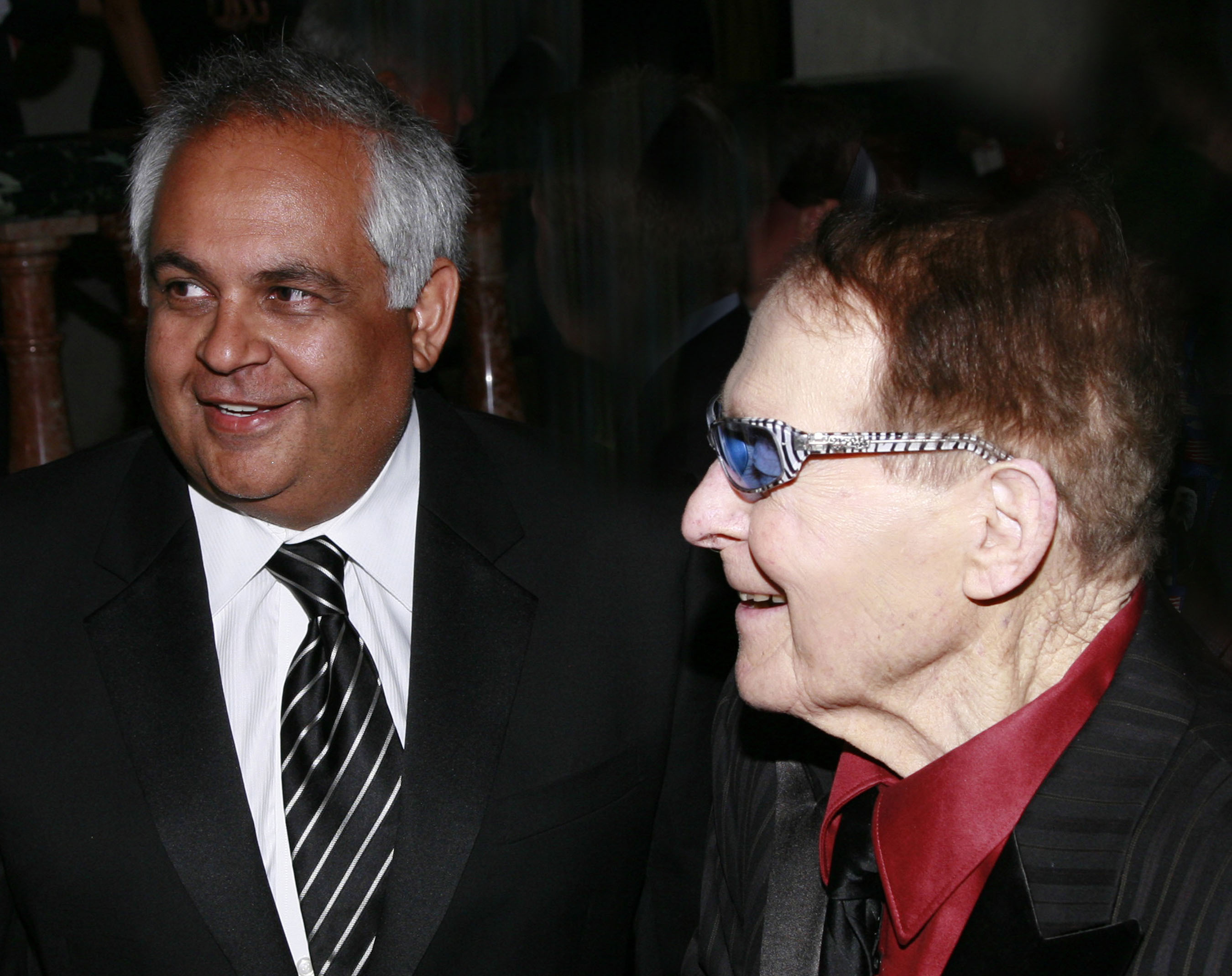
The photograph catches a different register from a product pitch: two people smiling together, with no appliance between them. It is a reminder that a commercial relationship can become a personal one over time. A familiar face may introduce a product to the audience; the people making the campaign still have to work together.
Another partnership brought chef Emeril Lagasse into the company’s appliance business through Emeril Everyday. The offering included countertop appliances, cookbooks and recipes. For a buyer, a recipe supplies something useful beyond the machine itself: a reason to take it out of the box. A kitchen appliance earns its place on the counter through repeated use, one meal at a time.
A pan acquires a surname
Copper Chef’s square pan was followed by a broader cookware collection. PowerXL, meanwhile, grew into a family of kitchen appliances. The shift from a single item to a recognizable range matters. A product has to explain its own usefulness. A brand can carry some recognition into the next encounter, whether that happens on television, online or in a store.
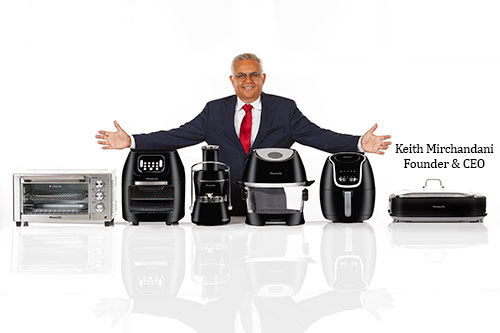
Mirchandani’s involvement also appears in design-patent records. U.S. patent D790,908, granted July 4, 2017, names him and Mo-Tsan Tsai as inventors of a pan design. Other records list cooking apparatus and additional pans. A design patent concerns an object’s ornamental appearance. It supplies a precise, limited kind of evidence about his work: his name is attached to the shape of products as well as their sale.
The pan is therefore a particularly apt object through which to read his career. It has a physical form, a commercial identity and a route to a customer. Those are separate jobs, even when the buyer experiences them as one purchase. The cheerful simplicity of an advertisement sits on top of quite a lot of coordination.
“Always listen to the consumer.”
Keith Mirchandani
The household business at scale
In 2020, Mirchandani described Tristar’s effort to expand its social media marketing alongside traditional retail and online shopping. A business associated with television was working across other screens too. The practical challenge remained recognizable: put the product in front of people, help them understand it and make a purchase possible wherever they choose to shop.
There was a family dimension to that work. His wife, Anjali, led Tristar’s direct-to-consumer division in the 2019 and 2020 profiles, with responsibility for television media buying and planning. Keith and Anjali have two children. The division of professional responsibilities is a more concrete glimpse of their working life than a generic claim about entrepreneurial devotion could provide. Someone had to decide where those demonstrations would appear.
By February 2022, the appliance and cookware operation had attracted Spectrum Brands. Its announced agreement specified $325 million in cash at closing, with up to $125 million more tied to performance conditions. The business being acquired had generated approximately $546 million in net sales in the twelve months ending December 31, 2021. Its brands included PowerXL, Copper Chef and Emeril Lagasse products.
Cash specified at closing for Tristar’s appliance and cookware business.
Spectrum’s interest extended to Tristar’s content production and direct-to-consumer capabilities. The buyer saw value in the way products were introduced and sold, alongside the brands themselves. For Mirchandani, the proposed combination offered additional reach and resources. The household object had brought with it an organization capable of explaining, advertising and distributing a succession of household objects.
A sale does not close every chapter
The acquisition was completed in February 2022. PowerXL and Copper Chef were acquired outright; the Emeril products involved licensed brand rights. That distinction matters when following the brands afterward. A founder’s history with a product and its subsequent ownership are different parts of the same commercial story.
The years after the transaction were difficult for the acquired business. In a May 2025 disclosure, Spectrum described distribution problems, retail inventory pressures, lower sales and higher returns and costs. It also reported acquisition-related litigation seeking recovery for losses and alleging fraud by sellers and others. Those allegations are the buyer’s claims, rather than findings of wrongdoing against Mirchandani. The sale belongs in his biography with that later complication intact.
A demonstration has a beginning and an ending chosen for the viewer. A business continues after the cameras stop. Products must keep selling, inventory must find buyers and relationships must survive a change of ownership. The transaction gives Mirchandani’s story a financial milestone, while the subsequent difficulties resist a tidy closing scene.
On the other side of the pitch
His industry connections continued. In September 2023, the International Housewares Association announced his reappointment to a second three-year board term, identifying him as founder and CEO of Trend Makers, LLC. He also appeared on the Housewares Charity Foundation’s 2020 board roster. In 2021, Tristar announced a Feeding America contribution equivalent to 1.5 million meals, paired with awareness messaging across its brands.
Then, on November 25, 2024, Mirchandani took a seat among the judges at American Heritage Schools’ inaugural Business Incubator Pitch Challenge finals. Five student companies presented their businesses. The setting supplies a pleasing turn in a career spent bringing products before an audience: this time, he was part of the audience deciding what to make of the pitch.
The square pan remains a useful place to leave him. It is familiar enough to require little introduction, different enough to invite a question and ordinary enough to be used again tomorrow. Mirchandani’s career has repeatedly occupied that small space between recognition and curiosity. Sometimes it contained a microwave accessory. Sometimes an appliance with a famous name. For a while, it had corners.