Kazuhiro Ikumi has a fairly practical answer to a difficult career question: what happens when the work you wanted to do turns out to be work somebody else might do better? He founded a company. MEDICOLAB began in June 2018, and the distinction matters. He was choosing another way to get useful ideas into the world. Entrepreneurship gave him a different job to do, with a different set of responsibilities and rather more accounting.
The appealing part of this story is its absence of inevitability. Look at the years individually and there are changes of location, changes of work, new colleagues and new obligations. A company eventually appears. So does a founder who describes strategy and management as strengths, and who puts an unusually unglamorous sentence near the front of his professional introduction: “Rome wasn’t built in a day.”
A departure from Takasaki
Ikumi was born in 1986 in Takasaki, Gunma Prefecture. He later moved to Nagoya for university, graduating from Nagoya University in 2010. Those two cities give his story its first coordinates: the place he came from and the place where his adult working life took shape. Nagoya would also become the base for MEDICOLAB.
There is a temptation, when writing about a founder, to turn every early detail into evidence of a future company. A birthplace becomes a destiny; an education becomes a master plan. Ikumi’s actual sequence is more interesting because it allows room for revision. University came before the company by years. His eventual decision to build a business followed experience of doing something else, and finding reasons to reconsider it.
Before the pitch, a pizza party
In 2009, Ikumi spent two months at the University of North Carolina at Chapel Hill. His account of the exchange contains the ordinary business of being new somewhere: asking fellow students questions, adjusting to a demanding schedule and learning to work within shorter deadlines. He described himself as someone who tended to work at his own pace. The timetable had other ideas.
His colleagues called him Kaz. At the end of one placement, an attending hosted a pizza party. Ikumi brought Japanese food and played the cello as his contribution to the exchange. It is a lovely, specific farewell: food, music and a student finding a way to say thank you. His account credits the friendliness of the people around him with making the demanding experience easier.
That small scene deserves its place alongside the later business milestones. A professional biography can make a person disappear beneath job titles. Here, briefly, the titles retreat. There is a young visitor, a borrowed nickname and a cello at a pizza party. The company is still nine years away.
The experiment was a change of direction
Ikumi traces his decision to start MEDICOLAB to frustration with research. After two years without results he could feel confident about, he reconsidered where he could contribute. Other researchers were doing work he admired. Helping turn that work into a business offered a role for his own energy and willingness to act.
He describes this change with a frankness that makes the familiar founder origin story more useful. The disappointment counted as experience. It helped him choose where to put his effort next. Looking back in 2022, he called the route difficult and still unfinished. His advice was to understand the present position accurately while retaining a large ambition, and to do the small, painstaking work that moving forward requires.
A revised ambition can be harder to explain than an unchanged one. The clean version of a career is easy to tell at a dinner table. This version asks the listener to take a change of mind seriously. It also gives the founder a useful obligation: once you have chosen to help ideas become businesses, the business itself has to work.
“Rome wasn’t built in a day.”Kazuhiro Ikumi’s professional profile
A company enters the room
By early 2019, Ikumi was presenting MEDICOLAB through the Aichi Accelerator 2018 programme, operated by Aichi Prefecture and 01Booster. Its demo days took place in Tokyo on February 21 and in Aichi on March 20. The listed teams included MEDICOLAB and its founder, alongside ventures working on cooking robots, employment services and manufacturing technology.
That is a different setting from an academic department. The programme put his company among businesses with other customers and other problems to solve. A presentation had to make the venture understandable in a room where expertise could not be assumed. The Tokyo venue was DMM.make AKIBA; the Aichi venue was the Nagoya Noh Theater. Company-building had acquired a public calendar, a stage and fellow founders.
It is an early marker of the work that would recur: explaining, meeting, finding partners and returning to the task with something more concrete. A demo day provides a date for the explanation. The obligations behind it continue the following morning.
- 2018Founds MEDICOLAB
- 2022Fujitsu partner award
- 2023Joins MEDISO as a supporter
- 2026Presents at Nakanoshima Qross
The work around the work
Ikumi’s own description of running MEDICOLAB ranges across business development, software development, intellectual property, accounting and finance. He also lists hiring and employment matters. His stated interests include strategy and execution, fundraising, overseas sales and marketing. The list has the texture of a founder’s desk: several professions arriving at once, each expecting attention.
He says he evaluates business-building through intellectual property, regulation and finance, with return on investment in view. That is a revealing choice of emphasis. An idea needs a route to customers, a way to pay for the work and a reason for the organisation to keep doing it. Those are separate questions even when one person is carrying them.
His current company page lists six people, including contractors. For a reader trying to picture the organisation, that is a helpful scale. Six people can bring different skills; they still have to allocate time among the tasks. The founder’s broad job description makes more sense when placed next to that number. A small company does not receive a correspondingly small supply of obligations.
A thank-you with a trophy attached
In February 2022, Fujitsu announced its accelerator Best Partner Award 2021 recipients. MEDICOLAB was among the companies receiving a Best Partner Award. The announcement distinguished that category from the MVP award and placed the recognition in the context of collaboration with Fujitsu, following the accelerator’s ninth cohort.
Ikumi’s response thanked the departments involved for their prompt, energetic support in making collaboration happen. It was a comment about people doing work together. Awards compress a long sequence into a short ceremony; his acknowledgement restored some of the sequence. There had been departments to work with and a partnership to get moving.
For this biography, the useful fact is the kind of milestone it represents. A founder who had chosen commercialisation was now receiving recognition for collaboration. A trophy is pleasant to have on a shelf. Getting two organisations to do something together is the part another founder might want to understand.
Help received, help offered
Ikumi added a part-time supporter role at MEDISO in August 2023. His supporter listing covers business planning, fundraising, management strategy and intellectual property management. These are closely related to the responsibilities he describes inside his own company. They also place him in a position to work with researchers considering how to commercialise their ideas.
On September 6, 2024, he joined a MEDISO discussion at the Nihonbashi Life Science Hub. The gathering examined an emerging pattern: ventures that had received support were beginning to support other ventures. Ikumi participated alongside a fellow company leader, MEDISO supporters and the programme’s senior project leader.
The format matters. A panel makes a founder answerable to other people’s questions, while the networking afterwards lets the conversation continue without the microphone. His place in that room adds another dimension to the company history. Experience accumulated inside one venture can become useful to someone who is still deciding how to begin. The route from needing an introduction to making one is a modest, practical form of progress.
Still taking the microphone
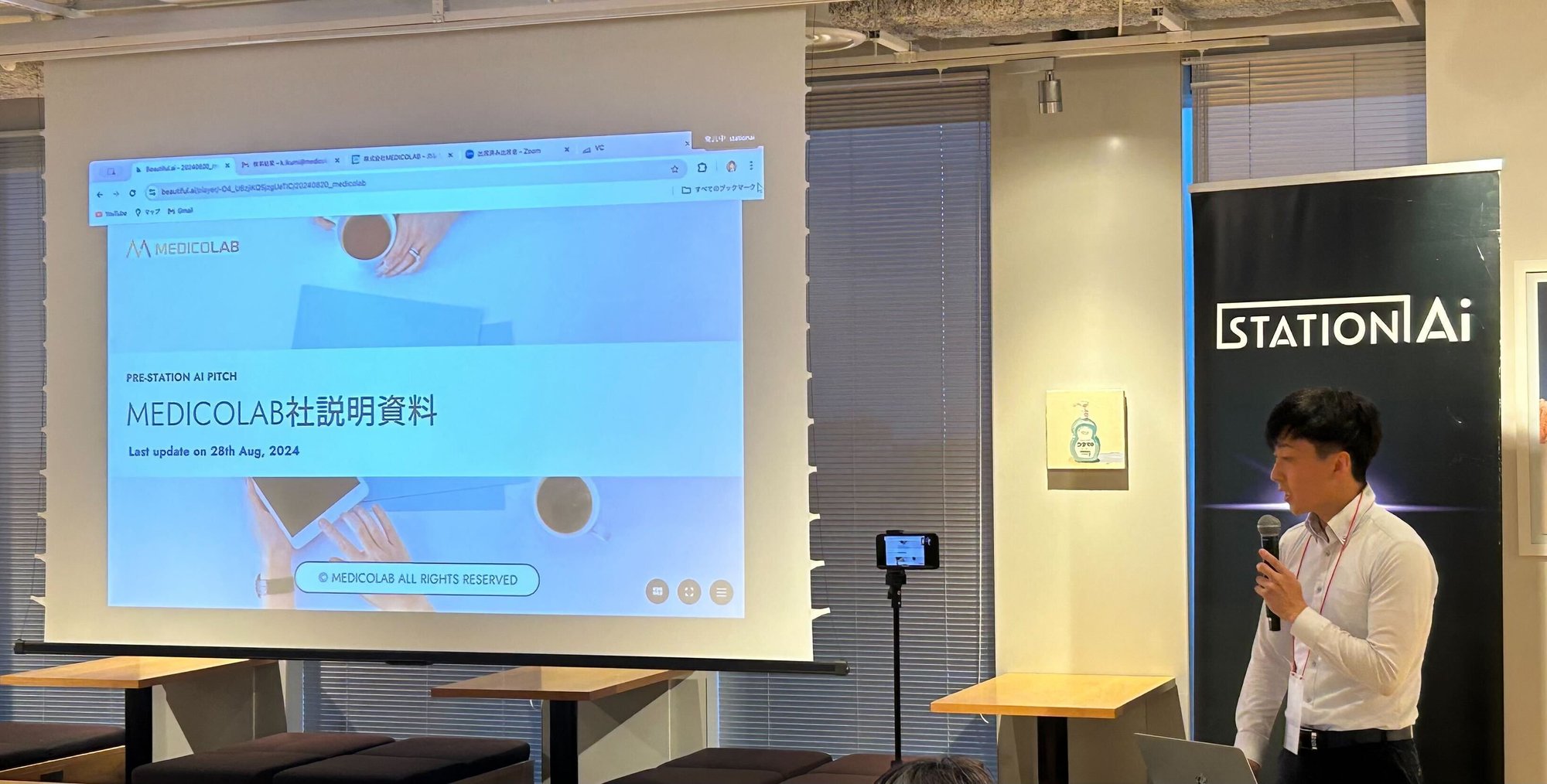
Just over a week before that panel, on August 28, 2024, Ikumi presented at PRE-STATION Ai’s Pitch & Meetup in Nagoya. Six companies took part at the WeWork Global Gate Nagoya lounge. The event combined presentations with questions and networking. The photograph catches him beside his company’s opening slide, microphone in hand.
In March 2026, he appeared among the eleven selected participants presenting results from the NQ Bio-Catalyst AI Accelerator programme at Nakanoshima Qross in Osaka. The programme offered mentoring on business models, intellectual property priorities and public funding. Participants presented their progress and received comments from the instructors. Eight years after founding MEDICOLAB, he was still taking part in a structured setting for developing the business.
Later that year came another concrete marker. AMED’s April selection announcement named his company among four projects chosen from twenty-one applications. MEDICOLAB announced the grant decision in July, with a subsidy ceiling of approximately ¥109 million. The ceiling describes support available to a company project; it says nothing about its founder’s personal wealth. The practical story remains the work the support enables, and the responsibilities that come with it.
A business still being built
By September 2026, MEDICOLAB was seeking a lead investor for a seed round. Its plans included partnerships and a potential acquisition as an eventual exit route. Those are statements of intent, with decisions and execution still ahead. They give the next chapter a business vocabulary: capital, collaborators and choices about how a company might grow.
Ikumi’s route offers a useful way to think about a working life. An early plan can be taken seriously without being kept forever. Skills learned in one setting can create obligations in another. A founder can ask for help, receive it, and later find himself in a room where somebody else is asking the questions. None of those movements needs a dramatic announcement to matter.
The photograph beside the presentation screen is an appropriate place to leave him. There is a company to explain and a room to address. The next step will need people, time and a workable plan. Ikumi has given himself a job that requires all three. His chosen proverb allows for the duration.