The decisive second in insurance is not when the advertisement ends with a relieved family, or when the policy document arrives, fat with clauses. It is later, usually on a worse day. A tree has met a roof. A car has become an accordion. Somewhere, a policyholder asks whether a promise made in calm weather will survive contact with the storm.
Kathy Tuite has a name for what should happen next: “the promise of insurance.” The phrase is grander than the plumbing behind it, which is precisely the point. Payment rails, digital wallets, core-system integrations, fraud controls, reconciliation, and vendor networks are not naturally stirring material. Yet when a claim is approved, all that invisible machinery must produce something acutely human: money, delivered quickly, with enough communication to prevent uncertainty from becoming panic.
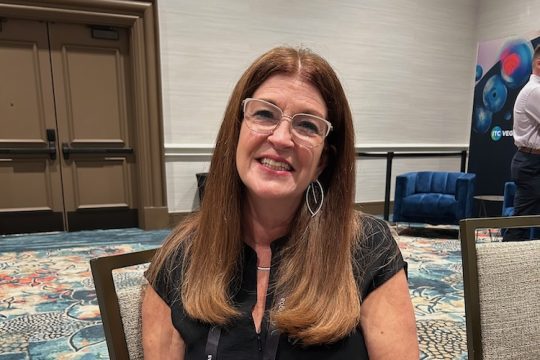
Tuite is the Chief Marketing Officer of One Inc, a company that handles incoming premiums and outgoing claims for insurance carriers. She oversees digital marketing, demand generation, product positioning, and strategic development. This is the public description of the job, accurate and bloodless. A better description is that she translates machinery into consequence.
“When you have a claim, it’s getting paid fast, efficiently, with lots of communication.”Kathy Tuite on the promise of insurance, 2025
A technical beginning
Tuite did not begin with the conventional marketer’s kit. She completed a Bachelor of Science in Computer Science at Marist College in 1988. The degree is a useful clue to the career that followed. She moved through commercial banking at JPMorgan Chase and held executive roles at Hudson Valley Bank, My Choice Medical Holdings, and Vertrue. Later came a succession of chief marketing posts across businesses where money moves under rules: TransFirst, TSYS Merchant Solutions, Rectangle Health, and now One Inc.
There is an elegant consistency to the route. Merchant payments ask whether a sale can clear. Healthcare payments ask whether a practice can collect without making an already complicated encounter worse. Insurance payments ask whether funds can reach a consumer or vendor at precisely the point they are needed. The industries wear different suits, but the underlying work keeps returning to trust, timing, and technical systems that must cooperate without demanding applause.
- Computer science degree from Marist College.
- Commercial banking and executive roles in financial services and technology.
- CMO roles at TransFirst and TSYS Merchant Solutions after TSYS acquired TransFirst.
- Led the public story of Rectangle Health’s new name and direction.
- Joined One Inc to lead marketing through its next growth stage.
- Framed digital claims payment as the practical promise of insurance.
At TransFirst, Tuite was CMO before the payment processor was acquired by TSYS in 2016; she continued in the role at TSYS Merchant Solutions. By 2018 she was CMO at Retriever Medical Dental Payments, a name so descriptive it seemed to arrive wearing an invoice. The company had outgrown it. Under the new identity Rectangle Health, the business signaled a broader role in healthcare payments. Tuite called the rebrand a “strategic pivot” and spoke of expanding resources and bridging gaps across the industry.
Rebrands are often treated as corporate millinery: a new hat, the same head. This one offers a sharper view of Tuite’s operating interest. A name had to catch up with a changing product and market. Positioning was not decoration applied after strategy. It was how strategy became legible.
Growth, translated
One Inc announced Tuite’s appointment on December 1, 2020, alongside three other additions to its senior team. The company then supported more than 160 insurance customers. Tuite arrived with a mandate covering the whole marketing circuit, from demand to positioning, with direct responsibility for strategic development and revenue growth. Her own note was brief: she was excited by the team and wanted to help One Inc reach “our next level of growth.”
The level moved. In 2024, One Inc said it served more than 240 insurance customers, processed $70 billion in payments annually, and connected to more than 700,000 vendors. It reported revenue growth above 65 percent year over year. The announcement came as Nordic Capital joined Great Hill Partners as an investor, with management retaining a significant continuing investment.
By October 2025, Tuite described a business growing 40 to 50 percent each year, consistently, across the previous five years. The vendor network had passed one million. One Inc was working with seven or eight of the ten largest carriers and bringing two more live. Chief Executive Ian Drysdale said the platform was moving about $350 million each day. These figures belong to the company, not to any lone executive, but they describe the scale of the story Tuite’s team had to make coherent.
Scale complicates language. A product can pay an individual policyholder, a body shop, a mortgage company, a lawyer, or a medical provider. It can take a premium from the same consumer to whom it later sends a claim. It must connect to old insurance systems and new digital channels, satisfy regulators, recognize fraud, and explain itself to carriers whose reputations travel with every transaction. Marketing such a network means resisting both alphabet soup and fairy tales.
The wallet remembers
Tuite’s clearest product explanation concerns One Inc’s unified digital wallet. A customer pays premiums often and makes claims rarely. When a claim does occur, the same wallet used for premiums can receive the disbursement. The feature sounds tidy in a diagram. In a catastrophe, it becomes urgent. Funds sent to a phone through a digital wallet can be used immediately for a hotel, transportation, or food.
This is where a computer scientist’s instinct and a marketer’s discipline make useful companions. The system must work across integrations; the story must end with what the person can do next. Tuite does not describe a wallet as an exciting container. She describes dinner and a bed for the night. Technology earns its adjective only after it earns its keep.
The same practicality appears in her comments on artificial intelligence. Insurers are cautious, she has said, but if AI can answer customer questions faster and resolve claims more efficiently, it is something they should want One Inc to use. This is neither a manifesto nor a shrug. It is a test: does the tool reduce the distance between a problem and its resolution?
“If we can respond to customer inquiries faster and resolve claims more efficiently because of AI, then it should be something they want us to leverage.”Kathy Tuite, 2025
Expansion by connection
In 2025, One Inc prepared to bring ClaimsPay into the Canadian property-and-casualty market through a pre-built Guidewire integration. Tuite called Canada “a natural extension.” The phrasing suits her career too. Commercial banking extended into merchant payments; merchant payments into healthcare; healthcare into insurance. At each stage the apparent product was a transaction, while the real concern was a relationship under pressure.
Other partnerships widened the map. A relationship with Copart targeted lienholder payments that could otherwise take five to eight weeks. Core-system integrations connected the network to the software insurers already used. The result was not a dazzling object but an increasingly dense set of paths. Networks become valuable by accumulating connections. Marketing becomes valuable by explaining why those connections spare someone time, expense, or bewilderment.
Tuite’s public professional persona supplies a few quieter notes. She has volunteered with Open Door Family Medical Centers since 2014. She has celebrated women colleagues in fintech and insurance, writing that she was honored to be in their company. In 2025, she recommended an article about kindness at work, highlighting the idea that kindness toward others begins with kindness toward oneself. These are modest signals, and worth keeping modest. Still, they rhyme with her customer language: systems are judged by the quality of the experience they create for people.
There are careers built around making new things visible, and careers built around making complicated things feel simple. Tuite’s belongs to the latter. The work is less cinematic. It demands the patience to understand a technical stack, the precision to position a product, and the good sense to remember that nobody files an insurance claim because they hoped to admire the payment architecture.
They want the roof repaired. They want the car replaced. They want an answer, followed by money, followed by the freedom to think about something else. The payment may be digital, instant, compliant, embedded, or connected to a million vendors. Its highest achievement is more ordinary. It arrives. The promise survives the storm.