A customer puts down a phone, opens a laptop, and asks a company to remember the conversation they were having a few hours ago. It is an unremarkable request. The customer has not become a different person in the interval. Yet somewhere between the two screens, the company may have misplaced everything it knew. The machinery is sophisticated; its manners could use work.
Kathy Juve was writing about that problem in 2015. Her argument for customer-service chat included a practical expectation: a conversation begun on a mobile device should continue on a laptop without making the customer repeat information. She also had little patience for the chat prompt that kept appearing while someone browsed. She compared it to a department-store assistant checking in every time a shopper picked something up.
The example is funny because it is small. Nobody needs a conference presentation to understand an assistant who cannot leave you alone. But the proposed fix asks a business to do something substantial: recognize context, choose its moment, and carry information from one interaction to the next. Juve’s career keeps returning to that work. Her current chapter, as Group CEO & Executive Operating Partner at Morse., places it inside a group of operating businesses.
A marketing career with an operating question
Juve studied business and marketing at Michigan State University. Her career has included Creditek, Convergys, [24]7.ai and Concentrix, with responsibilities extending across sales, product strategy, customer success, marketing and digital operations. The job titles describe different parts of a business. Together, they suggest why a customer-service problem would interest someone trained to think about a company’s promises as well as its delivery.
At [24]7, she served as chief marketing officer during a period when service channels were being drawn closer together. In 2012, Microsoft and [24]7 announced a customer-service technology partnership involving speech and natural-language capabilities. Microsoft also took an equity stake. The company confirmed that it had acquired Voxify, bringing more speech self-service technology into the business.
These were company transactions, rather than personal trophies. Juve’s role was to explain what the combined capabilities could do. By 2013, [24]7 was describing Visual Speech, a service offering that connected speech, mobile and web capabilities with predictive analytics. The customer might arrive through a telephone, a browser or a chat session. The commercial proposition depended on making those routes work together.
“The connected consumer demands a connected experience.”
Kathy Juve, 2013
Her own writing that year started with familiar reasons people contact businesses: a first bill, a move, a change in service. Those reasons give a company clues about what someone will need next. She argued for using customer information to anticipate the inquiry and for making service available through the channel convenient to the customer. Data had a job to do beyond accumulating in a database.
The customer has already changed channels
By January 2020, Juve was talking about messaging and self-service at Concentrix. She described a customer who tries to resolve an issue independently before reaching a contact center. Under that model, the person who eventually needs an advisor may arrive with a more complicated question. Simple requests have been handled elsewhere; the remaining conversation requires greater understanding.
She also pointed to sentiment as an increasingly significant measure. An answer can be technically correct while the experience of obtaining it is thoroughly irritating. Anyone who has navigated three menus to receive information already printed on a website can appreciate the distinction. A service operation needs to understand the whole journey, including what happened before the customer reached a person.
That broad view had become part of her operating responsibilities. In 2016, Convergys appointed her senior vice president of global marketing and product development. Her remit included how the company invested in and positioned analytics and digital capabilities. She later led digital operations there, including analytics, voice-of-the-customer and omnichannel technology businesses.
Team members in the digital operations organization she led, with a P&L exceeding $100 million.
The scale matters because continuity is easy to promise in a product demonstration. Operating it across a substantial organization requires people, budgets, processes and accountability. In Juve’s case, digital operations put the tools and the business responsibilities together. A screen could look elegant while the organization behind it still needed considerable attention.
Concentrix acquired Convergys in 2018, and Juve joined Concentrix. Her leadership during that acquisition was part of the work recognized when she received a Silver Stevie in the Female Executive of the Year category in 2019. The award marked an operating chapter: bringing businesses together while customer relationships and service commitments continued.
Feedback needs somewhere to go
At Concentrix, Juve’s responsibilities included customer-experience technology, analytics and insights. The scope brought together consulting, technology and voice-of-the-customer work. Each addresses a different question. What is happening? Why is it happening? What should the business change? A useful operation needs answers to all three.
In 2019, Concentrix was included as a Representative Vendor in Gartner’s Market Guide for Voice-of-the-Customer Applications. Juve described the value of giving employees customer insights they could act on. A separate Forrester evaluation named the company’s customer-feedback management platform a Strong Performer, with attention to speech, text and employee-related capabilities.
Analyst classifications describe a product or service at a particular moment. They also reveal the kind of work around which Juve’s teams were organized: interpreting customer interactions, making the information usable, and connecting it to decisions. The crucial handoff comes after a dashboard has made a problem visible.
Concentrix’s VOC Essentials platform made that connection explicit. Its announced capabilities included identifying reasons for contact, tracking recurring problems and helping teams follow up on customer feedback. Juve’s accompanying comments emphasized understanding customers without a long, complicated implementation. A system that learns why people keep calling has a chance to remove the reason for the next call.
Help for the person doing the helping
Juve’s 2021 writing brought the advisor into the technology discussion. She described personalized AI coaching during customer calls, dashboards that connected agents and team leaders, and easier access to supervisors. The employee answering the question needed useful information and support while the conversation was happening.
She also argued that global operations required room for local leadership. A process suitable for one location could not simply be imposed everywhere. Her discussion of flexible staffing similarly placed coaching, supervision and security inside the design of the operation. Those are practical conditions for making a service model work.
There is a human detail in this line of thought. A customer-service employee is expected to sound informed, attentive and composed even when the systems make the task awkward. Giving that person another tool is helpful only if it makes the work easier at the right moment. The quality of an interaction depends partly on what the organization has placed within reach.
That concern also appeared in her later discussions of AI. A recorded session with Stephanie Kozak explored agentic systems embedded in workflows and people working alongside them. The subject was enterprise operations, but the test remained close to the desk: can the technology improve what someone is trying to accomplish?
The platform needs attention after the party
Juve has been direct about the disappointment that can follow an automation investment. A business selects a platform, expects improvements, and fails to keep refining the system. The technology remains in place while its usefulness drifts. An implementation can be complete on a project plan and unfinished in a customer’s experience.
“Somebody picks a technology platform and then it dies.”
Kathy Juve, on service automation
Her examples included travel requests that require several systems to cooperate. Changing a flight may also mean altering a hotel booking, updating a customer record or adjusting loyalty information. The conversation is the visible part. Completing the task requires access to the underlying business systems.
That is a demanding definition of useful automation. The customer has asked for a change in the world, rather than a well-worded explanation of the change. Measuring, improving and maintaining the system therefore belongs to the operating model. The celebratory launch photograph cannot do the maintenance.
A ribbon in Marrakesh, a new chapter at Morse.

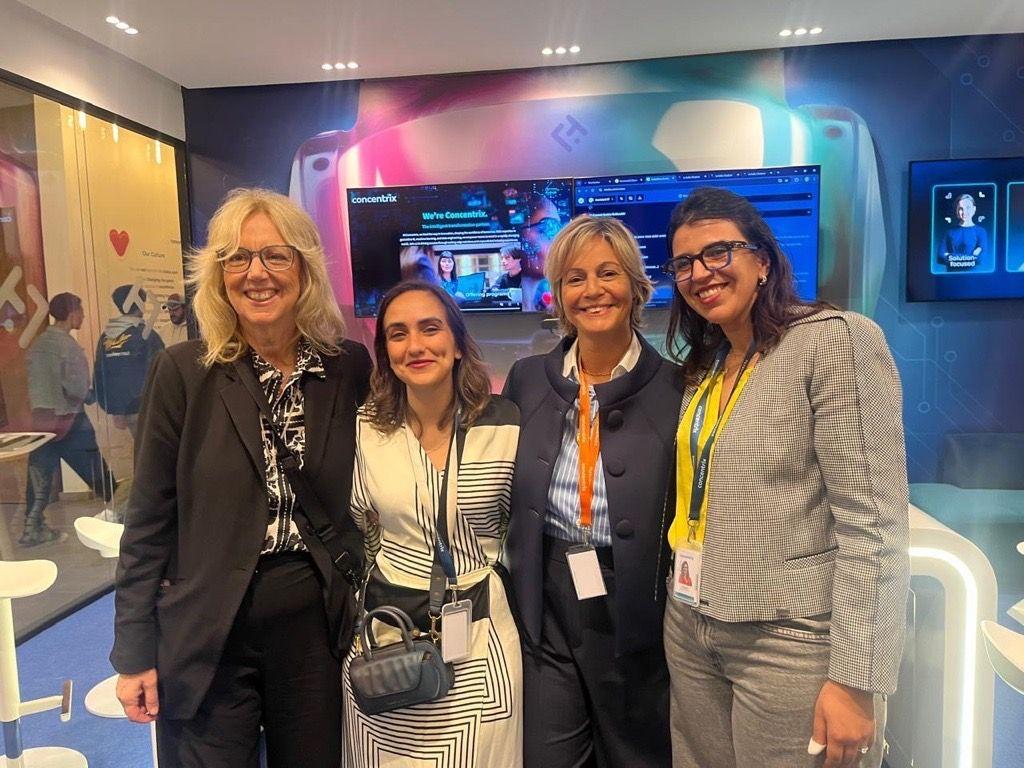
In April 2025, Juve attended the opening of Concentrix’s second Tek Lab in Morocco. She shared photographs of the ribbon cutting and of colleagues inside the space, describing a collaborative hub open to students, startups and people developing technology. During GITEX Africa in Marrakesh, she also discussed how leaders could prepare teams for AI and reconsider the measures used to run their organizations.
The photographs offer a welcome change of scale. Here is an executive whose work involves large organizations, standing with colleagues around a ribbon and a roomful of screens. The event has the familiar rituals of a business opening. The stated ambition concerns what people will be able to build there afterward.
Her current organization, Morse., describes itself as an enterprise intelligence company built around operating businesses. Its model connects financial services, benefits administration and customer-experience automation. The company argues that disconnected vendors and separate pools of data obstruct improvement. Its portfolio is intended to work together rather than merely share ownership.
That is the organizational setting for Juve’s latest role. The connection to her earlier work is a recurring concern about fragmentation: information available in one part of a business becomes less useful when another part cannot act on it. At Morse, the question extends across businesses as well as customer-service channels.
For the customer, the desired result remains wonderfully mundane. Finish the errand. Continue the conversation. Recognize what has already happened. Juve’s career gives those small requests their proper weight. Behind each one sits the harder work of making an organization remember.