Antonio Neri had a useful preparation for running a technology company: he had been the person customers called when the technology caused trouble. In 1995, he was working in an HP support operation in Amsterdam. By February 2018, he was president and chief executive of Hewlett Packard Enterprise. The distance between those two jobs is usually measured in promotions. It can also be measured in the number of times a person has had to understand something well enough to explain it.
The call center gave him more than a career. He met Caroline there, and they later married. When he began his first day as CEO, he recalled the place where their lives had intersected, then the moves that followed: Boise, Houston, Palo Alto. His account of reaching the top began with the people he had encountered on the way. The title arrived late in a much longer story.
It is an unusually patient route through an industry fond of abrupt departures. Neri stayed, though the business around him changed repeatedly. His apprenticeship kept expanding: different countries, different products, different kinds of responsibility. The headset was an early installment.
A school with ships attached
Born in Bahía Blanca, Argentina, in 1967, Neri grew up in a family with Sicilian roots. His parents had emigrated from Italy, and his upbringing included time in both countries. At school age, his interest in electronics led him to a technical education connected to a naval base. As a civilian apprentice, he worked on radar and sonar equipment. Learning a principle and making a device function belonged to the same working day.
There is something pleasingly concrete about this beginning. Radar has a job to do. A customer support desk has a job to do. In both settings, technical knowledge eventually meets a stubborn external test: does the thing work? A polished explanation can carry a meeting. It has less influence over a defective circuit.
His education also included art. Neri studied drawing and painting for nine years and has taught both. The pairing does not require a theory about engineers secretly longing to escape into watercolors. He has described himself as analytical and interested in design. When asked what he might choose if beginning again, he offered architecture: a profession that would let him combine those interests.
“I would be an architect.”
Antonio Neri, reflecting on starting again
He has carried that interest into corporate life. Neri has described his involvement in the design of HPE workplaces in Houston and California, including the experience of the people using them. A CEO choosing to concern himself with the building is a modestly entertaining detail. The architect, it seems, found a way onto the payroll.
The business, learned from several sides
After Amsterdam came services work in Boise, then Houston. His responsibilities widened into technology services, servers, networking, and the Enterprise Group. These are substantial differences in perspective. Supporting a computer, selling infrastructure, and managing a business built around that infrastructure expose different parts of the same customer relationship.
In 2015, Hewlett-Packard separated into HP Inc. and Hewlett Packard Enterprise. Neri led the enterprise business through that transition, became HPE’s president in 2017, and succeeded Meg Whitman as CEO on February 1, 2018. He described Whitman as a friend and mentor. He had inherited an enterprise company with a famous engineering ancestry and a market that would give ancestry very little credit on its own.
- 1995Amsterdam
Customer support - 2011HP
Technology services - 2018HPE
President & CEO - 2025Juniper
Acquisition closes
The temptation with a career like this is to turn persistence into a universal instruction. Stay long enough and a large office will become available. Neri’s record supports a narrower, more interesting observation: staying can include considerable movement. He changed geography, products, and operating problems while remaining within the same corporate family. Institutional knowledge accumulated alongside new assignments.
The innovation hiding in the bill
One of his consequential decisions concerned the way customers would pay. In June 2019, HPE announced a plan to make its entire portfolio available through subscription, pay-per-use, and service offerings by 2022. Customers would retain traditional purchasing options. GreenLake was central to the effort.
The distinction matters. An enterprise can want the flexibility associated with cloud computing while needing equipment and data to remain in particular locations. It can also prefer to pay as resources are used. HPE’s proposition was to bring more of that experience to the customer’s existing world, with a choice of financial and operational arrangements.
This widened the definition of innovation. A faster machine might be useful; a different way to acquire and operate it might also remove a real obstacle. Purchasing departments seldom receive the romantic treatment given to inventors. Yet a product that cannot fit into a budget has encountered a technicality with remarkably strong veto power.
The practical stakes were familiar to someone who had spent years in services. Customers have to live with the product after the sales conversation ends. The work includes maintenance, capacity, staffing, and the awkward business of predicting demand. GreenLake put those questions closer to the center of HPE’s offer.
A very large number, built patiently
Some achievements are easier to picture on a graph than in a contract. In May 2022, Frontier, the HPE Cray EX supercomputer at Oak Ridge National Laboratory, recorded about 1.1 exaflops on the benchmark used for the TOP500 ranking. It became the first system to cross the exascale threshold on that list. One exaflop represents a quintillion floating-point operations per second.
About 1.1 quintillion double-precision calculations per second.
The number belongs to a collaboration involving Oak Ridge, HPE, AMD, and many engineers and researchers. Teams worked for months to prepare the machine and measure its performance. The result arrived during Neri’s tenure, but the work resists the convenient portrait of a lone executive producing a breakthrough by having a sufficiently forceful vision.
For his story, the connection is more grounded. Practical engineering remained visible inside the company he was changing. The teenager working on naval electronics and the executive talking about supercomputing occupied very different worlds. Both worlds demanded that complex systems function outside the description of how they were supposed to function.
The network gets its turn on stage
At HPE Discover in 2024, Neri appeared with NVIDIA founder and CEO Jensen Huang at Sphere in Las Vegas. They announced an expanded partnership, including HPE Private Cloud AI. The setting was theatrical; the proposition addressed a fairly workaday enterprise problem. Companies interested in AI also needed computing, storage, networking, software, and a manageable way to put the pieces together.
Neri’s ambition was to make HPE a comprehensive AI partner for enterprises. That requires relationships as well as products. The NVIDIA collaboration offered an example of his approach: combine HPE’s infrastructure and operating experience with a partner’s technology, then take the package to customers through a wider commercial ecosystem.
Networking became still more central when HPE completed its acquisition of Juniper Networks on July 2, 2025. Neri’s argument was that AI depends on moving and protecting data across distributed systems. The connections between machines become part of the computing proposition. The network has escaped its supporting role and would like a speaking part.
The acquisition also met resistance. The U.S. Justice Department sued to block the deal; a settlement opened a route to completion, with requirements including divestiture of HPE’s Instant On business. HPE argued that the combination would increase customer choice. The episode placed Neri’s strategic argument in a public contest over competition.
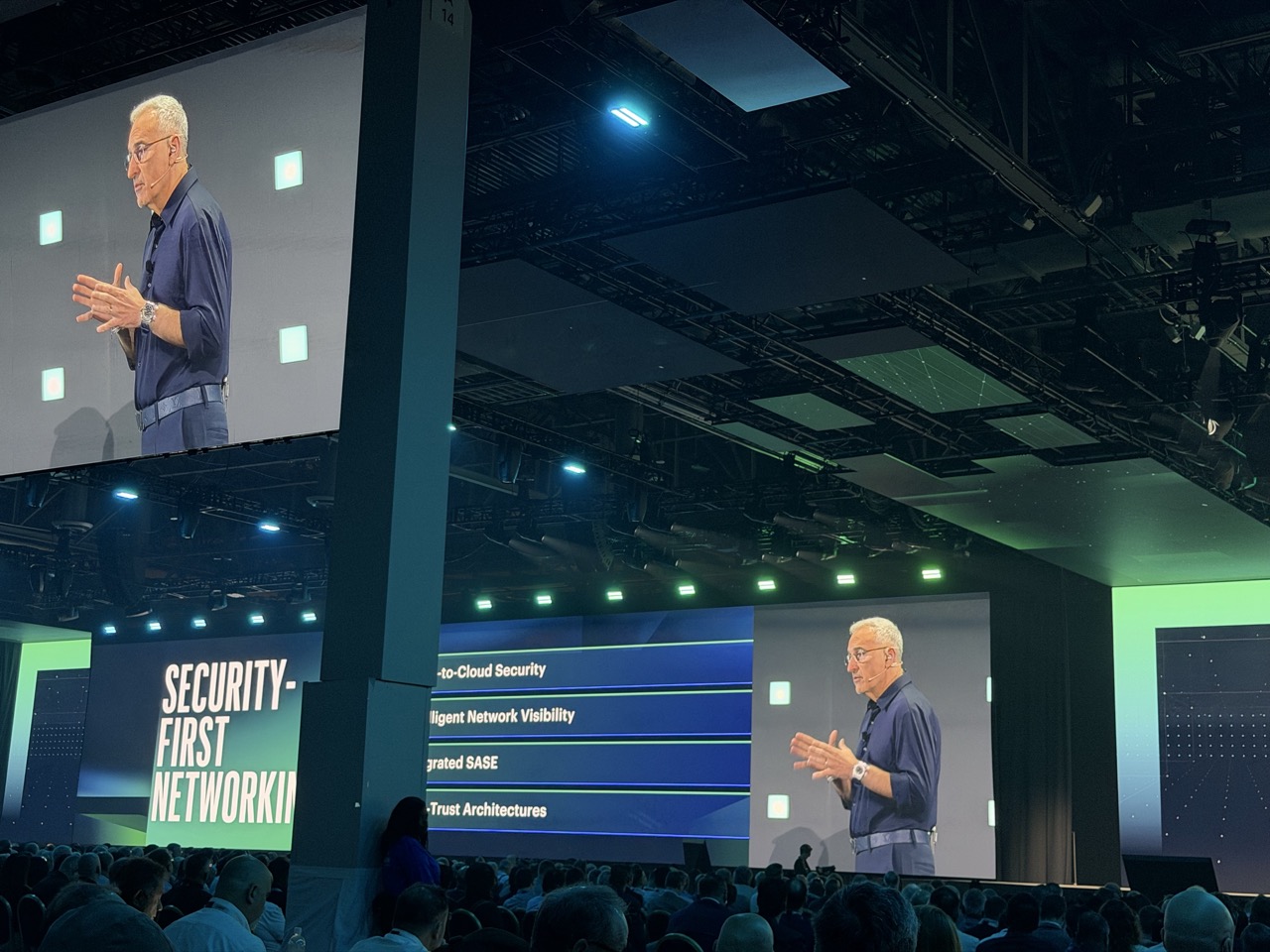
By June 2026, his Discover keynote was putting networking prominently into the AI discussion. The purchase had become an operating assignment. The meaningful test for customers would be the behavior of the combined products, the management experience, and the support behind them.
Before choosing the tool
Neri’s public writing adds a useful complication to the AI sales pitch. In January 2025, he argued that organizations should first decide whether AI is the appropriate tool for a task. He called for attention to energy, data efficiency, privacy, and the whole operating life of a system. Selling infrastructure does not remove the need to ask what the infrastructure is for.
A year later, he made a related argument about digital sovereignty. AI, in his account, would increasingly operate across central facilities, regional systems, and locations close to the data itself. Businesses and governments needed ways to retain control while participating in a connected technical ecosystem. This was also an extension of the hybrid approach he had been promoting at HPE.
Commercial results provide another measure. On September 2, 2026, HPE reported fiscal third-quarter revenue of $12.2 billion, up 34 percent from a year earlier. Neri described AI as a source of growth extending over several years. Those figures belong to a specific reporting period. The longer task remains making the strategy useful enough that customers return.
There is still a game on Sunday
For all the corporate scale, there are ordinary enthusiasms in the picture. Neri speaks Spanish, Italian, English, and Dutch. In a 2023 conversation, he said he played league football every Sunday. He also recalled meeting Diego Maradona several times and playing a game with him. That is a fairly effective answer to the question of whether the hobby ever produced a memorable afternoon.
His account of leadership leaves room for the people who follow him. In 2019, he said, “My legacy is going to be the culture I leave behind”. It is a statement whose eventual proof sits in other people’s careers: who gets a chance, who learns the business, who is trusted with the next difficult assignment.
Somewhere in that idea is the Amsterdam support desk. A company hired a technically curious person who would go on to learn much more of its work. Decades later, he was responsible for creating opportunities inside it. The apprentice had acquired a new assignment: make room for the next one.