An engineer accepts an offer. Somewhere in the company, a spreadsheet turns green. It is a pleasing moment, and also a slightly misleading one. The engineer still needs access, context, a place in the team, and a useful piece of work. A vacancy has closed. Whether the project has moved is another question.
That gap is a useful way into Applicantz. Founded in 2001, the Houston business has long been described in terms of finding technical talent. Its current pitch puts engineering delivery in the foreground. The distinction matters to anyone who has ever watched a well-staffed project remain mysteriously behind schedule.
- Applicantz supplies technical talent and engineering services to enterprise customers.
- Its client list includes Meta, Lam Research, Autodesk, and Halliburton.
- Its current offer spans AI, software, cloud, semiconductor engineering, testing, and managed programs.
- The useful buying question: what must this team deliver, and who stays responsible?
The résumé is the opening act
Older public descriptions of Applicantz emphasize searching job boards and presenting candidates ready for interview. One older description makes the proposition especially plain: keep suitable candidates available so that a resignation need not leave a team scrambling. The problem being sold is continuity. The résumé is the means.
Read the company’s technical-recruiter vacancy and that apparently simple task becomes rather more demanding. The recruiter must analyze a client’s requirements, break them into coherent components, search, qualify candidates, answer questions, and present talent to hiring managers. An engineering degree and experience with enterprise staffing systems appear among the requirements.
There is a lesson here for an employer tempted to begin with a search box. A title is a poor specification. “Engineer” conceals the work, the environment, and the tradeoffs. Finding someone gets easier when the team can explain what success looks like. Applicantz’s recruiter description treats that explanation as part of the job, rather than paperwork someone else should have completed.

A supplier award with a practical point
Consider Autodesk. In August 2024, Applicantz announced that the software company had named it Supplier of the Year across the USA, Canada, and Asia Pacific. Applicantz thanked both Autodesk and Talent Solutions TAPFIN program teams. This is the company’s own account of the recognition, and the geography is the interesting detail.
An enterprise relationship can involve several regions and several sets of people responsible for approving, receiving, and managing talent. A candidate may be technically suitable while the surrounding engagement remains difficult to run. The mention of program teams directs attention toward that surrounding work: the people and processes through which a supplier becomes usable by a large customer.
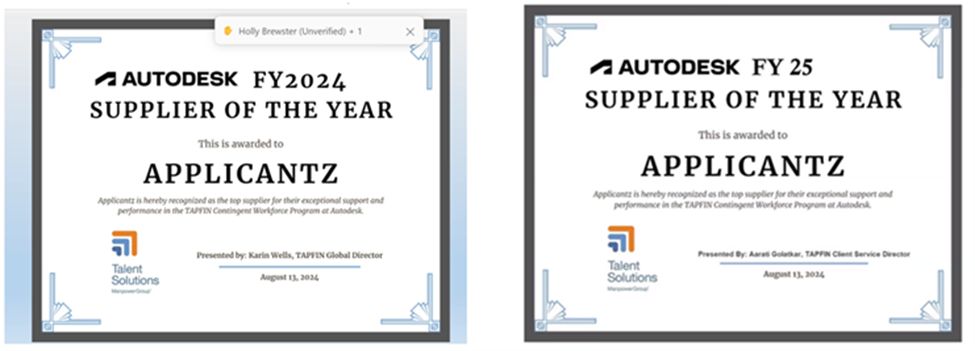
For a buyer, the award is a reason to ask about delivery in detail. How does a requirement travel from a manager to a recruiter? Who resolves a mismatch? Who handles an engagement that crosses borders? Recognition is useful when it opens a conversation about the machinery underneath it.
AI still has to report for work
Applicantz’s current website says, “We deliver the engineering that builds AI.” It is an economical sentence. AI is the customer’s undertaking; engineering is the company’s contribution. The service list includes data pipelines, evaluation systems, and model-training operations, alongside application development, cloud infrastructure, manufacturing engineering, and quality testing.
The range gives a buyer several possible entry points. A team with a defined technical vacancy can seek talent. A team trying to execute a larger piece of work can discuss a managed engineering program. The practical difference is the assignment of responsibility. A person joins an existing operation; a managed engagement needs an agreed result and an owner for delivery.
“We measure outcomes, not activity.”
Applicantz’s stated delivery principle
That principle deserves to be taken literally. Counting submissions is easy. Deciding whether the people supplied are helping a program succeed requires the buyer and provider to agree on the work. For an AI project, that might mean an evaluation system that runs reliably. For another engagement, it might mean an application release or a functioning engineering team. These are examples of acceptance criteria, rather than reported Applicantz project results.
- 01UnderstandThe requirement and operating context
- 02BuildDraw on specialist relationships
- 03DeliverMobilize engineering capability
- 04StayManage the engagement and accountability
The company’s stated process, condensed. Each handoff gives a buyer something concrete to examine.
The map is really a management question
Applicantz lists delivery networks in ten countries. Its published footprint stretches from North America to India and Southeast Asia, with Saudi Arabia, Brazil, Australia, and Sri Lanka also on the map. The company also describes an engagement spanning seven countries for an unnamed technology customer.
A geographic footprint offers options. It also asks more of the engagement. The buyer needs to know which work happens where, which people must overlap, and who can make a decision when a handoff stalls. A long country list has little practical value until it becomes a workable schedule and a clear chain of responsibility.
This helps explain the appeal of a managed program. Someone must connect the pieces. A buyer should distinguish access to talent in several markets from responsibility for coordinating that talent. Applicantz’s current proposition explicitly includes continuing management. That promise belongs in the scope of work, where it can be tested.
The competition has people, too
Applicantz sits in the overlap between technical staffing and engineering services. TEKsystems offers talent solutions and technology services. Randstad Digital offers talent, delivery centers, and managed programs. An internal recruiting team is another alternative. The choice depends on how much execution work the customer wants to keep inside the business.
Applicantz’s claimed distinction is accumulated domain knowledge, specialist relationships, and accountability across an engagement. Those are plausible things to buy, but they call for evidence suited to the requirement. A semiconductor engineering reference may tell a buyer more than a polished general presentation. A recent example with a similar delivery structure may tell more than a distant, famous logo.
The company’s named customers make this a business aimed at enterprise requirements. Its pitch makes particular sense for a technical team that already knows what needs doing and needs help putting capacity behind it. The quality of that fit will depend on the actual scope, rather than the elegance of the sales language.
Buy the handoffs along with the hours
An engineering engagement is a scope-and-contract purchase. The useful comparison starts with what is included: sourcing, qualification, onboarding support, management, and an agreed deliverable. A cheaper hourly proposal can become less attractive if the buyer must supply considerably more coordination. That is a buying consideration, not a claim about Applicantz’s rates.
The same logic sets the limits. If a customer cannot define the work or make timely decisions, adding external engineers can add another queue. If the aim is simply to organize applications for a few vacancies, an engineering delivery engagement is a different purchase. Start with the bottleneck, then choose the service.
There is something a reader can copy without signing a contract. Write the requirement as a result. Name the person who accepts it. Record the dependencies before recruiting begins. Measure the time until useful output, as well as the time until an offer. Ask a delivery partner to explain what happens when the first match is wrong.
The green cell in the hiring spreadsheet is still worth celebrating. It just needs a companion: a piece of work completed, a team functioning, a manager able to move the program forward. Applicantz’s current proposition invites customers to buy toward that second milestone. It is the one the project was waiting for.