Karun Naga grew up near Lansing, where an engineering degree seemed to come with a company car. Michigan's auto industry was not merely nearby. It was the atmosphere. His father, Manohar, was an engineer and entrepreneur who designed and supplied parts to automakers, and Michigan State trained young mechanical engineers with that industrial landscape in view. Naga earned his degree in 1998. The path ahead was respectable, legible and, to him, incomplete.
So he did something guaranteed to enliven a family conversation in Spartan country: he went to the University of Michigan for law school. He later called it "that other school in Ann Arbor," preserving the rivalry even while crediting the experience with stretching him socially, politically and academically. Patent law caught his attention because it joined the two halves of his curiosity. An invention could be understood as a machine, then defended as an idea, then organized into a venture.
That sequence became the grammar of his career. He started in legal practice, worked inside Mentor Corporation as its first in-house intellectual-property counsel, and spent his days close to people trying to make new things real. The proximity produced a blunt realization. "I soon realized, I don't want to be your lawyer," he recalled. "I want to be you." It is a career-change sentence with no decorative upholstery.
A career built by crossing disciplines
The lawyer joins the experiment
Ardian was where the crossing became permanent. The Foundry portfolio company was developing a catheter-based approach called renal denervation. Naga joined its executive management team and led intellectual property and legal affairs. His remit placed him at the hinge between science and company strategy: patents had to protect the work, but the work still had to survive clinical evidence, financing, partnerships and the habits of a cautious market.
Medtronic agreed to acquire Ardian in 2010 for $800 million upfront, with additional milestone payments possible. Naga moved into Medtronic as a director of corporate development. The transition gave him a rare double view of a transaction, first from the startup building the asset and then from the strategic company absorbing it. At a later industry panel, he described Ardian's commitment to science and thought leadership as a point of pride. The company did not simply guard an idea. It worked to create a field around it.
His next chapters kept widening the operating aperture. At Altura Medical he worked on strategy and corporate affairs. He returned to The Foundry as an entrepreneur in residence. He became founding CEO of Allay Therapeutics, then a Foundry partner in 2018. The résumé reads like a tour of functions that usually sit in separate meetings: intellectual property, business development, venture formation, financing and executive leadership.
“You have to be willing to stub your toe a few times along the way and learn from those mistakes. Those painful lessons really inform your judgment later on.”Karun Naga
This is the quiet advantage of his unusual route. Engineering asks whether something can work. Law asks what can be protected and defended. Business asks who will fund it, adopt it and keep it alive. A clinical-stage executive has to hold all three questions at once, usually before breakfast and occasionally during what Naga has called a round of "fire drills." Credentials alone do not create that range. Repeated responsibility does.
The discipline of subtraction
Naga's most reusable advice has little to do with patents or devices. He has a name for the founder's appetite to chase every promising direction: "self-destructive ambition." He admits to having spread himself across too many projects and commitments. The phrase is funny because it is accurate. Ambition is socially rewarded right up to the moment it consumes the attention required to accomplish anything.
His corrective is a two-part filter. He says he is most effective and happiest when he concentrates on the ability to make a real impact and the quality of the people working beside him. Time, money and manpower are always limited. The operator's work is therefore editorial. Select the problem. Select the team. Accept that a worthwhile no may protect a more important yes.
Impact × people. Naga's public test for where to spend finite energy is strikingly compact: can the work matter, and are these the people with whom you want to do it?
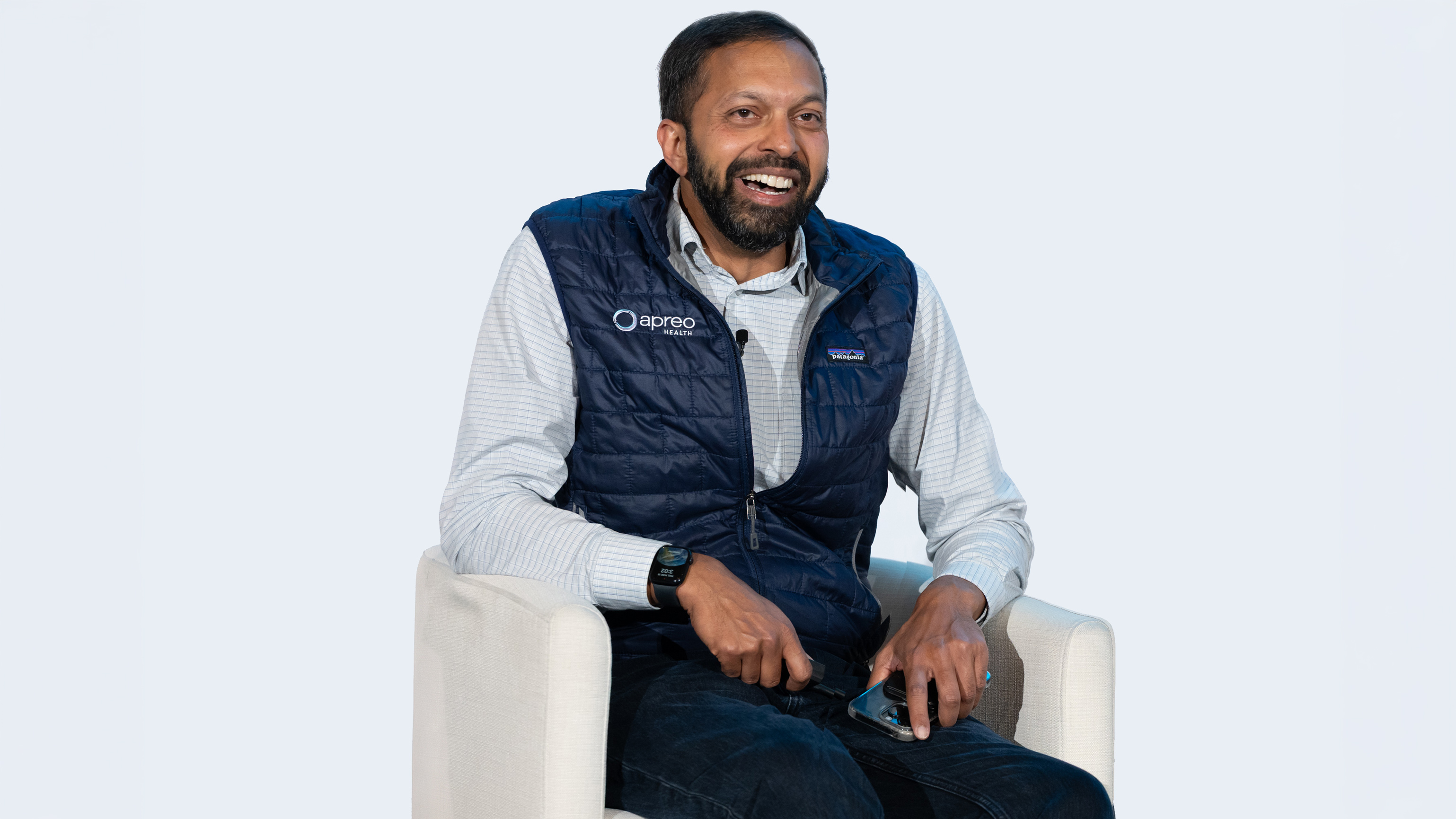
Apreo Health is the concentrated version of that filter. Co-founded with physician Martin Mayse in 2021 and incubated at The Foundry, the company is developing an investigational airway scaffold. Naga serves as President and CEO while remaining a Foundry partner. The work combines technical development, intellectual-property strategy, clinical study design and the patient work of assembling a syndicate willing to finance a pivotal program.
In August 2025, Apreo announced an oversubscribed $130 million Series B co-led by Bain Capital Life Sciences and Norwest, with F-Prime, Intuitive Ventures, Lightstone Ventures and Santé Ventures participating. The money was designated for the company's pivotal trial, regulatory work and early commercial preparation. A large financing can make a company appear suddenly inevitable. Naga's history argues against that optical illusion. The round came after years of earlier ventures, difficult evidence, strategic acquisitions and institutional memory inside The Foundry.
Twenty-five years can fit inside one decision
The Foundry had worked in respiratory devices long before Apreo existed. Earlier efforts produced technology, setbacks, acquisitions and, eventually, products taken forward by other teams. When Naga talks about painful lessons informing judgment, this is what the sentence looks like at institutional scale. A company can inherit knowledge without inheriting a product. It can study why a previous path narrowed and design a new program around what remains unresolved.
That perspective also explains his insistence on intellectual property as part of company formation, not paperwork performed after the interesting work. In pioneering medical technology, research consumes years and capital while competitors can learn from every published step. Protection makes the risk legible to investors. Evidence makes the protection meaningful. Each without the other is an expensive half-bridge.
Naga's language tends to resist the mythology of the overnight success. He talks about toe-stubbing, unfinished business, focus and teams. Even his account of a large financing included the image of fire drills. There is no complaint in it. The point is that venture building remains work when the press release arrives, and that earlier errors become useful only if they alter today's decisions.
The engineer others might overlook
His interest in entrepreneurship also loops back to Michigan. A decade after his father's death, Naga established the Manohar Naga Memorial Endowed Scholarship at Michigan State's College of Engineering. It recognizes high-achieving engineering students with entrepreneurial potential. He has described the intended recipients as people who may not stand out immediately in conventional engineering circles, yet show the grit and instinct to build something consequential.
The scholarship is more than a memorial. It is a scouting philosophy. Traditional academic and corporate paths are easy for institutions to recognize because the signals are familiar. An entrepreneurial engineer may look restless, oddly interdisciplinary or insufficiently devoted to the approved ladder. Naga remembers needing to search beyond the automotive applications surrounding his own degree. His response is to tell similarly unconventional students, in effect, that their instincts have a place.
He now mentors student founders, hosts networking events and works with Michigan State's Spartan Founders Club. In one pleasing turn, he later met a recipient of the scholarship who had moved to San Francisco after founding an AI and augmented-reality company. A father's example had shaped a son; the son created a scholarship; the scholarship helped another engineer cross from technical study into enterprise. Venture studios would call that a repeatable model. Families might choose a warmer word.
“Don't try to do everything. Prioritize what truly matters and what will help you build something meaningful, with people who share your vision.”Karun Naga
The line also describes Naga's career when viewed from the right distance. It was not a sequence of abandonments. Engineering remained useful inside patent law. Patent law remained useful inside corporate development. Corporate development remained useful inside venture creation. The Foundry gave those disciplines a shared workshop, and Apreo gave them a single current assignment.
The useful thing to steal is not his exact route. Few people need three degrees or a tour through this particular corner of medtech. The useful thing is the stacking. A detour earns its keep when its tools travel with you. A failure earns its keep when it changes your judgment. Ambition earns its keep when it survives editing. By that measure, Karun Naga's story is less about reinvention than accumulation, with just enough subtraction to make the accumulation count.