Karoly Nikolich had already learned how to be a scientist when he began learning how to be a founder. His second education came through a friendship with Bob Swanson, the co-founder of Genentech. The classroom was a startup. The course lasted roughly two years. By Nikolich’s own account, this was where he learned the basics of entrepreneurship. A doctorate had brought him into research; working beside Swanson helped him imagine making organizations of his own.
By 1998, the two had co-founded AGY Therapeutics. Nikolich served as its founding chief executive and chief scientific officer. The name carried a small piece of home into South San Francisco: agy means brain in Hungarian. Company names often require a consultant, a workshop and an explanation. This one required a dictionary. Its brevity suited a scientist whose working life would stretch across universities, companies, investment firms and foundations.
AGY occupies a particular place in that life. It joined a researcher who had built a program inside an established company with an entrepreneur who had helped establish the company itself. Their shared history preceded the new venture. The relationship makes the usual account of a founder’s sudden leap feel incomplete. Nikolich had spent years around enterprise before he began building businesses alongside his former colleague.
From Sopron to a bicycle in California
Nikolich was born in Sopron, Hungary, and studied chemistry at Eötvös Loránd University in Budapest. He graduated in 1971 and earned his doctorate in 1974. His early work included Hungary’s Institute of Isotopes and the university. A fellowship then took him to Tulane University in New Orleans. Back in Hungary, he worked in the biochemistry institute at Semmelweis University. The route to California included departures and returns.
Tulane placed him in the laboratory of Andrew Schally, who received a Nobel Prize in 1977. Nikolich later worked at the University of California, San Francisco. His training moved him between countries and research settings before he settled into industry. There is a practical distinction between reading about another scientific culture and having to work inside it. His early career repeatedly put him in the latter position.
In the early 1980s, he joined Genentech and moved to San Francisco. His wife, biologist Éva Szőnyi, followed him. An account of those beginnings records that they started from scratch and rode bicycles to the laboratory. It is an appealingly ordinary detail in a career usually described through executive titles. Before the board appointments and company formations, there was the business of getting to work.
At Genentech, Nikolich initiated and directed the neuroscience research program. That assignment asked him to create something within a company before he created companies himself. A research program needs a purpose, colleagues and enough institutional support to keep going. The eventual founder was already practicing the work of assembling an enterprise, with Genentech providing the setting and Swanson among the people who would shape his next chapter.
- BudapestChemistry & doctorate
- New OrleansTulane fellowship
- San FranciscoUCSF & Genentech
- StanfordInstitute leadership
- HeidelbergFoundation board
The investor who could not get there
After Genentech, Nikolich became vice president of research at Lynx Therapeutics, a DNA-sequencing company. AGY followed in 1998. Its early years offer a less tidy picture of entrepreneurship than the familiar progression from idea to funding to success. A business can have researchers, plans and interested investors, and still find itself waiting for a meeting on which far too much depends.
AGY was supposed to meet a prospective lead investor from Europe on September 13, 2001. The attacks of September 11 prevented the visit. The financial markets deteriorated afterward. Nikolich later described the missed meeting as a major setback. The company operated with bridge financing while it pursued a larger round. An event far beyond its offices had changed the timetable inside them.
In July 2002, AGY announced a $31.3 million Series C financing. Nikolich estimated that approximately $28 million remained in cash after some of the money had already been used. He said it could support at least two years of operations if no other funds arrived. Those figures reveal the calculations beneath the announcement: money raised, money spent, time available. A financing headline measures a moment; a founder has to measure the months after it.
The investors came from several countries, including the United States, Switzerland, Japan and Taiwan. AGY also worked with academic collaborators across the United States and Europe, including institutions in Hamburg, Lund and Budapest. The company had an office in California, but its working relationships crossed borders. For Nikolich, international collaboration had become part of company building as well as part of his own education.
An office on either side of the campus boundary
From 2005 to 2007, Nikolich served as executive director of Stanford’s Neuroscience Institute. The move put him back inside a university after his years directing industrial research and leading AGY. It also makes his career difficult to compress into a single ladder of promotions. The positions belong to different systems. A university institute, a startup and an investment firm all have different ways of deciding what deserves time and support.
He subsequently co-founded companies including Amnestix, Neurofluidics, Chase Pharmaceuticals, Circuit Therapeutics and Alkahest. Institutional biographies also connect him with Hummingbird Diagnostics and Engrail Therapeutics. Each name represents another organization and another set of collaborators. The recurring activity is visible without pretending that all the ventures followed the same course or produced the same result.
Alkahest was established in 2014 with Stanford scientist Tony Wyss-Coray. Nikolich’s later work included advisory relationships with Pivotal BioVentures and Grifols. Alkahest’s board biography identifies him as a strategic innovation advisor to Grifols. Stanford continues to list him as an adjunct professor. The affiliations place academic participation beside business advice rather than assigning each to a neatly finished period of his life.
In conversation about his career, Nikolich calls himself a serial entrepreneur while also describing his continuing academic interest. The two descriptions sit comfortably together. His record includes founding, research leadership, board service and advising. The interest is in how often he changes his position around an idea: sometimes building the organization, sometimes directing its research, sometimes helping from a board or an advisory seat.
“learned the basics of entrepreneurship from him.”
Karoly Nikolich, on Bob Swanson · 2023
Giving someone else the next opening
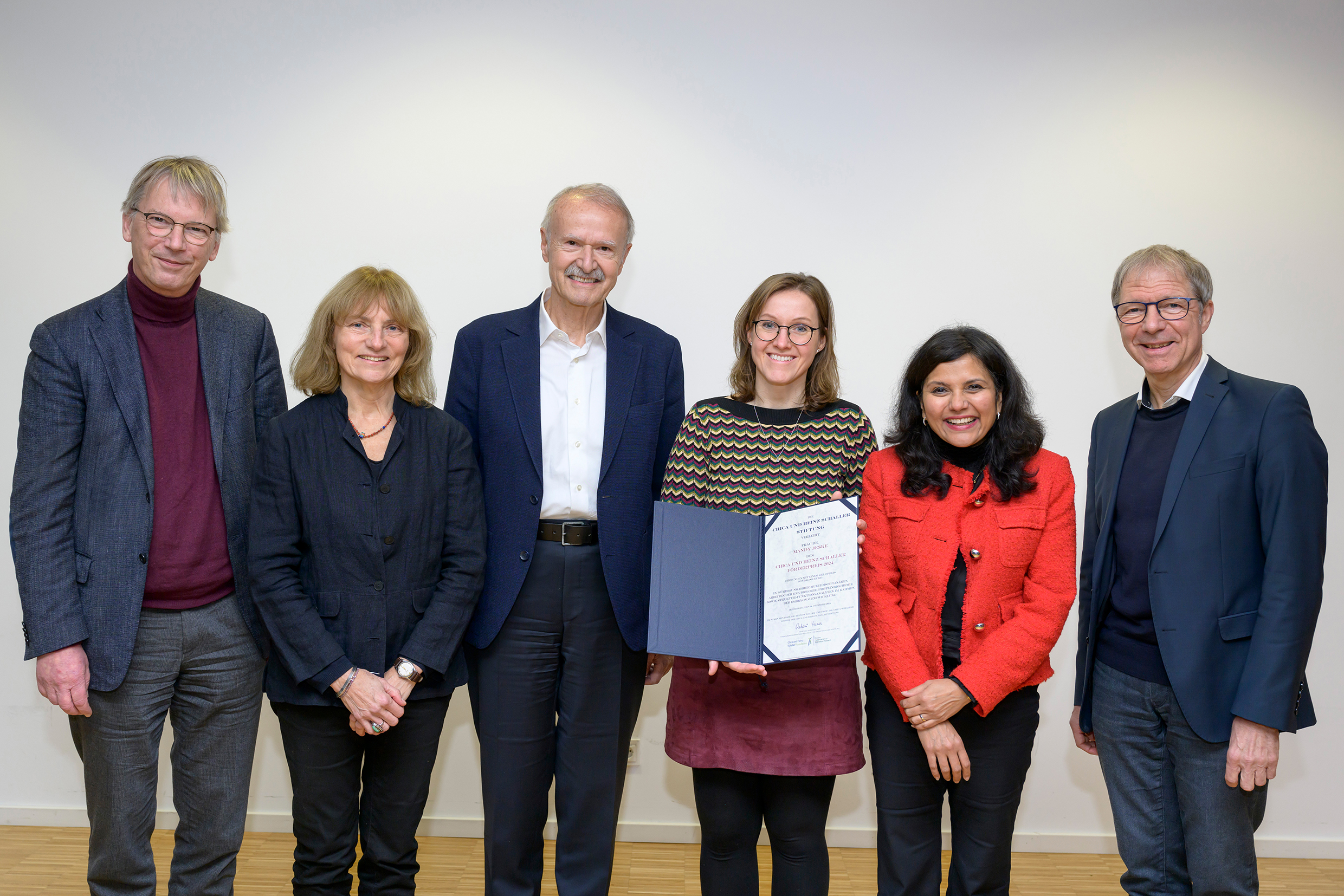
On December 4, 2024, Nikolich stood at Heidelberg University’s Marsilius Kolleg to present a research award to Mandy Jeske. He was there as deputy chair of the Chica and Heinz Schaller Foundation. The award carried €100,000 in research funding. In this scene, the scientist with a long list of companies was helping give another researcher room to work. The achievement being celebrated belonged to someone else.
The foundation supports young researchers at important stages of their careers and promotes women in science. Its support includes research groups and fellowships as well as awards. Nikolich serves on its board with Rohini Kuner and Ralf Bartenschlager. These are structures that give scientific work continuity: colleagues to judge it, funding to sustain it, and an institution prepared to take an interest before the full outcome is known.
He also participated as a foundation representative in a 2024 Heidelberg conference commemorating Chica and Heinz Schaller. Researchers and industry participants came from several countries. A different international effort, The Science Bridge, carries his endorsement of collaboration across nations and cultures. He describes science as a shared language for building trust. That aspiration fits a working life that began in Hungary and developed through American and European institutions.
The conversation keeps going
Nikolich’s board work also includes Selonterra, where he is listed as an independent director. That role extends his participation beyond the ventures most often attached to his name. Founding and governance occupy different parts of an organization’s life. His affiliations put him in both, working with colleagues who bring their own experience of research, operations and company leadership.
In 2026, Nikolich and Robert C. Malenka appear as the editors of an open-access book, Translational Neuroscience: Foundations for Precision Therapies. The editorial partnership follows their organization and co-chairing of a California conference in 2024. A book adds another form to Nikolich’s habit of bringing people together: contributors, editors and readers gathered around a shared field of inquiry.
The open-access format matters in a modest, concrete way. A reader can reach the volume without buying it. After a career involving private companies and investment decisions, Nikolich is also helping assemble a work available beyond a single organization. Editing sits naturally beside the other verbs in his biography. It requires selecting people, setting a scope and giving different contributions a place within a larger undertaking.
His route now runs from a chemistry degree in Budapest through laboratories, corporate research, AGY, Stanford and a foundation board in Heidelberg. Swanson’s informal lessons remain an early hinge in that sequence. The bicycle commute supplies its human scale. The award ceremony shows how the role can change with time: the researcher who received opportunities becomes one of the people helping to provide them.
AGY’s Hungarian name makes a useful final detail because it is so small. Across a career full of institutions and titles, three letters preserved a connection to where Nikolich began. He learned a new profession beside Swanson, carried an old language into a new company, and kept taking seats at tables where scientific work was being organized. By the time he was presenting Jeske’s award, there was another person’s beginning to attend to.