An acquisition makes a convenient full stop. Put a company’s name beside a larger company’s name, add the word “acquired”, and a complicated career suddenly looks as tidy as a business card. Kareen Looi’s biography contains just such a sentence: she was CEO and co-founder of Setagon, a US company acquired by Medtronic. Then the biography carries on. There is another company, PEDRA Technology. There are more investors to meet, presentations to give and colleagues to work with. For Looi, the line that could close a founder’s story sits somewhere in the middle.
Her route there began in a different profession. Before the executive titles, she was an attorney at Drew & Napier in Singapore. She holds a law degree from the National University of Singapore and an MBA from Darden at the University of Virginia. Her name also appears among inventors on US patents. Lawyer, business graduate, founder, inventor: the labels fit, although none manages to contain the whole career.
A name in the court file
In 1995, Looi was named as counsel from Drew & Napier in a Singapore High Court judgment. Another judgment in 1998 lists her alongside Indranee Rajah, representing defendants for the same firm. These are specific appearances in a working legal career, long before the conference programs that now identify her with PEDRA.
The detail gives her later entrepreneurship an unusual starting point. A founder’s biography often opens with a product idea and moves rapidly towards a company. Looi’s includes a period when her professional identity belonged to a law firm and the court record. Her current title conceals that earlier occupation rather efficiently. Three letters, CEO, can cover a considerable amount of ground.
Her education crossed the same professional boundary. At NUS, she studied law. At Darden, she studied business; her University of Virginia attendance is listed as 1998 to 2000. The two qualifications belong to different disciplines, and both remain part of her professional introduction. They give the career a geographical turn, too, linking Singapore with Charlottesville, Virginia, where the university is based.
It would be easy to turn these facts into a dramatic scene: the lawyer deciding to become a founder, a desk cleared, a new future announced. The visible sequence is quieter and more interesting than that convention allows. Legal practice, business school and company leadership all occupy space in the same working life. The transitions can stand without a speech attached.
Setagon, and the names below the title
At Setagon, Looi became CEO and co-founder. The company was based in the United States and was acquired by Medtronic. That corporate outcome is a substantial marker in her career. It also introduces a collaborator who appears again in the next chapter: Whye-Kei Lye, Setagon’s CTO and co-founder.
There is another way to see their work together. In November 2007, US patent 7,294,409 was granted with Looi, Lye and Michael L. Reed named as inventors. The University of Virginia included the patent in its annual record of inventor achievements. A later university report lists Looi, Lye and Reed again on a patent issued in 2009.
Those entries add something that the executive biography alone cannot. They place Looi among named contributors to inventions, alongside her company role. A patent credit has its own limits: it records inventorship for a particular invention. Within those limits, it is a useful detail. The person identified as the chief executive also appears in the technical history.
Company stories tend to give the founder a large share of the stage. Patent lists are less accommodating. They put several people on the same page, sometimes in very small type. Looi’s record benefits from reading that small type. The collaborators become visible, and Setagon begins to look like a shared enterprise with several kinds of work behind its name.
- SingaporeLegal practice at Drew & Napier
- 1998-2000University of Virginia · Darden MBA
- SetagonCEO and co-founder · acquired by Medtronic
- PEDRACEO and founder · Singapore
The familiar colleague in the next company
At PEDRA, Looi and Lye occupy the CEO and CTO roles respectively. The recurrence is one of the most distinctive facts in her career. A company name has changed; two of the people building it have worked together before. That continuity connects the Setagon chapter with the Singapore business she now leads.
PEDRA’s management also includes Paul Hayes as chief medical officer. The leadership list brings different professional backgrounds into one company. Looi’s own combination of law, business education and startup leadership sits alongside Lye’s physics training and invention record. The company’s story has several working vocabularies, even before an investor opens a presentation.
The public record establishes the repeated collaboration without needing to decorate it with imagined conversations. We can see who held which role, whose names appear together and where they reappear. For a profile of a founder, that is valuable texture. It moves the account beyond a succession of titles and towards the people whose careers have intersected with hers.
Two numbers, two different stories
There are two funding figures worth keeping separate. Looi’s career biography reports more than S$20 million raised in startup funding. PEDRA announced a $4.7 million Series A in September 2020. The first covers a founder’s fundraising record across her career. The second belongs to a particular company and round. Their currencies and scope are different; combining them would make a handsome statistic and an unhelpful one.
The Series A participants included SEEDS Capital, the investment arm of Enterprise Singapore, M&L Healthcare Investments and two strategic manufacturers. The list brought public-backed investment and industry participants into the same financing. It gives the announcement more substance than the amount alone: the company was assembling a group of backers with different institutional positions.
In the company’s 2020 summit introduction, PEDRA also described its team’s experience and cash management while seeking further capital. It is a revealing choice of emphasis in an investor-facing introduction. Alongside the business proposition sat the practical question of how the company would use its resources. The pitch included the people expected to manage the money.
Funding announcements freeze a moment. A founder’s career keeps moving around it. For Looi, the 2020 round is one identifiable event within a longer record of raising capital and presenting companies. It belongs beside the earlier Setagon outcome and the later investor events, each marking a different kind of encounter between a business and the people considering its future.
Back in the room, this time as a speaker
Looi has spoken about entrepreneurship at Darden, Singapore-Stanford Biodesign, INSEAD Singapore, NUS and Singapore Management University. Two institutions in that list, Darden and NUS, also appear in her education. They recur in a new capacity, as places where her experience of company building has become something to discuss with an audience.
In October 2024, she was listed among the guest speakers at a Withers Singapore seminar about investing in innovation. The program examined family-office and foundation capital alongside venture capital. Its questions included how to structure investments, measure returns and align interests. Looi’s place on the program brought a founder’s career into a conversation involving several kinds of capital provider.
The following year, her public calendar included LSI Asia in Singapore, where she announced a June 12 presentation. A July 1 Hong Kong Roadshow program also listed her among its panelists. The Hong Kong agenda covered subjects including intellectual property, investment criteria and valuation expectations. These appearances extend the picture of her work beyond the company office and into the rooms where entrepreneurs explain what they are building.
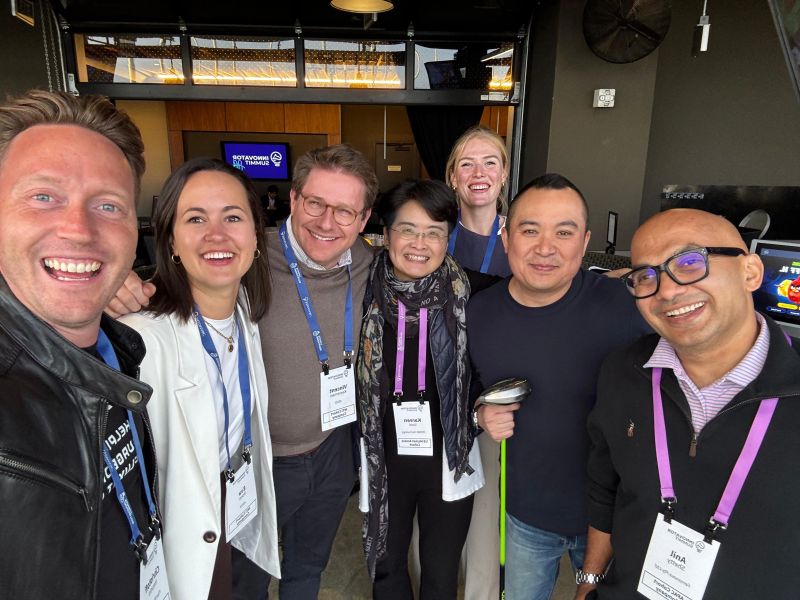
A photograph she shared from a San Francisco summit offers a less formal version of the same activity: a group of attendees gathered for a picture, badges still on. In the accompanying post, she thanked Paul Grand, Fredrik Nyberg, Glen Lim and Nerissa Yu in connection with the US-Entry APAC program. The image gives the conference circuit a recognisable human scale.
“Happy to be at MedTech Innovator Summit in San Francisco, meeting fellow device entrepreneurs.”
Kareen Looi · public LinkedIn post
The next appointment
In September 2026, PEDRA announced that it had been selected for One Six 8 Ventures’ September 29 showcase. The company described a field of 180 applicants from 20 countries, with eight startups chosen to present. It named participating strategic leaders from several large organisations. Selection gave PEDRA another scheduled opportunity to put its business in front of potential partners.
The announcement establishes that selection. It leaves the commercial outcome open. There is no need to supply a deal to make the episode useful: the founder who had already led one company through an acquisition was still engaged in explaining another company to a new audience.
That continuing work gives Looi’s career its shape. There is the attorney in Singapore, the business student in Virginia, the co-founder at Setagon, the named inventor and the CEO at PEDRA. The acquisition remains an important sentence. Around it, the biography has kept accumulating verbs: study, build, raise, present. A full stop was available. Another company followed.