Min-Han Tan had a working invention. That was when the questions multiplied. A discovery could be described in a paper, defended in a discussion and protected by a patent. A company had to employ people, find customers, pay its way and deliver the same standard of work again tomorrow. In 2016, after years in research, he founded Lucence. The scientist had acquired another occupation. It came with rather less predictable examination questions.
By August 2024, Lucence had seventy-three staff, compared with five in 2017. Tan had helped take it from its Singapore beginnings to operations in Palo Alto. The figures describe a business getting larger. They also suggest a change in the founder’s job: more people to coordinate, more expertise to listen to, more distance between having an idea and getting it into someone else’s hands.
His younger brother, Min-Liang Tan, had already co-founded Razer. Min-Han once introduced himself as the less cool older brother. It was an economical way to acknowledge the famous surname and get on with his own work. There was plenty to get on with.
There was curiosity before there was a company. Tan has described a childhood in which his parents encouraged interests across science, the arts and sport. Hiking remained an interest. He enjoyed abstract questions in science and history, including problems where information was incomplete or contradictory. He also introduced Min-Liang to computer games. His brother remembered a distinction between them: Min-Han was more interested in programming, while Min-Liang preferred playing. Even their early shared pastime offered two ways of looking at the same machine.
A laboratory is only the beginning
Tan’s first substantial training ground for this part of his story was Singapore’s Agency for Science, Technology and Research, better known as A*STAR. He joined in 2011 to lead the Laboratory of Systems Medicine. He had earned both his first degree and his PhD at the National University of Singapore. Research leadership meant organising work around questions whose answers were still uncertain.
Founding Lucence in 2016 carried that work into a different setting. The company would commercialise technology developed at A*STAR. The research had given him something to build around; the spin-off required him to decide how it should reach the outside world. He subsequently received A*STAR’s Outstanding Scientist-Entrepreneur Award in 2018, a title that neatly puts his two occupations on the same line.
Early on, he described commercialisation as three connected tasks: establish the core technology, move it into a commercial setting, and develop the ability to deliver and grow. Each task put a different demand on the founder. Scientific confidence could support the first decision. The later decisions needed an organisation.
“Every maverick that was correct eventually became the status quo.”
Min-Han Tan, 2018
The remark has a little mischief in it. It also contains a practical challenge. An unfamiliar idea has to survive long enough, and work consistently enough, to become familiar. Being right once leaves a considerable amount of work outstanding.
A brother in the next business
Min-Liang’s experience gave Tan an unusually close view of entrepreneurship. Razer had been founded in 2005, more than a decade before Lucence. Its growth was something the older brother could observe at close quarters. He later described that vantage point as a chance to understand the effort that building a company required.
The relationship became useful in concrete ways. In 2017, Min-Liang introduced him to Lim Ka Ling and Koh Boon Hwee, two of Razer’s early angel investors. Both backed Lucence. Introductions matter because a young company has to persuade people to take an interest before it has a long operating record. Here, the younger brother could open a conversation. The older brother still had a company to build.
Subsequent investors included Heliconia Capital, IHH Healthcare and Openspace. These were different kinds of backers with different experience to bring. The growing investor group added another constituency to the founder’s working life. Research had collaborators and reviewers. A business had shareholders as well, with money committed to what might happen next.
It is tempting to let the family connection explain the whole venture. Tan’s daily responsibilities resist that shortcut. An introduction does not organise a laboratory. A shareholder does not automatically supply a customer. The relationship helped him begin conversations that the company then had to turn into lasting work.
The invention needs a roomier address
In 2018, Lucence was preparing to move from a 1,200-square-foot laboratory in Henderson Industrial Park to a nearby facility spanning 9,500 square feet. Expansion had acquired the practical form of floor space. This was a company beginning to need a larger place in which to do its work.
A year earlier, it had won S$100,000 at the Slingshot@SWITCH startup competition. Such events give a young business a brief, concentrated opportunity to explain itself. The building that follows is less theatrical. Rooms have to be ready. People have to be hired. Work has to continue through the move.
Staff at two points in the journey.
2024 figure reported in August.
By 2024, the staffing figures offered another view of the change. Five people had become seventy-three. At that size, an organisation necessarily contains skills beyond those of any one founder. Keeping the work coherent becomes a problem of communication as well as technical competence.
Tan’s later account of company-building made space for that fact. The people around him were part of his education. A larger organisation brought more work to coordinate, but also more people capable of teaching him something. Growth altered the available answers along with the questions.
An ocean between the offices
Lucence opened its second laboratory in Palo Alto in 2020. The Singapore operation had already given the business experience in its home market and Hong Kong. The American laboratory added a second operating base, putting the company’s international ambitions into premises, equipment and a local organisation.
The financial preparation had begun earlier. Lucence raised a US$20 million Series A in 2019, led by IHH Healthcare. It subsequently secured US$45 million in funding across 2022 and 2023. Those rounds put capital behind the expansion, while leaving the founder with the continuing task of turning resources into a working business.
Singapore origins · United States expansion in 2020
The company also worked with Enterprise Singapore on internationalisation. An overseas network can help a founder reach people who understand a market’s practices and institutions. A small business crossing into a large country has a strong reason to seek that knowledge. Tan argued for partnerships as a practical way to operate across the geographically dispersed United States.
It is a recurring feature of his story: another stage of progress brings another need for people who know something he needs to learn. Building abroad extends that dependence. The founder has to make connections between places as well as between disciplines.
A trophy for the work between discoveries
In July 2022, Tan stood at a lectern in Geneva during the inaugural WIPO Global Awards. Lucence was one of five winning companies. There had been 272 submissions from 62 countries, followed by a shortlist of twenty. The judging considered successful commercialisation of intellectual property and its wider impact.
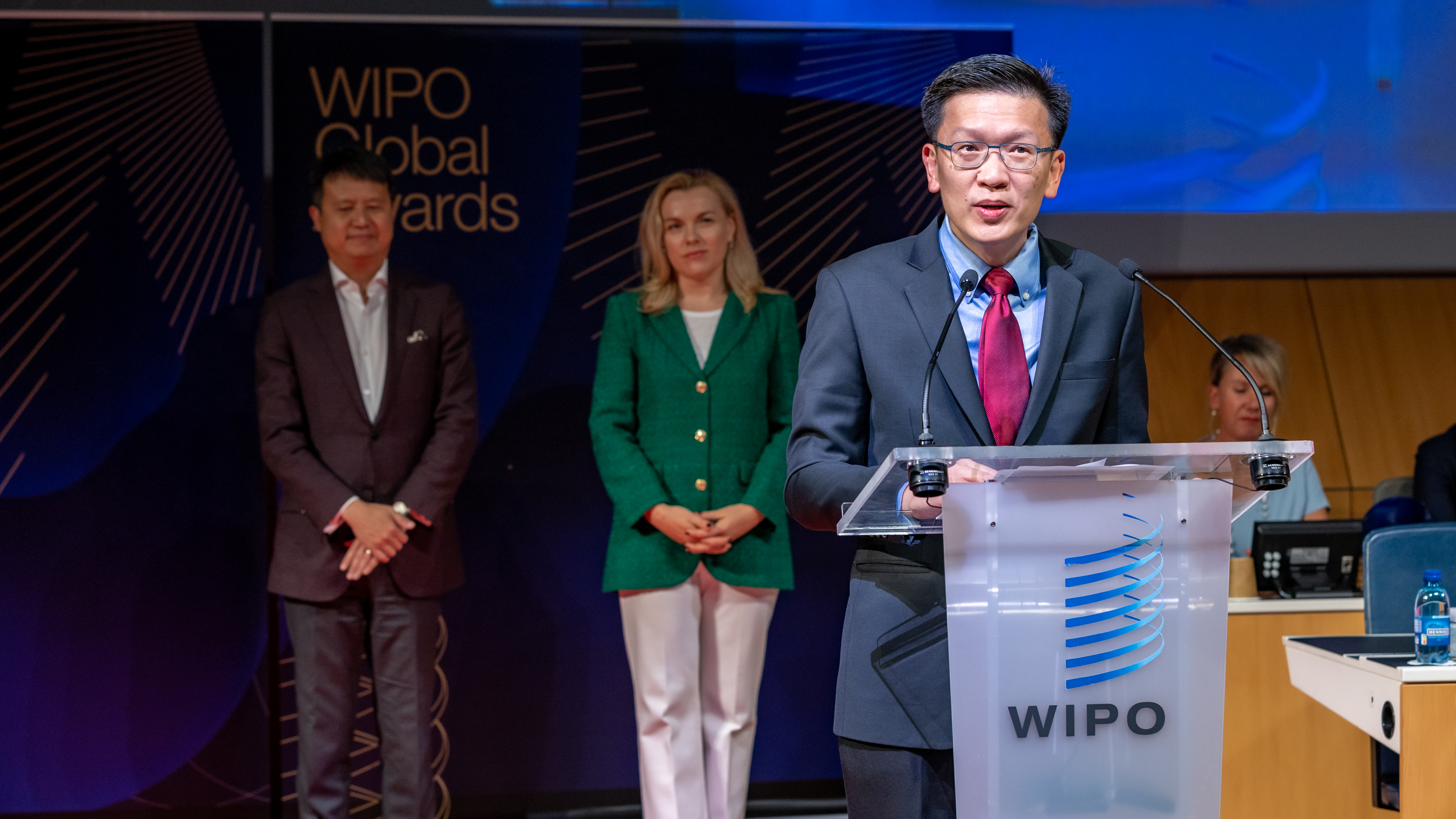
The award recognised a kind of work that sits between research and routine delivery. Intellectual property had helped Lucence emerge from A*STAR. It also gave prospective investors and partners a basis for understanding the company’s assets. An invention could be discussed as something a business could develop, protect and bring into agreements.
Tan regarded commercialisation as the logical continuation of invention. In that view, forming a company was a way of carrying the work further. The change required a different collection of skills, including an understanding of partnerships and the ability to organise a service around a technical result.
The trophy made one part of that progress visible. It could not finish the job. Recognition arrives on a date; an organisation has to keep delivering after the ceremony. Lucence’s award belonged on the same timeline as its laboratories, funding and growing team.
Still taking lessons
In a filmed conversation in 2024, Tan described his career in three phases, with research preceding Lucence. When he discussed building the company, he pointed to the human work of understanding problems and aligning people. He also acknowledged the financial knowledge that a scientist entering business needs to acquire.
His teachers included the team, customers and investors. That is a revealing list. Each group encounters a different version of the company. Colleagues understand what it takes to produce the work. Customers experience what is delivered. Investors ask how the organisation can sustain and extend it. Listening across those perspectives makes the founder’s own view less solitary.
In a public reflection that August, he considered the uneven pace of technological change: long periods of development punctuated by rapid movement. He encouraged people frustrated with the pace to keep contributing and fixing things. The sentiment fits a career spent moving through research into operations, where progress has to survive both impatience and repetition.
Lucence marked its tenth anniversary in Singapore in 2026. A decade gives the company a history; it also gives Tan a longer record of learning beyond the laboratory. His second education has involved investors, colleagues, customers and an ocean between offices. The useful question has kept changing, from whether an invention works to how many people an organisation can reliably reach with it.