At a NewVision Software townhall, Kapil Godani’s colleagues gave their CEO a picture collage. It gathered moments from ten years with the company into one frame. For an executive accustomed to thinking about what comes next, the gift required a pause. Here was a decade that could be looked at, with the people still in it.
Godani later called the experience overwhelming in the best way. His chosen word was gratitude. He thanked teammates for the early days, difficult decisions and ordinary persistence that had made the company possible. The anniversary belonged to them, too. In his telling, the people who showed up each day deserved space beside the person whose tenure was being celebrated.
That instinct runs through his reflections on work. The founder and CEO has spent more than thirty years in technology, moving through engineering, delivery, business development and business leadership. When he explains how he got here, however, the career ladder makes room for friends who arranged conversations and colleagues who remembered to call.
Three introductions, several different lives
Early in his career at NTPC, his school and college friend Vikrant Sisodia helped him prepare a CV, opened an interview opportunity, hosted him in Delhi and took him to the bus stop. Godani credits that intervention with helping him move into IT.
Later, Santwana Singh introduced him to InfoBeans. The first opportunity lapsed when he extended his US stay. A Diwali message revived the conversation; he became Director of Delivery. Working near founders made entrepreneurship feel more accessible.
Then came morning tea at a friend’s home in Noida. Vijay Shrivastava encouraged him to see himself as a CEO and connected him with Anupam Pathak. Godani recalls exchanging a substantial part of his salary for sweat equity. His account gives each friend a place in the decision, rather than treating the eventual title as something he reached alone.
“So make the introduction. Send the Diwali message. Say the sentence out loud.”
Kapil Godani
Learning the work before leading it
The formal education began with electronics. Godani earned his B.E. at Maulana Azad National Institute of Technology, studying from 1989 to 1993. He later completed the Indian School of Business’s PGPMAX programme, listed for 2012 to 2013. The two qualifications sit on either side of a long stretch of professional experience: technical training first, executive education after years inside organizations.
His career includes Tata Consultancy Services and Clarion Technologies, where he served as chief operating officer. Those names describe different organizational settings. The roles describe the apprenticeship more usefully. An engineer needs to understand how something works. Delivery brings a team and a commitment into the picture. Business development adds the customer’s decision. Responsibility for profit and loss brings the organization’s ability to sustain the work.
By the time he was leading NewVision, he had worked across these concerns. It gives his current role a practical history. The CEO discussing technology investment has also occupied positions in which somebody had to organize the people, understand the requirement and get the work delivered.
Four areas of a career spanning more than thirty years.
The people outside the current team photograph
A former colleague once told Godani that she still had an email he had sent appreciating her work. Years had passed. She had kept it because it encouraged her. She also wished they had stayed in touch.
He returned to the encounter in a public reflection, thanking people who had contributed to the company and subsequently moved on. The recognition was specific: he named former teammates rather than leaving the sentiment at the level of a general thank-you. Their careers had taken them elsewhere; their contribution remained part of what NewVision had become.
One respondent, Bharat Bansode, remembered Saturday discussions about challenges, learning and career goals. He also recalled “Coffee with Kapil,” an opportunity to connect and build confidence. Another former colleague, Debapriya Brahma, remembered being trusted and given room to work.
These recollections give texture to the language of leadership. A saved email is a small object with a long shelf life. Someone has moved jobs, met new colleagues and taken on different responsibilities, and a few lines from a former manager are still worth keeping.
Ten years, assembled in a frame
NewVision’s anniversary celebration brought that history into the workplace. Colleagues gathered to mark Godani’s ten years of leadership, and Anupam Pathak, the company’s director and advisor, joined the occasion to reflect on his journey. The company’s video records the gathering, the presentation and the framed tribute.
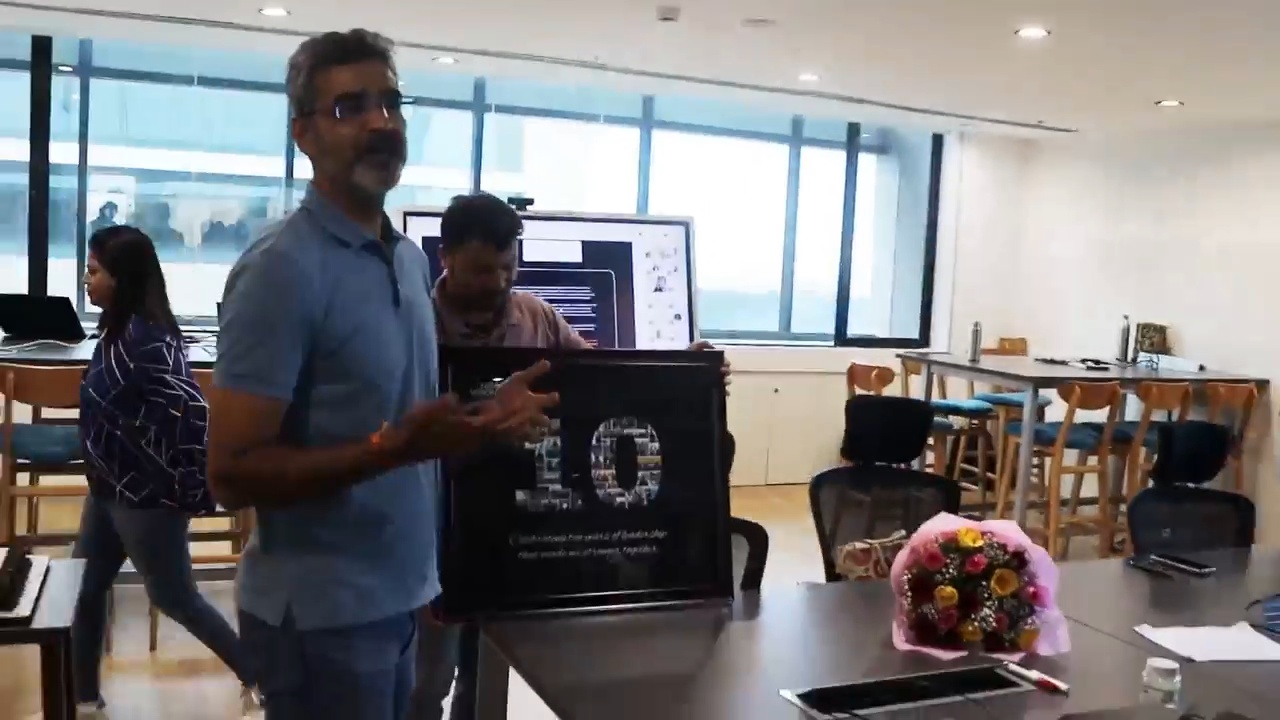
The scene has the useful untidiness of an office occasion. Chairs, tables and colleagues share the frame with the anniversary gift. There are flowers on the table. The business is still visibly a place where people spend their working days.
That setting suits the story Godani tells about the milestone. The finished collage can collect moments, but the decade itself was assembled through individual contributions. Some people remained in the room; others had already gone on to different jobs. The anniversary gave him an occasion to recognize both.
A company birthday can generate enough ceremony to frighten a wedding planner. Here, the most revealing detail is the object the team chose: their shared past, made visible.
An engineer’s interest in what happens next
Godani’s writing on technology has a similarly practical center. In July 2023, he described digital transformation through people, processes and changes in how a business works. His argument placed technical capabilities alongside knowledge of customer needs and operating models.
He discussed testing, cloud architecture, data and automation as parts of the job. The range matters. A new digital service needs to function reliably, use information well and fit the organization that will operate it. A technically impressive component still has to live with everything around it.
In January 2024, he turned to generative AI and customer experience. He was interested in systems that could bring context to an interaction: information about the customer, the product and the problem being discussed. He urged businesses to identify suitable use cases and consider return on investment.
Those were arguments about adoption, rather than reports of results. They show where his attention was going: toward the work required to make a developing technology useful inside a business. Customer support offered a concrete place to begin, with specific questions to answer and interactions to improve.
There is another expression of this interest in his work beyond NewVision. FinBraine lists Godani as a director, describing his experience in requirements analysis, business development and strategic planning. Those responsibilities connect the technical discussion to the decisions a business needs to make before a system is built. What does the customer require? Which problem deserves attention? What can the organization actually deliver? The questions are familiar across his career, even when the technology under discussion changes.
The same attention appears in NewVision’s partnership announcements. For its ServiceNow relationship, Godani emphasized reliability, performance and improvement in infrastructure services. Discussing UiPath, he pointed to certified technical teams, understanding business processes and reducing the time needed to put automation into use. The platform supplies capabilities; people still have to apply them to a customer’s circumstances.
For a services executive, those details carry the substance of the promise. The client needs an operation that works on a Tuesday afternoon as well as a demonstration that works during a meeting. Godani’s public comments repeatedly return to the mechanics of getting there.
The next door opens onto a larger network
On July 14, 2026, SoftServe announced its acquisition of NewVision Software. Financial terms were undisclosed. Godani, chief operating officer Balan Ramaswamy and the leadership team would continue running NewVision. The company kept its name and brand as a wholly owned SoftServe business.
A new parent.
A familiar leadership team.
The announcement placed NewVision’s engineering capabilities inside a wider organization. SoftServe reported more than 10,000 people across fifteen countries. Its rationale included being closer to enterprise clients with Global Capability Centres in India, where more of their engineering work and business decisions were taking place.
For Godani, the combination offered wider capabilities and greater scale while preserving collaborative working relationships. The continuity is a meaningful part of the arrangement: customers and employees would continue with leaders who knew the business. The ownership changed while those relationships carried forward.
In August, NewVision set out an expanded India strategy. Godani’s stated ambition was for Global Capability Centres to take a greater role in innovation. The company also described investment in engineering teams, AI tools, training and delivery workflows. These were plans for the next phase, with execution still ahead.
The career that began in engineering now includes the task of leading through that transition. A larger network creates more possible conversations, more capabilities to bring into a project and more people whose work has to fit together. Godani’s earlier reflections offer a useful way to read the assignment. He pays attention to the individual who makes an opportunity possible, and to the people who do the work after the opportunity arrives.
The earlier chapters suggest a particular habit of attention: remembering the person alongside the decision. The friend who made time, the colleague who made an introduction and the teammate whose work deserved acknowledgment each have a place in his account. As NewVision grows within a larger organization, that habit gives the story a human scale.
For the anniversary, his colleagues put ten years in a frame. The next chapter will need its own photographs.