Kamal Reggad was building a company to help people travel for work. Then the travel stopped. A founder can prepare for competitors, reluctant customers and a product that needs another round of tinkering. It is harder to prepare for the disappearance of the activity the product exists to organise. His business-travel platform had a rather immediate problem: business travellers were staying put.
The company, SafarPass, had begun in September 2019. By 2020, Reggad had to choose what to do with a venture whose original market had abruptly changed. He looked at a difficulty much closer to home. His own distributed team needed to be hired, managed and paid across borders. The work could move between countries more easily than the paperwork or the money.
Reggad and his co-founder, Karim Nadi, turned towards that problem. RemotePass took shape in 2020 and launched in January 2021 with coverage in seven countries. The business waiting inside the business was the machinery required to run it. The customers they hoped to serve were employers with the same administrative headaches, and workers on the receiving end of them.
There is a useful irony here. The travel venture assumed people would move. Its successor would help companies employ people who could remain where they were. Both concerned the distance between a person and a job. The practical answer changed considerably.
Boston, with a clock running
Long before RemotePass, Reggad knew what it meant for a career to depend on geography. He grew up in Morocco and studied at Northeastern University in Boston, completing undergraduate and graduate degrees. His training was technical; his early career included work at Spotfire, later acquired by TIBCO, as a lead systems engineer building infrastructure for software deployments.
His recollection of being an international student is less tidy than a résumé. He has described searching for an employer willing to sponsor his H1B before his twelve-month work permit expired. He transferred to Northeastern because its undergraduate programme offered co-op work experience. The appeal was specific: time in a workplace before graduation could improve his chances of getting hired afterwards.
He remembered being prepared to work for free to demonstrate that he deserved sponsorship. The pressure arrived before the degree was finished. A graduate job search, in his account, came with a deadline and a second negotiation about permission to stay. It is a revealing piece of his story because RemotePass now works on another version of access to employment across borders.
That experience does not make every later decision inevitable. It does give his interest in international work a personal reference point. When he talks about talented people reaching employers elsewhere, he has already been the applicant trying to make the arrangement possible.
A shop window for Casablanca
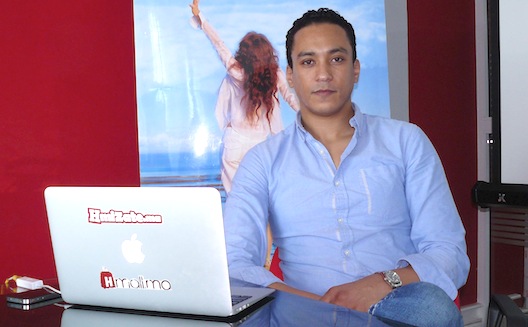
Reggad returned to Morocco and launched Hmizate in January 2011. Its daily deals connected customers with offers from businesses, with travel an important part of the mix. In June 2012 he added Hmall, an online marketplace bringing offline merchants onto the internet. He was working on the distance between a seller and a buyer before he began working on the distance between an employer and a worker.
The details were decidedly physical. Hmall listed fashion, electronics and household goods. Products were checked manually before appearing online, and the team worked with suppliers on delivery. Reggad explained that customers wanted more than service deals: they wanted a choice of goods at competitive prices, delivered to their doors. The next product came from watching what buyers were asking for.
In an interview at the time, he called entrepreneurship an emotional roller coaster. He enjoyed people liking the product and acknowledged the strain when things failed to work. Asked about further projects, he said his hands were full with Hmall. Founders are often photographed looking towards the horizon. This one was also occupied with the parcel that had to arrive.
His advice was to learn what the customer wanted and adapt to the local market. That sounds modest beside the language of international expansion. It is also concrete enough to be useful. A marketplace needs sellers, products, prices and deliveries that suit its customers; enthusiasm about e-commerce will not complete the transaction for them.
The 3 a.m. investor meeting
One of Reggad’s early funding connections began in an aeroplane. In 2011, he was travelling to a Wamda e-commerce event in Amman when the passenger beside him became curious about what he was reading. It was around three in the morning. Reggad answered, and the conversation moved into Moroccan e-commerce and Hmizate.
The neighbour was Pamir Gelenbe of Hummingbird Ventures. By the end of the flight, an ordinary exchange between passengers had become the beginning of an investment conversation. Hmizate was self-financed and approaching profitability. Those details helped give the discussion somewhere to go. The eventual funding story involved $1.6 million.
It is tempting to treat an encounter like this as a recipe: buy a plane ticket, bring interesting reading material, sit beside venture capital. The less glamorous part is that Reggad already had a business to discuss. He could describe a market, customers and revenue. Chance supplied the seat assignment. The company supplied the substance.
Travel made up more than 45 percent of Hmizate’s revenue in the account of that period. Years later, travel would again figure in his career, this time through SafarPass. The repeated subject makes the later change of direction more striking: he had reason to understand travel as a commercial opportunity, yet he was willing to move away from it.
Offering the money back
Reggad became an Endeavor Entrepreneur in 2015. After Hmizate was sold, he moved on to his next venture. The change from SafarPass to RemotePass raised a question that had little to do with software: what did he owe investors who had backed the previous idea? He considered returning their money before beginning the new business.
The investors had funded a travel platform. He was proposing a company concerned with hiring and payroll. In their conversations, he learned that their confidence extended to him as a founder. They stayed with the changed direction. That episode gives the word “pivot” some human weight. A revised product also meant a revised promise to people who had already committed money.
RemotePass then had to earn its place in an unfamiliar industry. In 2022, Reggad described the difficulty of understanding employment practices across countries, building a flexible platform and getting established providers to pay attention when his company had only a few transactions. Early customers might see a simple interface; behind it sat research, advisers and considerable documentation.
He also admitted that, in his first startup, he had wanted every decision to be perfect. By 2022 his emphasis had shifted towards the team’s ability to carry decisions out, and the speed of doing so. That is a practical change in outlook for someone whose next company depended on many moving parts, each of which had to work for the customer.
- 2011Hmizate
Daily deals in Morocco - 2012Hmall
Offline merchants go online - 2019SafarPass
Business travel & expenses - 2021RemotePass launches
Employment & payroll
The founder keeps his login
In his 2022 conversation with Amir Farha, Reggad discussed continuing to handle client onboarding himself. The detail matters because onboarding is where a product’s promise meets somebody’s actual company. A demonstration can be rehearsed. A customer arrives with the particular circumstances that the demonstration may have left out.
That habit has another, more recent expression. Reggad has said he remains the administrator of RemotePass’s own account, processing payroll or sitting in its approval flow. His description is wonderfully unromantic: checking salaries, payments and expenses for the item that is wrong. The company sells a system its chief executive still encounters as a user.
In 2026 he described an AI payroll agent doing much of that review in recent cycles. It flags discrepancies such as duplicate invoices, mismatched expenses or unusually large bonuses, leaving him to make the decision. His interest was expressed through examples from the work. The promise of automation becomes easier to understand when the founder can name the receipts he previously had to inspect.
Across these accounts, a consistent behaviour is visible: Reggad stays close to the administrative experience. Client onboarding and his own payroll approvals are different jobs, but both put him in contact with the product’s everyday demands. That is a more specific description of his working style than a collection of complimentary adjectives.
“I discovered I liked to be part of the inception of something”Kamal Reggad · 2022
35,000 workers, and the next border
By May 2026, RemotePass reported serving more than 35,000 workers across over 150 countries and facilitating more than $800 million in cross-border payroll. It announced a $17.4 million Series B led by EBRD Venture Capital, with 500 Global joining the round. The company said it had reached profitability in early 2025. These are company-reported milestones, dated to the announcement.
Reggad’s own account added a picture of the people building it: a team spread across 27 countries. He thanked customers for pushing the product and credited his colleagues with the work of reaching each market. The business that grew from running a distributed team had become a larger distributed team itself.
“This round is about acceleration,” he said. The plans included expansion in Europe and the United States, further investment in financial products and AI. SpendCards, introduced in late 2025, brought corporate expense cards into the platform. The travel-and-expense starting point has a faint echo here, although the company now approaches spending through the wider task of employing and paying people.
His public schedule remains close to those practical questions. In September 2026, he promoted a discussion with Jamie Lane about hiring, payroll and employment structures across Saudi Arabia, the UAE and the wider region. There is plenty to talk about once a company decides to recruit beyond its home market. Announcing international ambitions is the pleasant part; arranging the first payday requires rather more attention.
Reggad’s career has moved from Moroccan merchants to international workers, from online shopping to payroll, from a business built around journeys to one built around the possibility of staying put. The connection is the transaction that needs help happening. For the person at the other end, the outcome is refreshingly ordinary: a purchase arrives, a contract is completed, a payment comes through. Ordinary is a respectable ambition when someone has been waiting.
Continue the conversation
- RemotePass ↗
- Kamal on LinkedIn ↗
- Kamal on X ↗
- The 2022 conversation with Amir Farha ↗
- Watch the 2012 Casablanca interview ↗
- Watch the Smashi Business interview ↗
- The early marketplace interview ↗
- The aeroplane investment story ↗
- The Boston student recollection ↗
- RemotePass’s May 2026 announcement ↗
- Hiring across MENA with Jamie Lane ↗