Kaizan Wants an AI Watching Every Client You'd Hate to Lose
The London startup assigns a tireless AI helper to every account, reading the emails, calls and silences that hint a client is about to walk. It raised £2.5m in May 2026 to carry the idea into the US.
Think about the last client you lost. Not the one who blew up in a meeting - those you see coming. The quiet one. The account that just got a little slower to reply, whose weekly call shrank to fortnightly, whose main champion moved teams and never got replaced. By the time the renewal email bounced, the decision had been made weeks earlier, in a hundred small signals nobody was paid to read.
Kaizan, a London startup, is betting that reading those signals is a job for a machine. Its product plugs into the places a client relationship actually lives - email, calls, chat, the CRM, the project tracker - and gives every single account its own AI helper. That helper doesn't sleep, doesn't forget, and doesn't quietly deprioritise the account when three fires break out at once. Its whole job is to notice.
In May 2026 the company raised £2.5m in a seed round led by Pembroke VCT, with Velocity Capital and a group of angels, on top of roughly €1.1m in earlier pre-seed money. The plan is to take the idea to the United States. The bet underneath it is smaller and more interesting than "AI for customer success": that your client relationships are already data, and you're just not reading them.
The problem is memory, not dashboards
Why noticing doesn't scale
The best account managers I've met all do the same unglamorous thing: they remember. They know that the client's new CFO hates surprises, that the last QBR ran long because of a billing gripe, that the person who used to reply in ten minutes now takes two days. That memory is the job. The trouble is it doesn't scale. Ask one human to hold the full history of forty accounts in their head and something has to give - usually the account that isn't currently on fire, which is exactly the one drifting toward the exit.
Most tools built for this problem hand you another dashboard. A health score, a red-amber-green pill, a chart you check on Monday and forget by Tuesday. Kaizan's framing is different. Instead of asking a person to interpret the data, it puts an agent inside the relationship and asks it to do the interpreting - draft the follow-up, prep the quarterly review, flag the stakeholder who's gone dark, surface the line in an email that reads like the start of a problem.
Churn is almost never a surprise in hindsight. It's a surprise in real time because nobody was reading the whole relationship.
CARE, or four questions asked continuously
The model under the product
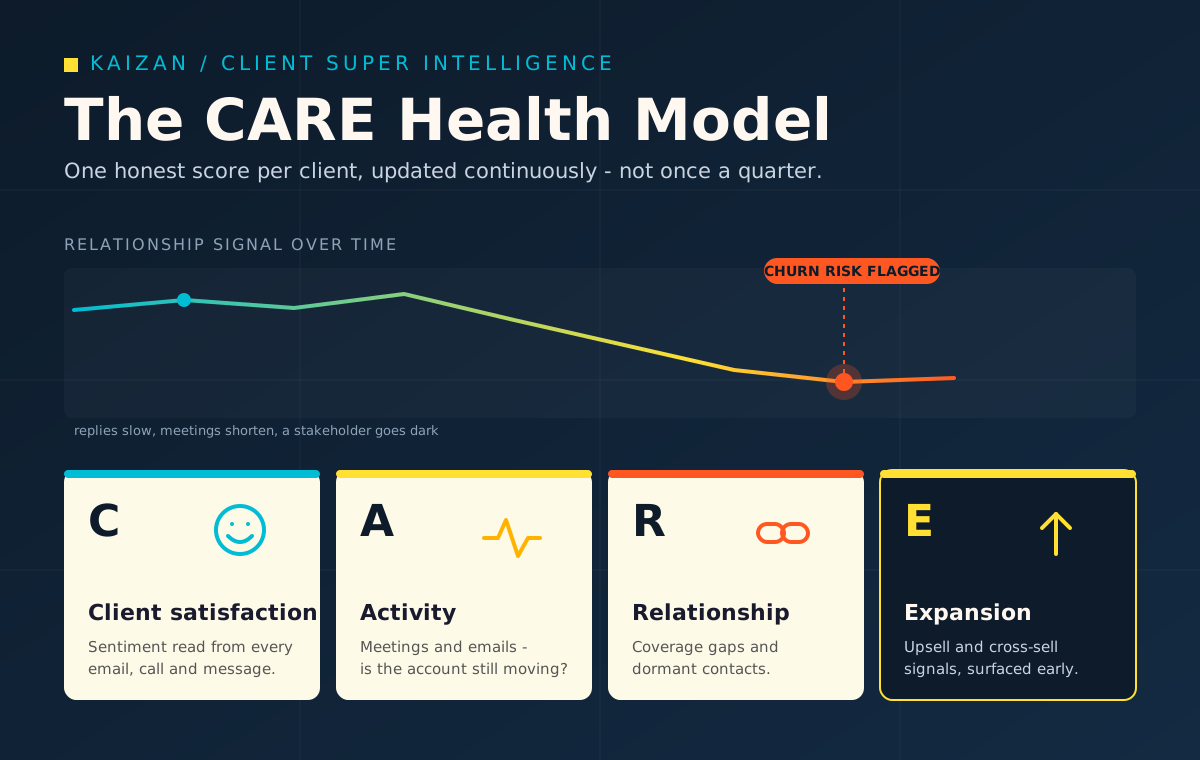
Kaizan organises all of this around a framework it calls CARE. It's an acronym, and normally I'd hold that against a company, but this one earns its keep because each letter maps to a question a service business actually loses money on. C is client satisfaction, read as sentiment across the emails, calls and messages. A is activity - are meetings still happening, is the thread still moving, or has the account gone quiet? R is relationship strength - who covers this client, and what happens when that one person leaves? E is expansion - the upsell and cross-sell signals that usually get spotted by luck, if at all.
The useful shift isn't the four categories. It's the word "continuously." A quarterly business review asks these questions four times a year. A renewal conversation asks them once, too late. Kaizan's argument is that the answers change weekly, in the texture of the correspondence, and that a machine reading every message can keep the score honest between the moments a human bothers to look.
It connects to the usual suspects - Salesforce, HubSpot, Gmail, Outlook, Slack, Zoom, Microsoft Teams, Jira, Asana, Notion. There's a chatbot layer that answers plain-language questions about an account and cites its sources, and it hooks into Claude, ChatGPT and other MCP-aware tools. The company says it's SOC 2 Type II and GDPR compliant, with customer data isolated and never used to train its models - a claim that matters more than it used to, given the product's entire premise is reading your most sensitive correspondence.
From ad-tech to account-tech
The founders
Kaizan was founded in 2021 by Glen Calvert, who runs it as CEO, and Pravin Paratey, the CTO. Calvert isn't new to this. He built Affectv, a programmatic ad-tech business, from what he's described as a tiny Soho office into a global operation with reach into the US and APAC, and stepped down as CEO in 2018; the company was later acquired. Before that he was on the founding team of Struq, an ad-personalisation company that Quantcast bought in 2014. The through-line from targeting ads to reading relationships is data most people ignore because it's messy and unstructured - the difference is that this time the payoff isn't a click, it's a client who renews.
Calvert is refreshingly un-hedged about the technology. "I think AI is under-hyped and the impact will be monumental," he said in an interview - a contrarian line in a year when most founders were busy managing expectations downward. You can hear it in the product's ambition: not a smarter alert, but a colleague-shaped thing sitting on every account.
I think AI is under-hyped and the impact will be monumental.
Glen Calvert, co-founder and CEO, KaizanA crowded, sharp-elbowed field
Where Kaizan sits
Kaizan isn't alone in noticing that the renewal call is too late to start caring. A whole category has formed around retention and client health, and the players are drawing the map differently. The rough shape of it:
The distinction worth holding onto is what each one reads. Hook and the usage-first tools watch what a customer does inside a product - logins, features, seats. That's a strong signal for software you can instrument, and a weak one for the agency or services firm where the real relationship happens over email and calls. Kaizan is aimed squarely at that second world, where the evidence isn't telemetry but tone. It's a narrower door, and probably the right one for the customers it wants.
What I'd watch, and what I'd steal
The honest read
The skeptic's question writes itself: if you let an AI read every client email and it's confidently wrong about a relationship, you've automated a bad instinct at scale. Sentiment analysis has a long history of missing sarcasm, culture and the deadpan of a client who is furious in perfect grammar. Kaizan's answer - keep a human in the loop, cite sources, let people check the reasoning - is the right posture, but it's a posture every AI company holds, and the proof is in whether service directors actually trust the flags enough to act before the renewal.
Here's the part worth stealing even if you never touch the product. Most teams run retention as a lagging metric - they measure churn after it happens and hold a post-mortem. The premise inside Kaizan flips that: the signals were always there, in writing, weeks early, and the only failure was that nobody read them. You don't need a £2.5m platform to start acting on that. You need a standing habit of asking, for every account that matters, the four CARE questions - is the client happy, is the account active, is the relationship deep enough to survive one departure, and where could it grow - and asking them this week, not next quarter.
Whether Kaizan becomes the tool that answers those questions for you, or just the company that named them well, the reframing lands. Clients rarely leave in a bang. They leave in a slow fade nobody was assigned to notice. Building the thing that notices is, at minimum, a good problem to be obsessed with.
Go deeper
Questions people ask about Kaizan
What does Kaizan actually do?
It ingests a client relationship's full history - emails, calls, chat, CRM and project data - and gives each account an AI helper that scores health, warns of churn risk, drafts follow-ups, preps QBRs and flags upsell opportunities.
What is the CARE model?
Kaizan's health framework: Client satisfaction (sentiment), Activity (meetings and emails), Relationship strength (coverage gaps and dormant contacts) and Expansion (upsell and cross-sell signals). It's meant to be a continuous read rather than a quarterly guess.
Who is Kaizan for?
Agencies, professional-services firms, SaaS businesses and account-management and customer-success teams that manage many client relationships and want earlier warning on retention and growth.
How is it different from Hook, Custify or Velaris?
They all target retention, but Kaizan leans on reading the full communication history - emails, calls and silences - rather than mainly product-usage telemetry, and assigns a per-account AI helper built around its CARE model.
Is client data used to train AI models?
No. Kaizan states it is SOC 2 Type II and GDPR compliant, with customer data isolated and never used to train its AI models.