Every fall, somewhere in America, a middle-schooler shuts a laptop lid on a pencil, cracks a screen against a locker, or drops a Chromebook down a stairwell. Multiply that by the thousands of devices a single district hands to students each year, and you get the quiet, unglamorous crisis that K-12 Tech has spent more than a decade turning into a business. The Valparaiso, Indiana company does not make the flashiest thing in education technology. It makes the broken things work again.
The story starts with a repair guy who kept getting the same customer. Zachary Marvel was running three cell-phone repair stores when local schools began dropping off boxes of damaged Chromebooks. Consumer phone repair is a crowded, price-pressured trade. School devices, it turned out, were a different animal: predictable volume, an annual damage cycle, and buyers - technology directors - who wanted one dependable vendor rather than the cheapest walk-in deal. Marvel, a former Army officer with a degree in military economics from Ball State, did the math and made a decision most side-hustlers never do. He stopped treating the schools as an add-on and made them the whole company.
What it actually does
The whole life of a laptop, under one roof
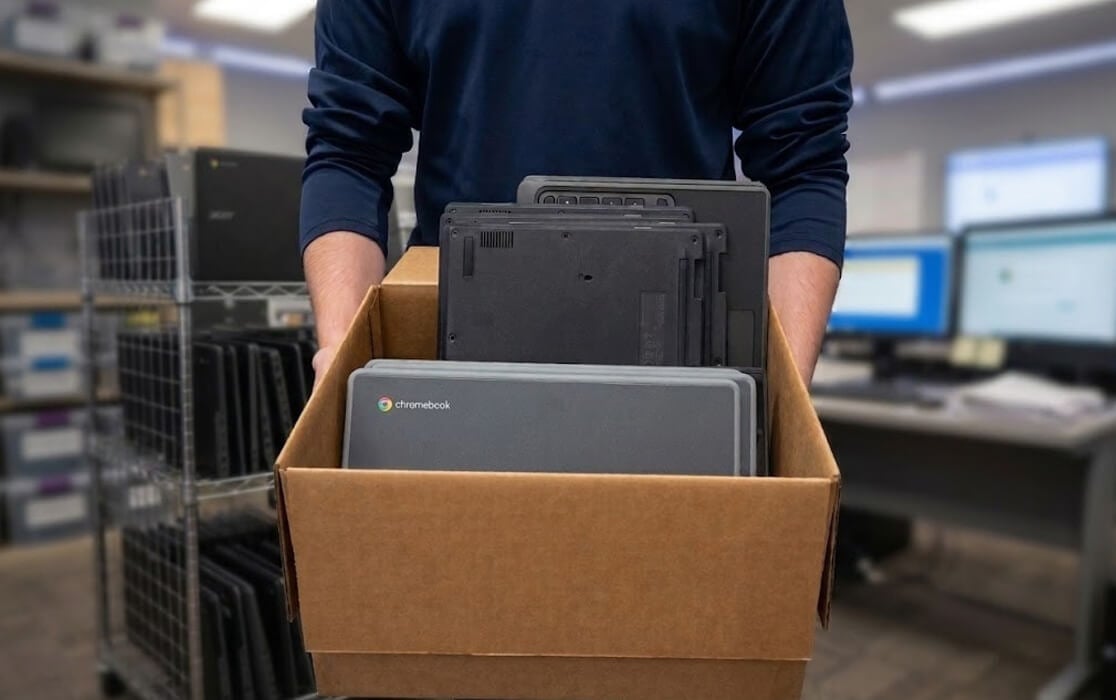
K-12 Tech's pitch is deceptively simple: it handles a school device from the day it arrives to the day it dies. That means four jobs most districts otherwise stitch together from four different vendors - deploying new devices, protecting them, repairing them, and buying them back at end of life. The company calls this lifecycle management, and it is the organizing idea behind everything it sells.

The repair bench
Insourcing the hard stuff
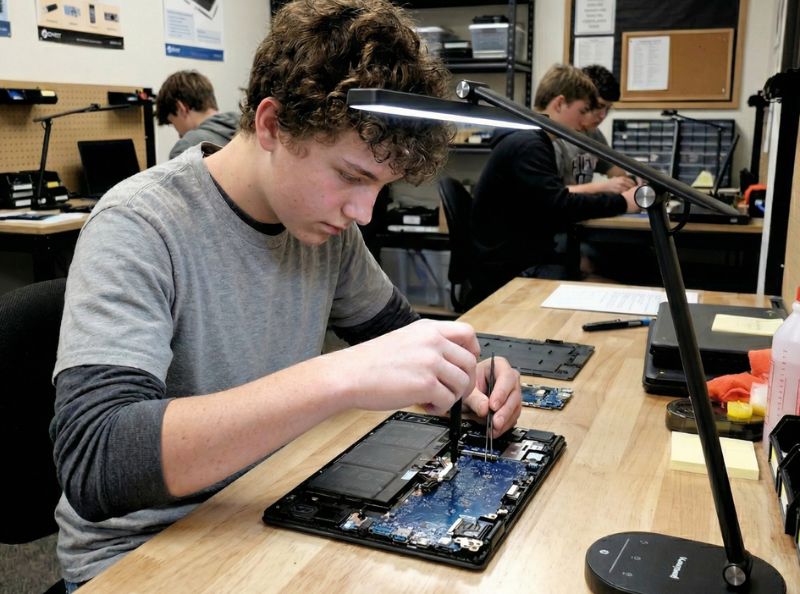
Plenty of repair outfits act as middlemen, mailing broken devices off to somebody else. K-12 Tech's differentiator is that it does the work itself. Its technicians are ASP-certified to perform in-warranty repairs for Dell, ASUS, Acer, HP and Lenovo, and the shop goes further than most: it does board-level microsoldering, the fiddly, high-skill work of fixing a circuit board that many shops would simply write off as scrap. Owning the hard repairs is a moat - it is also why the company can promise turnaround that keeps a device out of a student's hands for days, not weeks.
Speed is not a vanity metric here. When a district runs a 1:1 program - one device per student - a laptop stuck in a repair queue is a kid who cannot do homework. K-12 Tech says the majority of repairs are completed within five to ten business days, and it offers free local pickup or shipping so a broken fleet does not become a logistics headache for an already-stretched IT department.
The clever part
Give away the software, win the customer
The most interesting thing K-12 Tech built is not a repair bench - it is a piece of software it refuses to charge for. Rocket is an all-in-one asset, incident and help-desk ticketing platform made specifically for K-12 schools. It tracks devices, users and tickets in one portal, runs audits by building or room with barcode scanning, ships with more than 3,000 parts SKUs already listed, handles parent billing, and produces the dashboards a technology director needs to explain breakage trends to a school board.
And it is free. Permanently free, to any district, whether or not the school buys a single repair. As the company puts it plainly: "There's no advertising, and we don't sell data." No trial clock, no upsell nag screens.
Free Rocket is a genuine tool and a distribution engine. Put the software that runs a district's device operation into the tech director's daily workflow, and K-12 Tech becomes the obvious call the moment a screen cracks, a part runs out, or a fleet needs refreshing. In 2026, CTL began offering Rocket to its own national K-12 customer base - extending the platform's reach well beyond the company's repair depots.
The back end of the lifecycle
Turning dead devices into budget
When a fleet finally ages out, most districts see a storage-room problem. K-12 Tech sees inventory. Its buyback and eRecycle programs purchase retired devices and responsibly handle the e-waste, putting cash back into a school's technology budget. A related Community Buyback keeps refurbished devices circulating within the local community rather than shipping them off to a distant reseller. It is cost savings and sustainability wearing the same jacket - and for a public-school budget, both halves matter.
Where it sits in the market
Local at national scale
K-12 Tech competes with other device-lifecycle specialists like Synetic Technologies, ClearWinds and TECHSOL, with OEM repair depots, and with the in-house IT teams that would otherwise juggle all of this themselves. Its wedge is the combination: certified in-house repair, free software, and a depot model that offers local pickup across Indiana, Ohio, Michigan, Illinois, Missouri, Louisiana and Florida. For a district, that means the speed of a local shop with the range of a national vendor - and cooperative purchasing contracts through OMNIA Partners, TIPS and others make it easy to buy.
None of this is glamorous. There is no AI demo, no billion-dollar valuation, no keynote. There is a repair bench in Indiana, roughly 70 people, a free piece of software, and 1,700 schools that need their devices working by Monday morning. In a category that loves the new-device launch, K-12 Tech built its business on everything that happens after the box is opened - and that turns out to be the part that never stops.