Anecdote 01
The Wolf Den
On a recent Earth Force team call, Dawe noted a zone marked unavailable to protect a wolf den. The same software that points a chainsaw also tells it where not to go.
"Not all tons of carbon are equal." The Stanford engineer turned climate operator who put a Waymo-grade sensor stack inside a chainsaw cab.
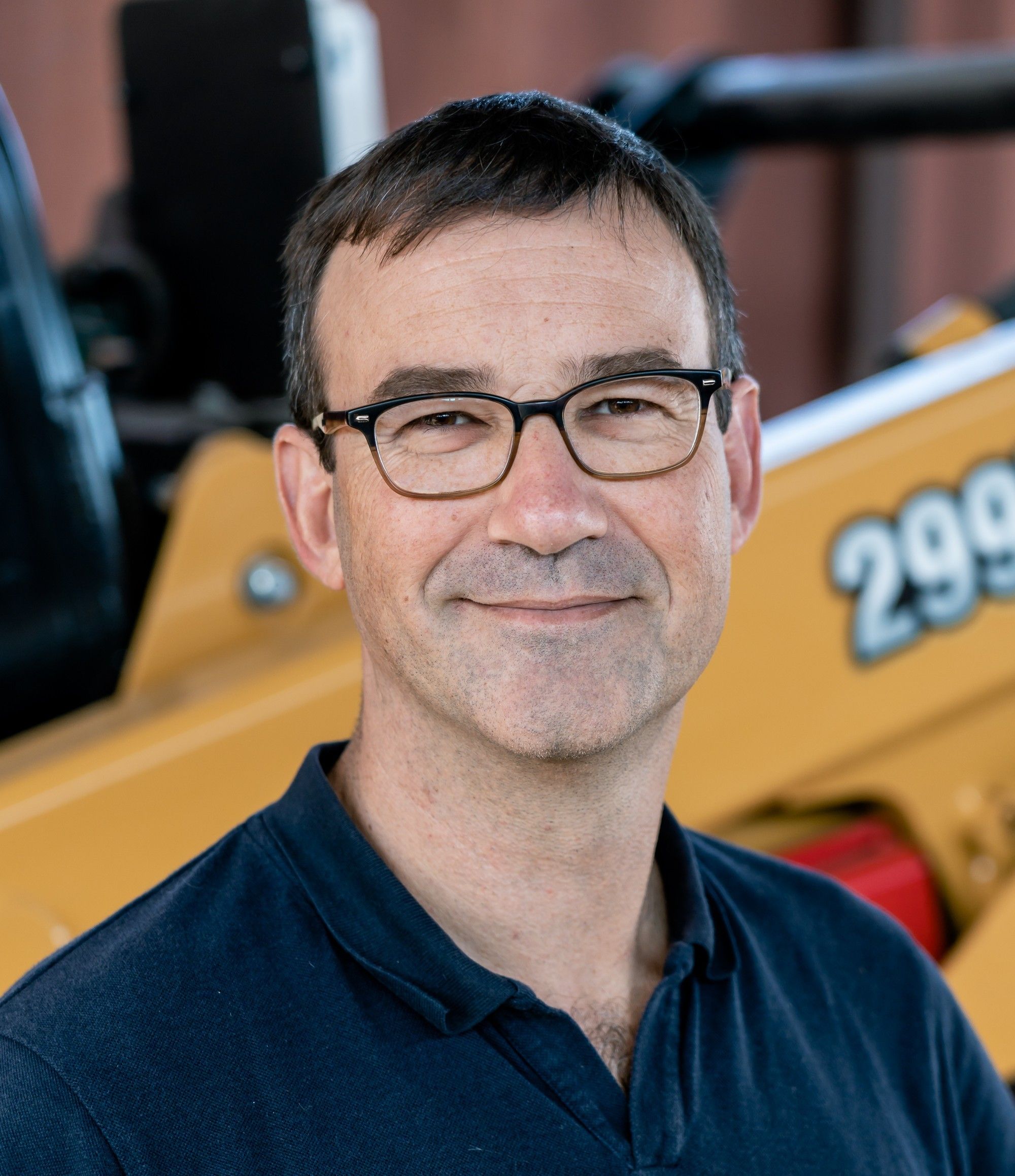
In a forest somewhere in the Santa Cruz Mountains, a man in a yellow hard hat watches a tablet light up with the silhouette of a wolf den. The zone glows red. He steers around it.
The tablet is called Guide. The company that built it is called Earth Force Technologies. The person responsible for both is Justin Dawe, an engineer who once ran an electric-scooter network and now spends his days thinking about tree crowns, fuel breaks, and what California's forests should look like after the next century of fire.
Earth Force makes two things. Guide is an in-cabin tablet bolted to forestry equipment. It fuses LIDAR, GPS and camera data into tree-level maps that tell an operator which thicket to thin, which oak to spare, and which acre belongs to someone else's deed. Portal is the web companion: a quiet bureaucratic miracle that lets a single administrator oversee, by Dawe's count, exponentially more acres than the clipboard-and-truck era allowed.
The pitch is not subtle. California needs to treat about 1.5 million acres of forest each year to stay ahead of wildfire. The state's current workforce can prep about 10,000. Dawe calls this being "off by two orders of magnitude," which is engineer talk for catastrophic. Earth Force exists to close that gap with software and sensors instead of with a workforce California cannot conjure.
The company raised roughly $8.6 million in seed funding in late 2022 from BOLD Capital Partners, Alley Robotics Ventures, and a quiet roster of climate-minded capital. The team has grown to about 18 people. The customers are land managers, forestry contractors, and the kind of state agencies that have spent the last decade learning, the hard way, that smoke does not respect property lines.
"What is missing is high-information strategies at scale. Faster, better, cheaper, and, critically, at greater scale." - Justin Dawe, Harvard International Review
On a recent Earth Force team call, Dawe noted a zone marked unavailable to protect a wolf den. The same software that points a chainsaw also tells it where not to go.
Earth Force's sensors caught an operator who had unknowingly drifted onto neighboring forestland. The data settled a payment dispute with Cal Fire and proved a quiet point: forestry has never had receipts before.
His aunt and uncle live in Ben Lomond. In 2020, the CZU Lightning Complex fire came within a mile of their door. The number you choose to take personally becomes the company you start.
Dawe is a Stanford engineer twice over - a BS in Manufacturing Engineering, then a master's in Engineering Economic Systems, the kind of degree you take when you want to model the world as flows of constraints. Then a Harvard MBA in 2007, which placed him squarely at the intersection of climate ambition and capital fluency that, fifteen years later, would finally have a name: climate tech.
He spent the early years door-knocking for Environment Colorado, then took fellowships through Green Corps and GE Energy's commercial program. He founded C12 Energy, an enhanced-oil-recovery and carbon-storage venture, and did time at Horizon Wind Energy as a project manager. He started Butter Home Services, designed to professionally manage homes in an environmentally efficient way, and closed it in 2016 when the unit economics refused to scale.
Then mobility called. As CEO and president of Scoot Networks, he ran one of San Francisco's early shared electric-mobility companies. After Scoot, he became VP of New Ventures and City Platform at Bird, a job that involved persuading municipalities that scooters were infrastructure. He left Bird in March 2020, just as the first lockdowns began, and the cities he had been negotiating with turned their attention to something else entirely.
Two years later, in January 2022, he started Earth Force.
Ask Dawe why he kept moving and he is fluent about it. "I stepped back and looked at the big map, if you will, of climate emissions," he told Harvard International Review. "This field is moving backwards. Frankly, it's a discouraging story." He has the particular tone of an operator who has spent a quarter century around climate work and has stopped expecting elegance.
What he found in forestry was something rarer than urgency. He found a sector that had not been digitized. Logging cabs still ran on paper maps and tribal knowledge. Forest plans still arrived as PDFs. Cal Fire still settled invoices on a handshake basis. The problem was not a lack of will. The problem was a lack of information density.
So Earth Force borrowed the playbook from somewhere that had solved a similar problem. VP of Operations Rikard Grunnan came from Waymo. He owns 20 acres of private forest land nearby. He, too, was radicalized by the 2020 fires. The DNA of self-driving cars now lives in chainsaw cabs, which is the sort of cross-pollination Dawe seems to attract.
Climate finance has spent twenty years treating a ton of carbon as a fungible unit. Dawe disagrees, and not gently. "Not all tons of carbon are equal," he says, and the line is more provocative than it sounds. A ton avoided through a soy-based offset in Mato Grosso is not the same as a ton kept in the soil of a thinned mixed-conifer stand outside Truckee. The work, the permanence, the co-benefits, the local economic effects - none of them are equal. The accounting was always a comforting fiction.
His policy frame is similarly direct. He talks about the need for "high-information stewardship of all lands," and he means all of them - grasslands, river settings, near-coastal landscapes. Wildfire, he says, is just a good place to start because it is urgent and visible. Earth Force is not a forestry company in the long run. It is a software company that has decided the operating system for natural land does not yet exist.
Inside the company, Dawe sounds less like a venture-backed founder and more like a coach. "Each member of our team gets to do work they are uniquely suited for," he says, which is a less catchy version of the kind of statement you only really hear from leaders who have closed a company before. (He has. Butter Home Services, in 2016. He talks about it without flinching.)
His career advice is plain enough to fit on an index card. "Follow the thing that you love to do," he told the Harvard interviewer, "and try to set your life up so that even if it takes time, eventually you're doing something that you feel really fulfilled by." It is a sentence from a man who spent twenty-five years getting to the work that finally fit.
"Follow the thing that you love to do, and try to set your life up so that even if it takes time, eventually you're doing something that you feel really fulfilled by." - Justin Dawe, on careers
The roadmap Dawe describes does not stop at trees. Earth Force, he insists, is starting with fire because fire is the wedge - the most urgent, most fundable, most data-hungry corner of land stewardship. The same sensor architecture and the same Portal back end, he argues, should eventually be deployable to a grassland in Kansas, a riparian corridor in Oregon, a coastal estuary in Louisiana.
Whether that vision survives contact with two more fire seasons and three more board meetings is, of course, the question every climate founder has to answer. Dawe has the unusual advantage of having already failed at one venture and survived two others. He knows what scalable means and what it does not.
For now, the company is quietly building. Earth Force's gear is being tested in the Santa Cruz Mountains, on land where the trees still carry the scars of CZU. The Guide tablets are in cabs. The Portal is in offices. The customers are signing. The forestry industry, long allergic to software, is being slowly taught to want it.
If Dawe is right about the math - and the math is hard to argue with - then the next decade of California fire planning runs through products like his. The state cannot hire its way to 1.5 million acres. It has to instrument its way there. Someone has to build that instrument.
So far, he is.