A tomato had become an unreliable business partner. Justin Chou was running Greendot, the vegetarian restaurant business he had co-founded in Singapore, when he noticed that its price kept wandering: S$1.80, then S$1.50, sometimes S$2. He wanted to understand the journey behind the bill. A restaurant needs ingredients every day. The people growing them need buyers. Somewhere between those two perfectly reasonable requirements, the explanation had gone missing.
Chou’s question was wonderfully unglamorous. It concerned a purchase that most diners would never think about, and that a busy restaurant operator might simply grumble over. Following it upstream would take him into agricultural distribution, introduce a different set of business partners and eventually put him in charge of Glife Technologies. The lunch counter had supplied both an income and a research problem.
There is a temptation to describe a food entrepreneur by the dishes he sells. With Chou, the more revealing subject is the distance those dishes travel. He has worked on restaurant brands, the movement of fresh produce and the development of plant-based products. Each job asks a related question: how do you get something people might enjoy into a place where they can actually buy it?
“why is my tomato S$1.80 today but S$1.50 tomorrow”
Justin Chou, recalling the question in 2019
A vegetarian and his meat-loving friend
Chou had been vegetarian since childhood. His friend Fu Yong Hong, whom he knew from secondary school, arrived at the idea from the other direction. Fu had once preferred meat and avoided vegetables. Meals cooked by Chou’s mother helped change his mind. That made their partnership a useful little market test before there was much of a market to test: one founder already believed in the food; the other had needed persuading.
In 2011, they started Greendot at Temasek Polytechnic. The ambition was an accessible restaurant brand, but the first version was a canteen stall. Fu agreed that the business should welcome people who ate meat as well as vegetarians. A customer ought to be able to choose lunch without applying for membership in a movement. The point was to make the food appealing enough to cross that boundary.
In a later recollection, Chou put the starting capital below S$25,000 and the founders’ monthly pay at S$500. His younger brother was studying at the polytechnic at the time. These are modest, domestic details: a sibling nearby, a small salary, a stall serving students. They give the eventual expansion a more useful starting point than any retrospective talk of destiny.
The early proposition also appeared in a government startup factsheet: convenient meals, attractive packaging and a focus on students. Even in that first incarnation, presentation and access mattered alongside what went into the bento box.
Ten seats, then a much bigger room
Moving from a school canteen to a shopping mall changed the arithmetic. Chou’s account of the Bedok Mall experiment described rent rising from a few hundred dollars at the school to S$8,000 in the mall. They began with only ten seats. A later Paya Lebar Square restaurant had about 100. It became profitable after six months, he recalled, but the founders also judged the space too large.
That is a pleasingly practical correction to the romance of expansion. A bigger dining room is impressive until you have to fill it. The sequence shows the founders adjusting a format, learning what size worked and finding the balance between a quick meal and somewhere customers wanted to sit. The restaurant had to earn its place in an ordinary day.
By 2017, Greendot’s nine outlets included malls connected to MRT stations. Location and ambience were part of the pitch to non-vegetarian diners. The business was meeting customers on their existing routes: shopping, commuting, finding lunch. Convenience was built into the address.
Chou eventually handed the chief executive role to Fu. In his own reflections, he describes his strengths as vision and strategy, and Fu’s as operations and relationships with people. That division allowed Chou to pursue another business while his friend led Greendot. Their shared history had produced a company, and then a workable way to stop sharing every task.
Following the ingredient upstream
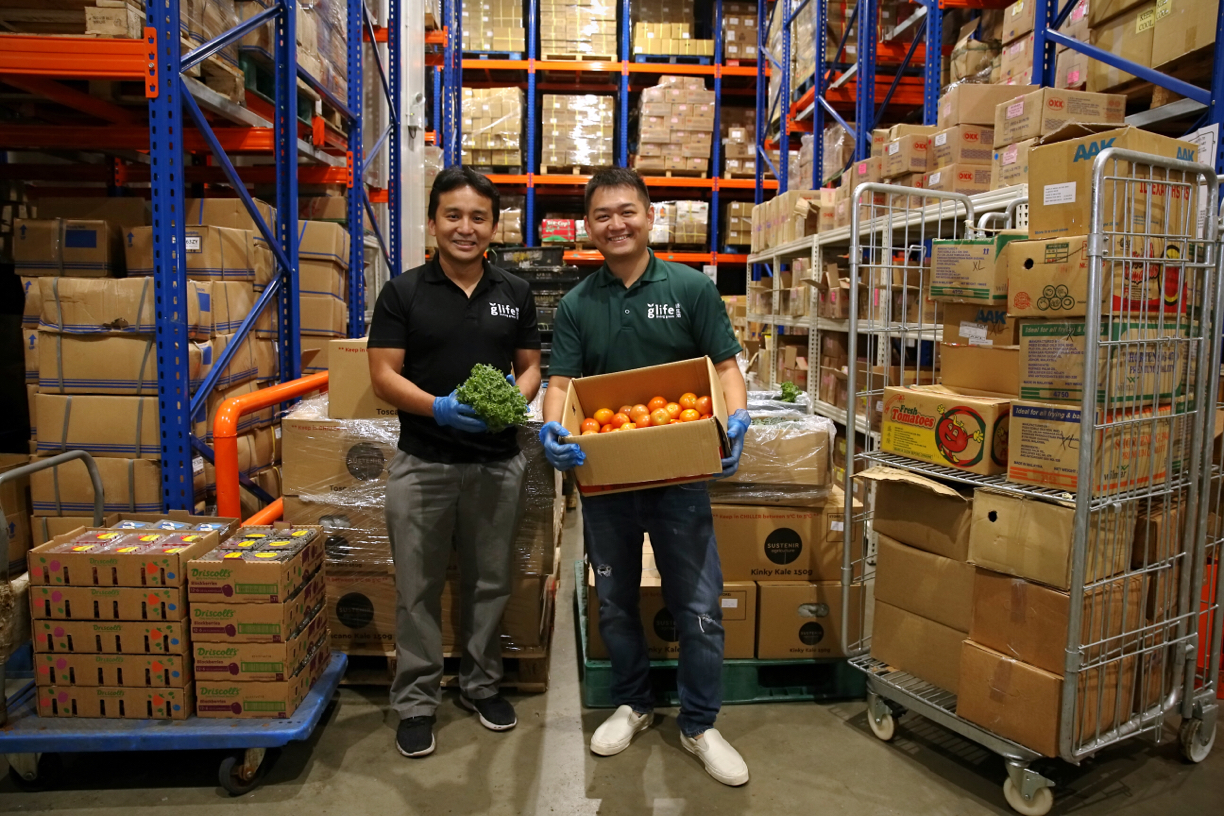
The next business took shape around the gaps Chou encountered as a restaurant buyer. Glife’s own milestones date its fresh-food supply operations to 2018. Its premise was direct purchasing from farmers and distribution to food businesses, with software helping customers order and follow the movement of their supplies. The company’s work would include a distribution network as well as an app.
The founding circle brought together Chou, Caleb Wu, Wayne Goh and Joe Chen. Chen came from a family involved in fruit and vegetable importing and brought connections to growers. Wu’s background was in commercial finance; Goh had previously built a deals aggregation business. The mix suited a problem that required buying, selling, financing and moving actual goods.
James Tan of Quest Ventures was an influential mentor. He introduced Chou to the example of China’s Meicai, which used technology to connect farmers and restaurants. When Glife considered spending its early funding on an ordering app, Tan urged the team to understand the customers first. Chou says they followed that advice and built their initial product after establishing demand.
A warehouse is a stern critic of elegant software. Somebody still has to deliver the right produce, in the right condition, to a kitchen waiting to use it. Chou’s early interviews repeatedly return to that practical standard. Farmers’ trust and customers’ habits were part of the work, too. A new system had to fit into somebody else’s working day.
When the restaurant orders stopped
In 2020, the restaurant trade that Glife served was interrupted by Singapore’s circuit breaker restrictions. Chou later described a sudden collapse in business orders and a decision made under pressure: sell directly to households. His account says the team assembled a consumer delivery app in three to four days. The company had fresh produce and distribution capability; it needed people who could still place an order.
He tells this part of the story with an eye for the absurdity of his own predicament. Restaurants had been difficult enough to operate. Supplying them around the clock with perishable goods had proved harder than he expected. In his public retelling, starting Glife resembles leaving an aeroplane while still constructing the parachute. The metaphor comes with a laughing emoji. The invoices, presumably, did not.
The consumer operation gave the business a way through that interruption. When restaurant activity returned, Glife closed the consumer platform and concentrated again on business customers. A hurried response to a crisis did not become a permanent commitment simply because it had worked.
This is one of the more interesting repetitions in Chou’s career. He can hold on to a broad ambition while changing the job he does to pursue it. He left restaurant management to Fu; Glife changed its customer during an emergency, then changed back. The route has been more negotiable than the destination.
A regional business needs local people
In November 2021, Glife raised S$11 million in a Series A round led by Heliconia Capital, with the Hibiscus Fund also participating. The funding announcement described an app and website through which food businesses could buy, manage and track orders. Investment provided resources for the next stage of that work, following earlier funding from Quest Ventures and Global Founders Capital.
Regional expansion involved acquiring local knowledge as well as adding geography. In 2022, Glife bought controlling stakes in PanenID in Bali and Yolek in Malaysia, and invested in Vietnam’s Koina. PanenID connected growers with hospitality buyers. Yolek brought an established plant-based distribution business. Koina worked with farmers and sold their produce to business customers.
Wu explained the preference for partnerships in terms of local networks, expertise and people. That approach fits the problem Chou had encountered at the beginning. Knowing that a restaurant needs vegetables does not automatically tell you whom a farmer trusts, how a local market operates or which relationships will survive the next difficult season.
A further US$3 million Series A1 round was reported in 2022, bringing Glife’s reported total funding to US$13 million at that point. Tin Men Capital joined existing investors. The stated plans included a digital marketplace and stronger technology infrastructure. The regional story was becoming a combination of software, physical distribution and businesses already rooted in their markets.
Separate rounds, separate currencies. Funding raised by Glife, rather than personal wealth.
The family business had a head start
Chou’s work with Growthwell grew from an older family enterprise. His father, Chou Shih Hsin, founded the business in 1989. Justin and his brother Colin later became part of the second generation leading its development. In 2021, Justin described a wish to broaden its direction beyond making substitutes for meat. Seafood alternatives and an investment in Israeli chickpea-protein company ChickP were part of that effort.
The distinction matters to his story. Greendot and Glife were ventures built with co-founders; Growthwell came with family history, products and experience accumulated before his arrival. Chou had grown up around his mother’s vegetarian restaurant and his father’s manufacturing work. He inherited familiarity with the trade, then sought a different scale and direction within it.
Growthwell raised US$22 million in September 2021 in a round led by Creadev. As the company prepared to expand internationally, it brought in an outside leader. Manuel Bossi joined as deputy CEO, worked alongside Chou for about six months and became group CEO in April 2022. Bossi later described that period as valuable preparation for taking charge.
It is another instance of Chou allowing someone else to occupy the chief executive’s chair. Building a company can involve choosing when to share authority, particularly when the next stage calls for experience in other markets. The handover gives his career a less solitary shape: friends, brothers, mentors and incoming executives all have consequential parts.
The next stop is the supermarket aisle
Happiee, Growthwell’s consumer brand, entered the UK in August 2023. By June 2025, Chou was discussing a range that included prepared lion’s mane mushrooms alongside plant-based seafood alternatives. He described a role covering product direction, innovation and retail listings. The setting had changed from a Singapore school canteen to British supermarket shopping, but making a product easy to choose remained central.
The mushroom range gives that ambition a concrete form. Prepared and marinated pieces reduce the work between buying an unfamiliar ingredient and getting dinner on the table. Chou was also considering other varieties and formats. There is room in his latest account of plant-based food for vegetables and mushrooms to stand on their own, alongside products designed to resemble seafood.
His declared ambition remains to feed 100 million people with plant-based food and encourage a billion lives to go green. Those numbers describe a mission, rather than a tally of people reached. Tatler recognised him among its 2021 Gen.T Leaders of Tomorrow, but the more revealing continuity is the problem he keeps choosing to work on: availability.
An appealing lunch needs a convenient counter. A farmer needs a dependable buyer. A new ingredient needs a usable format and a shelf where somebody will encounter it. Chou has approached that chain from several positions, sometimes wearing the restaurant operator’s apron, sometimes directing the supplier. The tomato’s wandering price was an invitation to look beyond the plate. He has kept following it.