The most revealing thing about Junction is an old HTTP header. Even after the healthcare-infrastructure startup changed its name from Vital, developers could still send requests using X-Vital-API-Key. It is a tiny archaeological layer in the documentation, and a tidy metaphor for the business: make the complicated parts underneath change without forcing the customer to rebuild what sits on top.
Junction gives digital-health companies one connection to two unruly worlds. The first is device data from watches, rings, glucose monitors, scales and other sensors. The second is laboratory testing - ordering the test, choosing a collection method, generating the requisition, nudging the patient, tracking the specimen and returning results. Neither world behaves like the frictionless diagram in a pitch deck.
Founder and CEO Maitham Dib started the company in 2021 as Vital. His initial pitch was straightforward: instead of asking every health app to maintain a thicket of integrations with Oura, Fitbit, Garmin and medical devices, let one API standardize the data. A company could embed a link widget, receive permission from a patient and pull familiar metrics into its own product.
01 / The moveFollow the data to the blood draw
Wearables were a useful wedge, but a heart-rate stream is not a diagnosis. Digital clinics also needed clinical biomarkers. They needed blood, saliva and other samples collected in a patient's home or at a nearby lab, then connected back to the same care experience. Vital added lab testing. When the company announced an $18 million Series A in March 2025, it also took the Junction name - a description of the place where device signals, lab results and care operations meet.
“We started out with devices, building integrations for different medical devices.”Maitham Dib, founder and CEO
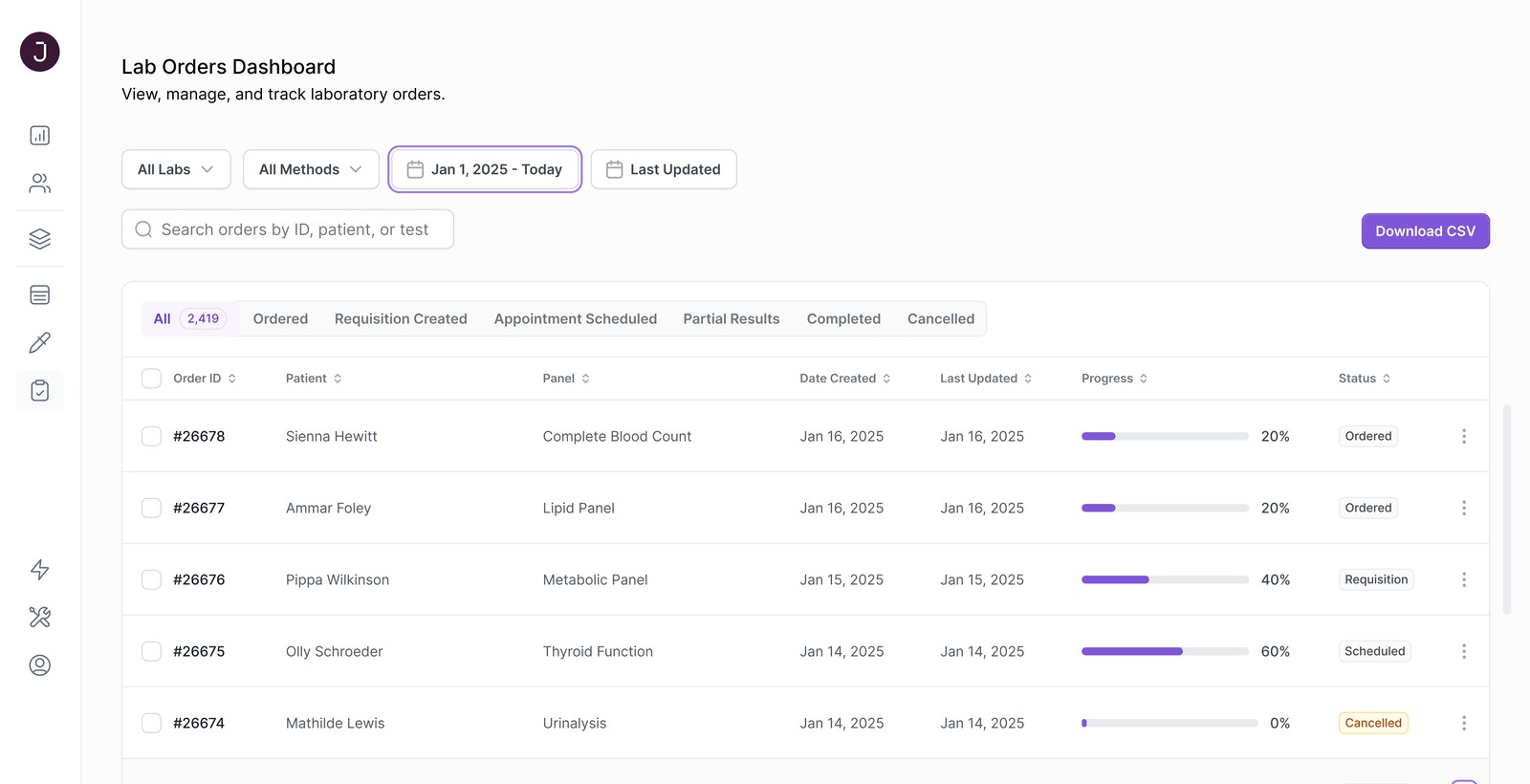
The expansion matters because it changed what the company sells. A pure data aggregator sells normalized fields. Junction sells completed workflows. Its customer can place a lab order, offer a walk-in draw, ship an at-home kit or schedule mobile phlebotomy, while Junction coordinates the unlovely details. Results can return as structured data and a laboratory PDF. Webhooks announce progress. Patient messages try to keep an order from vanishing into the familiar healthcare fog.
One request, many physical-world handoffs
The buyers are product, engineering, clinical and operations teams at virtual clinics, diagnostics brands, wellness platforms, EHR vendors and research programs. Junction has named Found, Parsley Health and Evidation among its customers. In its Series A announcement, it said it worked with more than 140 healthcare organizations, supported more than 500,000 lab tests annually and connected more than 2 million devices.
02 / The failureNew York breaks the neat diagram
The first thing to fail was not the API. It was the assumption that existing lab relationships could cover every market in the same way. Junction's customers could not use its earlier setup to order tests for patients in New York and New Jersey because of restrictions involving Quest and Labcorp. Geography met compliance, and compliance won.
The fix arrived through BioReference Health in October 2024. Its patient-service-center network gave Junction a compliant route into those two states. The customer-facing trick was continuity: Junction's API could decide which resources were available for a patient's ZIP code and route an order to an appropriate lab without making the customer invent a second workflow.
That episode is the company's moat in miniature. A competitor can copy an endpoint. It is harder to copy a collection of negotiated networks, state rules, order states, logistics procedures, security controls and lessons learned from specimens that did not arrive on schedule. Junction lists HIPAA compliance, SOC 2 Type 2 and ISO 27001 certification, and says it is GDPR-ready. In healthcare infrastructure, the paperwork is part of the product.
03 / The economicsCheap API, expensive alternative
Public pricing makes the device side easy to understand. The Launch plan begins at 50 cents per user per month with a $300 monthly minimum. Higher-volume Grow pricing drops below 50 cents. Enterprise Scale plans and lab testing are custom. Junction says a customized kit process usually takes four to six weeks and generally begins at 250 kits.
The sticker price is not the whole comparison.
Buyers weigh the subscription against direct integrations, vendor maintenance, lab setup, compliance work and the support queue created when a physical-world order stalls.
Launch plan
This is a B2B software business with a service layer. The API creates leverage, but lab operations keep it honest. Junction says it does not mark up tests on its current positioning; it earns through platform and service pricing rather than pretending a complex diagnostic program is a self-serve widget. The distinction from point competitors is breadth: device normalization, lab access and workflow automation live behind one relationship. The alternative might be Validic, Spike or ROOK for device data; a clinical-data network such as Health Gorilla; a lab infrastructure provider such as Ash Wellness; or an internal team knitting direct contracts together.
The company is not a consumer clinic and does not interpret a patient's results. It provides ordering authority in supported configurations, but it draws a line around physician consultations and personalized interpretation. That boundary is important. Junction is infrastructure for care delivery, not the care provider wearing a software costume.
04 / The copyBuild for the exception queue
There is a founder playbook here, and it is more specific than “build picks and shovels.” Start where many companies repeat the same expensive integration. Standardize the interface. Then keep walking through the customer's workflow until the promised outcome actually occurs. Junction began with access to device data. It expanded when access alone left the lab order, specimen and follow-up unresolved.
The Junction playbook, stripped for parts
- Choose a fragmented supplier market where every customer is rebuilding similar connectors.
- Offer a narrow developer wedge with a sandbox, clear documentation and one stable schema.
- Study manual exceptions: missed orders, odd state rules, failed syncs and support tickets.
- Add the operations that turn data access into a completed customer outcome.
- Preserve the interface while swapping and expanding the messy supplier layer underneath.
The sandbox is a small but sharp example. A developer planning support for several devices may not own every watch, ring or continuous glucose monitor. Junction can emit synthetic data for supported demo connections, letting the team test without assembling a drawer full of gadgets. It removes a practical obstacle at exactly the moment a prospect is trying to believe the integration will be easy.
Its culture appears designed around the same appetite for reality. Junction is remote-first, organized around hubs for periodic face time. One engineer described a paid trial day that involved adding a real endpoint to the company's monorepo, with the production release held until Monday. That is both slightly alarming and unusually informative: candidates see the work, and the company sees how they approach a live system.
The approach works when complexity repeats across many customers. It weakens when every workflow is clinically unique, volumes cannot clear minimums, a buyer already owns mature lab relationships, or vendor coverage is missing in the precise geography and modality required.
05 / The marketThe middle layer gets heavier
Junction sits between data sources and the companies delivering a health experience. Below it are labs, wearable makers, phlebotomy networks and logistics providers. Above it are clinics, software vendors and researchers who want structured information and predictable order states. The more fragmented the lower layer becomes, the more useful the junction can be - provided it can keep absorbing exceptions without turning every customer into a consultancy project.
The roadmap now reaches beyond connection and fulfillment. Junction Sense aggregates raw biometric streams. Its newer lab tooling can parse uploaded reports into standardized biomarkers, search a cross-lab compendium and select among lab accounts during ordering. The direction is clear: own more of the translation between a messy input and a decision-ready record.
The risk is equally clear. Infrastructure companies promise simplicity by taking complexity onto themselves. Every new device, lab, collection modality and billing arrangement adds another branch to maintain. Reliability, coverage and support matter more than the number printed on an integrations page. A single bad handoff can be a failed test, not merely a red error banner.
Still, the strategic insight holds. Digital health has spent years discussing what can be predicted from a stream of biomarkers. Junction asks a prior question: can the data arrive in a consistent form, and can the patient complete the test in the first place? It is a less glamorous problem. That may be why customers are willing to pay someone else to own it.