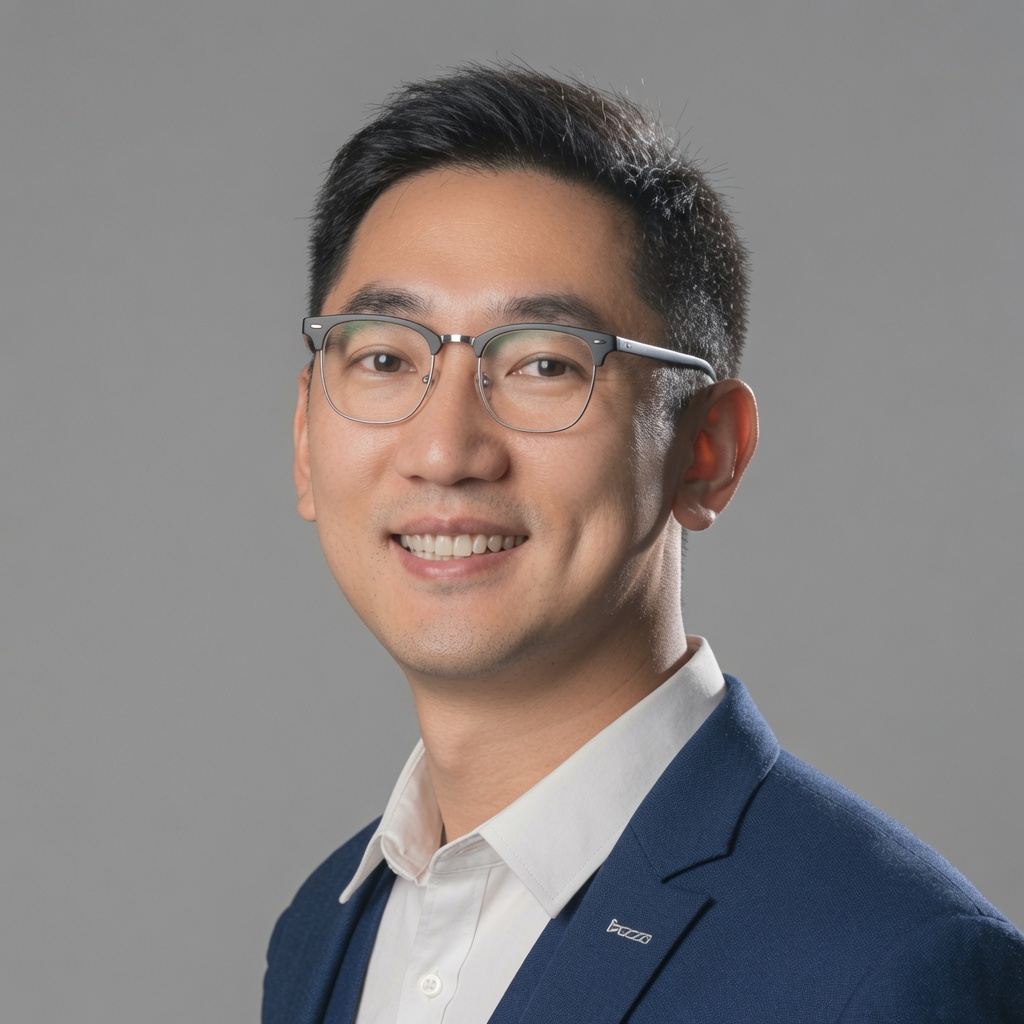
Junchen Wu pronounces alpha with a Greek letter. The flagship product at his company is spelled Sonαr - with that small, defiant α tucked where most companies would put an A. It looks like a typo on a slide. It is, in fact, the thesis.
Wu is the co-founder and chief executive of Menos AI, a Silicon Valley fintech building agentic AI for hedge funds, family offices, and the institutional investors who answer to them. The name Menos is borrowed from the Spanish word for less, and the company keeps repeating its own slogan back to itself the way a good restaurant repeats its own menu: less noise, more signal. They mean it. They have built a product around it.
What he is doing right now
Sonαr is what Menos AI calls an Intelligence Operating System for the buyside. In plain English, that means it ingests the firehose of research, transcripts, filings, third-party content, and trusted market data that any institutional investor drowns in on a Tuesday, and turns it into structured trade ideas that an analyst can actually test. The system is built on two pieces of in-house plumbing. The first is Narrative Architecture, which distills unstructured research into a finite set of market themes. The second is Voice Score, which evaluates contributors and figures out whose calls actually move the needle. One is a map. The other is a meritocracy.
Wu put it cleanly during the Fintech Sandbox Demo Day 12 panel: "We are a true multi-asset AI-powered research and portfolio management system. Today we focus on fixed-income and global macro - FX, commodity, rates." That is not the kind of sentence you write on a deck if you want to sound exciting. It is the kind of sentence you write if you want a $3 billion family office to take the meeting.
In August 2025, Menos AI announced an oversubscribed $5.2 million seed round, anchored by Silicon Valley family offices and venture firms. Three months later Wu was on the Funded, Now What?! podcast explaining the founder-market fit problem in fintech to a host who had clearly never tried to onboard a hedge fund. The episode runs fifty-six minutes. There is no filler.
The credential stack
Wu holds a PhD from Northwestern and a CFA charter. Both of these are hard. Holding both is statistically odd. The PhD signals patience and a tolerance for problems that do not resolve in a sprint. The CFA signals that he can read a footnote and find the sentence that costs you money. Add a decade in front-office quant work, and you have a founder who can speak to a researcher and a risk officer in the same hour without translating.
Before Menos AI he served as Head of Quant Analytics and a member of the Front Office Analytics team at Northern Trust, where the client list included Bridgewater and Citadel. The work was not glamorous. It was the plumbing of the buyside: onboarding, risk modeling, the daily mathematics of making sure a client's positions match the model that says those positions are safe. Earlier still, he managed risk on a multi-strategy book worth roughly $3 billion at a Boston quantitative hedge fund, a role public records and LinkedIn place at Weiss Asset Management.
None of that is the part of the resume founders usually lead with on a pitch deck. Wu leads with it anyway. The pitch for Menos AI is not that AI is exciting. The pitch is that he knows where the actual mistakes live in an investment workflow because he has made them, watched them, and modeled them.
Why the buyside is different
Most generative AI startups picked the easy demos. Summarize an email. Draft a memo. Write a Python script that nobody will run in production. Menos AI picked the hardest customer in software: an institutional investor who legally cannot be wrong, ethically cannot leak, and emotionally has been burned by every previous wave of fintech magic. Selling to that customer requires patience for procurement cycles measured in seasons. Wu seems to enjoy this. His LinkedIn essays read less like founder content and more like a research note that wandered out of an internal Slack.
What Sonαr actually does
That last bar - institutional memory - is the line that quietly carries the strategy. Hedge funds lose senior analysts and lose with them the unwritten knowledge of which contrarian call worked, which thesis was abandoned for the wrong reason, which counterparty got too cute in 2018. Menos AI bets the next moat is not just better answers. It is remembering what your firm already learned. Augmentation, not replacement. A bicycle for the analyst, not a robot in her chair.
The founding three
Menos AI was co-founded by Junchen Wu, Xiang Pan, and Baojiang Yang. Pan, the chief technology officer, came up through Google and SRI. Wu sits in the chief executive seat, the role that has to translate proprietary research math into language a chief investment officer trusts on a Friday afternoon. Yang rounds out the technical bench. The team is seventeen people. They are listed in San Jose. The work is happening in San Francisco, Menlo Park, and any conference room in Manhattan that will book a follow-up.
The quiet style
Wu does not perform online. He writes the way he thinks, which is to say slowly and with footnotes you cannot see. The Drucker quote on his LinkedIn - if you can't measure it, you can't improve it - is a small giveaway. It is the kind of line a quant pins to a wall in college and then accidentally builds an entire company around. He attended the NEX-T Summit at Stanford in late September 2025 and posted about it in the same understated cadence he uses for product launches. He goes by William in English contexts and Junchen in formal ones, a small bilingual housekeeping detail that, like everything else, he handles without making it a thing.
The aspiration
Ask Wu what Menos AI is for, in the longest possible version, and the answer is not a product. It is a stance. AI for asset management should augment the investor, not replace her. It should be auditable. It should be testable. It should preserve the institutional memory of the team that built it. It should give credit to the analyst whose Voice Score was loudest when it counted. It should ship to production at a hedge fund and survive the first quarter where everyone is wrong.
That is a long aspiration. It is also a precise one. The bet is that whoever wins the buyside AI category will win it not by being the loudest, but by being the most measured. Which brings us back to Drucker. Which brings us back, again, to less noise and more signal. Wu has been repeating the line for a year. It is starting to sound less like a tagline and more like a thesis.
Fun facts, on the record
The α in Sonαr is not a typo. Menos AI ships its thesis in the wordmark.
PhD and CFA. Both. A combination LinkedIn headlines rarely actually earn.
Menos is Spanish for less. The company has built its product around its own slogan.
The Menos AI pitch is straightforward enough to print on a coaster. The execution is the part that takes a PhD, a CFA, ten years of risk work, and a co-founder who has shipped systems at Google. Junchen Wu is building for the customer he was. So far the customer is calling back.