An empty paper dispenser has a peculiar power. It can make a building full of sophisticated technology feel badly run. The lifts may know which floor you want. The lighting may have opinions about daylight. Yet somewhere a person is waving wet hands at a machine that has exhausted its contribution to civilisation. Junaith Ahemed Shahabdeen has built a company around giving ordinary building equipment something useful to say before that moment arrives.
Shahabdeen is the CEO and co-founder of Zan Compute. His working materials include sensors, machine learning, bins, occupancy data and the decisions that cleaning teams make throughout a shift. It is a curious combination until you consider how much of a building's reputation depends on small things being attended to at the right time.
His career offers a useful way into that problem. He has been a programmer, a software architect and an Intel researcher. Since 2014, he has also had the founder's job of persuading other people that a technical idea deserves a place in their working day. A clever sensor has to survive that conversation.
The engineer before the entrepreneur
His education crossed two disciplines: mechanical engineering at Bharathiar University and a master's in computer science at Western Michigan University. That combination sits comfortably beside his later work, in which software needs to understand objects that take up space, use power and require someone to maintain them.
At DigitalSun, he worked as a software programmer. At Lusora, he became a software architect. In November 2005 he joined Intel as a machine-learning researcher, a role he held until November 2014. These were years spent on computing that could interpret signals from the physical world, well before an AI assistant became a familiar item on a product menu.
The research community was part of that working life. In 2008, he was among the co-authors of “IMOTE2: Serious Computation at the Edge,” alongside Lama Nachman, Ralph Kling, Jonathan Huang and Robert Adler. The title captures an engineering concern that still matters: useful computing can begin close to the thing being measured.
He also appears among the reviewers for UbiComp 2014, affiliated with Intel. Research involves this quieter labour as well as putting your name on a paper: examining other people's ideas, questioning methods and deciding whether a result deserves an audience. His professional world included both building systems and helping assess them.
A bin with something to report
One of Shahabdeen's early Zan ideas was wonderfully literal. A US patent application filed in December 2014, naming him as inventor, describes a smart garbage bin. Sensors measure its contents; a wireless connection sends information to a remote controller. A bin could report that it needed attention instead of waiting for somebody to look inside.
The application considers sensing from the lid or the base, using distance or weight. It also describes varying the frequency of measurements to conserve power. These are modest details with real consequences. A battery that needs constant replacement can turn a labour-saving device into another appointment on somebody's rounds.
The application was later abandoned. Its significance here is as a record of what he was trying to build, rather than a trophy for the mantelpiece. The idea brings an engineer's attention to a task that is usually performed through repetition: walk over, check, move on. Give the object a way to report its condition, and the visit can have a reason.
He wanted the lights to understand the room
By March 2016, Shahabdeen was writing about a larger question: how much should a smart building understand about the people inside it? His example was lighting. A movement sensor can turn on a light when somebody passes, but that alone says little about whether the person is walking through or settling down to work.
The distinction interested him because different activities call for different responses. A system that understood the activity could adjust its timing and illumination. He was thinking beyond separate controls for lighting, heating and security, toward a building that responded more meaningfully to its occupants.
Then his imagination acquired a mischievous edge. He floated the possibility of buildings giving users feedback, “even condemning resource wastage.” A building with a disapproving manner would certainly give the office something to discuss. Beneath the joke was a consistent ambition: make information about use matter to what happens next.
“even condemning resource wastage”
Junaith Ahemed Shahabdeen, imagining a more outspoken building, 2016
Recruiting people who knew the rounds
Shahabdeen also brought facilities experience into the company. In May 2016, Zan announced Mike Latham and David Farwell as board members. Both had worked at ABM Industries. Latham had run engineering and facility-services businesses; Farwell brought experience in finance, strategy and capital markets.
The pairing made practical sense. Shahabdeen knew sensing and data science. These colleagues knew the organisations expected to buy and use the results. For a founder taking software into building operations, the conversation has to include staffing, contracts and the economics of a service business.
Zan's early offering already reached beyond a single device. It connected objects such as dispensers, bins and water infrastructure to cloud analysis and interfaces for facility managers. Shahabdeen was assembling a business in which hardware and software had to work alongside people who already had a demanding job to do. Their experience belonged inside the design conversation.
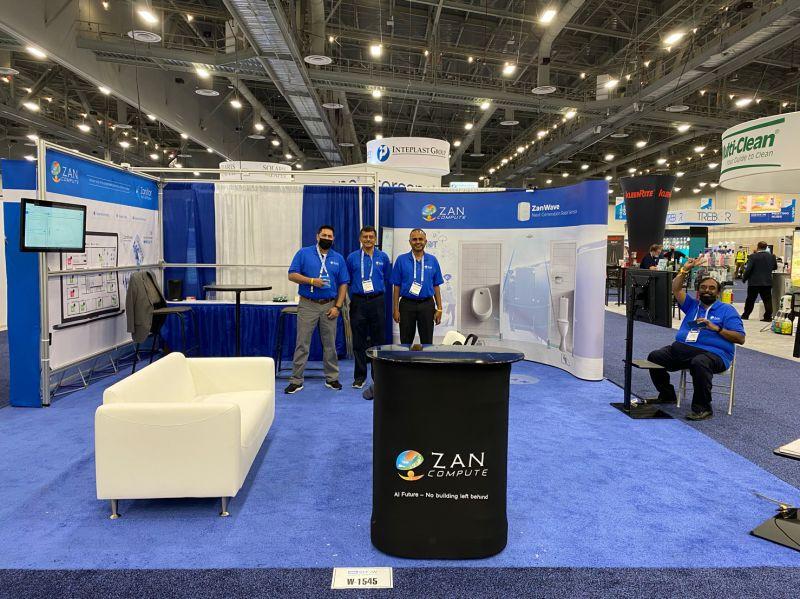
There is a more informal glimpse of him in his ISSA 2021 post. “Zan team ready for day 1,” he wrote. Afterwards he thanked the team for its work and visitors for their interest. The booth photograph has the familiar furniture of a trade show: matching shirts, demonstration screens, a white sofa and a lot of carpet. This is where an abstract platform gets explained one visitor at a time.
The partners behind the plumbing
In January 2019, Zan announced that Bobrick Washroom Equipment had invested in its seed round. More than $1 million had been raised from strategic partners and angel investors. Bobrick would also work with Zan on smart washrooms. For Shahabdeen, a manufacturer of the equipment itself was joining the effort to make that equipment informative.
The company said its systems were already installed in commercial offices and airports. It reported material and resource savings of 15 to 30 percent. Those were company-reported results, rather than a promise that every building would deliver the same return. The business argument was straightforward: use information to reduce wasted effort and supplies while improving service.
Later that year came a partnership with The Service Companies, bringing Zanitor into its smart facility offering. The service provider then worked across more than 1,500 properties and venues in the United States and Caribbean. That figure described the partner's footprint, rather than Zan installations. The opportunity was access to people already responsible for delivering the work.
- SenseUsage and supply levels
- InterpretPatterns and priorities
- ActTasks for facility teams
- RecordWork orders and inspections
A conceptual view of the work connecting Zan's sensors, analytics and facility software.
Shahabdeen's relationships also include Impala Ventures. In a testimonial, he describes Brian and Impala as advisers and a sounding board on fundraising and business development. He values the perspective of somebody who has been both a founder and an investor. Even a company devoted to collecting information benefits from having someone sensible to talk to.
Borrowing another building's senses
In September 2023, Enlighted, the Siemens-owned building-technology company, announced Zan as a partner. Zan would use Enlighted's occupancy data to guide cleaning and apply its analytics to workload and resource planning. A building's existing information could acquire another job.
This is an important development in Shahabdeen's story. A company that makes sensors can still find value in somebody else's sensors. If the aim is a better cleaning decision, the origin of a useful occupancy signal need not dominate the discussion. Connecting systems becomes part of the work.
The Bobrick relationship also remained visible in 2026. Its BobrickSMART brochure offered a turnkey analytics and dashboard option powered by Zan Compute, alongside an open API route to other systems. The product description walks through dispensers, gateways, cloud processing and alerts. Years after the investment announcement, the partnership appears in the practical business of specifying equipment for a building.
The next decision fits in a pocket
Shahabdeen has continued discussing the subject in public. In March 2025, he shared his appearance on “The Smart Building Blindspot,” an episode of Hard Refresh, the ISSA podcast. He thanked Caden Hutchens and Karina Neff for the discussion about smart buildings and cleaning. The topic still had questions worth working through.
By September 2026, ZanI's Android listing described work orders, sensor alerts, inspections and an AI assistant in one application. Inspections could be saved offline and sent after reconnection. That small accommodation says something useful about the setting: a facility team cannot organise its entire day around the availability of a connection.
For Shahabdeen, the next chapter therefore reaches from sensing into the tools people carry while doing the work. His longstanding interest in context has a concrete destination: helping a team decide what deserves attention and keeping a record when it is done. The building may eventually offer an opinion about waste. First, somebody needs to know which dispenser is running low.
Continue the conversation
Read Shahabdeen's writing, watch his podcast appearance, or explore the products and partnerships discussed here.