The revealing detail about Jumia is not hidden in an app screen or an investor spreadsheet. It is a paper catalog. In 2024, chief executive Francis Dufay told a reporter that the company had printed one million of them. This is how an internet marketplace advertises in places where connectivity is patchy, discovery still happens offline and a customer may trust a neighbor with a booklet more than a banner ad.
That catalog is a tidy metaphor for Jumia Group, the commerce company founded in Nigeria in 2012. The familiar shorthand is “the Amazon of Africa.” It is convenient, and increasingly incomplete. Jumia does run a vast online store, but its practical work is assembling the pieces that mature e-commerce markets can take for granted: a useful product assortment, a payment that clears, a route that exists, a seller who can ship and a place where a customer can collect the parcel.
Today, Jumia operates in eight countries: Nigeria, Egypt, Morocco, Kenya, Ghana, Uganda, Senegal and Côte d'Ivoire. Its 2025 annual report counted 6.0 million annual active customers, about 70,000 active sellers and 23.3 million orders. The company says its sites received more than 900 million visits that year. These are large numbers attached to a still unfinished business. Jumia recorded $188.9 million in 2025 revenue and a $50.5 million adjusted EBITDA loss. Management is aiming for adjusted EBITDA breakeven in the fourth quarter of 2026 and full-year profitability in 2027.
A marketplace with an offline nervous system
Jumia's core product is the marketplace, where consumers browse phones, electronics, home goods, fashion, beauty products and everyday items from local and international merchants. More than 91 percent of the items sold through the marketplace in 2025 were offered by third-party sellers. That matters because the seller, not Jumia, usually carries the inventory risk. Jumia can widen selection while earning commissions and fees around the transaction.
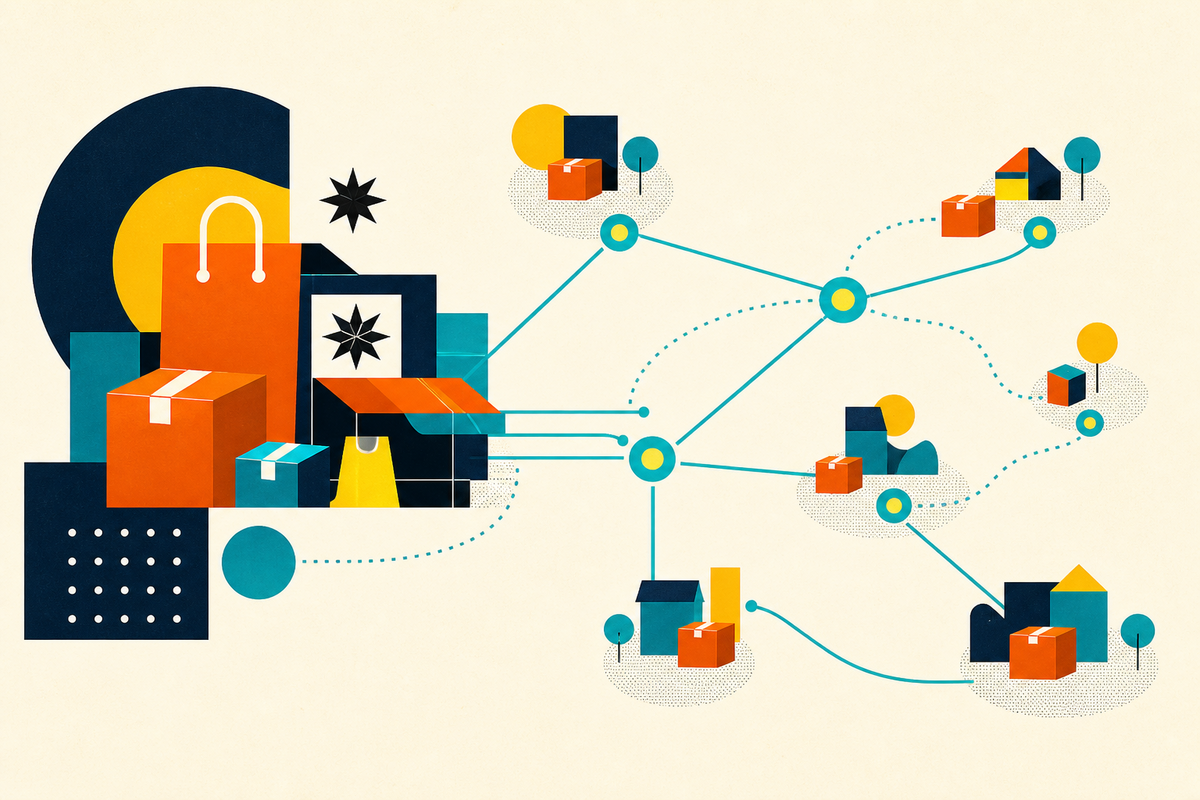
The marketplace is only the visible layer. Underneath it sits Jumia Logistics, a network of leased warehouses, seller drop-off locations, customer pickup stations and local delivery companies coordinated with Jumia's software and operating processes. The company does not need to own every van or motorcycle. It needs to make many independent pieces behave like one dependable system.
Local shops, distributors and global merchants list products, buy advertising and use fulfillment services.
Jumia connects discovery, checkout, payment gateways, warehouses, partner carriers and pickup points.
Consumers, retailers and corporate buyers receive a broader assortment without all living near a modern mall.
Payments receive the same local treatment. JumiaPay and the company's gateways work with licensed payment providers and other partners, allowing the platform to accommodate cards, bank transfers, mobile money and market-specific options. Cash on delivery has historically remained important too. A shopper's problem is not a lack of desire to buy. It may be that a card is unavailable, online fraud feels risky, or the household budget requires seeing an item before parting with cash.
“We have learned the hard way and today we prefer to focus on the fundamentals.”Francis Dufay, chief executive
The customer beyond the capital
Jumia's most interesting customer may live outside the largest city. By late 2025, management said orders from secondary cities and rural areas - “upcountry” in the company's vocabulary - represented 61 percent of volume, up from 56 percent a year earlier. A pickup station makes that growth possible. Instead of paying for a doorstep attempt along a difficult route, Jumia can consolidate parcels at a known local point. The customer collects on a predictable schedule. A fixed location turns uncertain geography into repeatable economics.
This customer base is price sensitive and practical. Jumia's stated mission is to improve everyday life with convenient and affordable online services while helping businesses grow. In concrete terms, that can mean making refrigerators or smartphones available where physical retail selection is narrow. In Kenya, a 2025 partnership with Watu Credit offered mobile-money installment plans for smartphones. In Egypt, Jumia and Arabic speech-technology company Intella introduced Ziila, a voice-ordering assistant that understands Egyptian dialect. A customer can speak as if sending a voice note instead of typing a product query.
These are not ornamental features. They tackle access: the cost of a device, the friction of text input, the distance to a store. Jumia also uses JForce, a network of independent sales consultants who explain e-commerce locally, and advertises through radio and print. The model is digital at its center and deliberately mixed at its edges.
How the machine gets paid
Jumia makes money in several ways. Third-party sellers pay commissions and fees; brands and merchants buy sponsored listings, display placements and customer-relationship marketing; logistics and fulfillment generate service revenue; payment activity produces fees; and Jumia sells selected goods directly as a first-party retailer. In the fourth quarter of 2025, marketplace revenue was $31.0 million and first-party sales revenue was $29.9 million. Advertising remained just one percent of gross merchandise value, leaving management a tempting source of higher-margin revenue if sellers can see a measurable return.
The company has also started selling its logistics capability on its own. Jumia Delivery, tested in Côte d'Ivoire and expanded to Nigeria in May 2025, accepts parcels from individuals and businesses that did not originate on the marketplace. It is a sensible piece of reuse: a delivery network built to solve Jumia's problem can become a product for everyone else's.
Growth returned in 2025
Bars are indexed within each metric. Revenue rose 13%; GMV rose 14% as reported.
The catch is that scale has not yet produced an annual profit. Jumia has spent the Dufay era narrowing its footprint, cutting overhead, improving fulfillment and choosing growth with better unit economics. South Africa and Tunisia closed in late 2024. Algeria followed in early 2026, leaving eight markets. Headcount stood at 2,016 at the end of 2025, down seven percent from a year earlier. The simplification is not a retreat from African e-commerce; it is a wager that depth in working markets matters more than flags on a map.
The local advantage, and its limits
Jumia competes with a peculiar crowd. There are conventional marketplaces such as Konga and Kilimall, Amazon and noon in parts of North Africa, cross-border platforms including Temu, Shein and AliExpress, and thousands of informal sellers trading through WhatsApp, Instagram and Facebook. The last group may be the most revealing. Social commerce is flexible, conversational and built on personal trust. Jumia's challenge is to offer that local fluency with clearer selection, payment protection, fulfillment and returns.
Global competitors can bring cheap supply and enormous marketing budgets. Jumia's defense is the accumulated knowledge of where to put a station, which payment method creates confidence, which assortment gap matters and how to manage a carrier network across borders. Its 2023 Starlink deal illustrates the two sides of that position. Jumia can distribute a product designed for underserved connectivity, first in Nigeria and then Kenya, while better connectivity may create more future Jumia customers.
International supply is growing as well. Jumia said gross items sold by international merchants rose 82 percent year over year in the fourth quarter of 2025, helped by direct sourcing and a new office in Yiwu, China. Cross-border sellers can fill product gaps and lower prices. They can also make Jumia resemble the global platforms it is trying to distinguish itself from. The balance is delicate: wider selection without losing local merchant relevance, affordability without a race to subsidy, and growth without reopening the cash drain.
A turnaround measured in repeat behavior
The early 2026 numbers offered evidence, not closure. First-quarter revenue rose 39 percent year over year to $50.6 million. Gross merchandise value reached $211.2 million. Adjusted EBITDA loss narrowed 32 percent to $10.7 million. More tellingly, the share of new customers who made a second purchase within 90 days improved to 46 percent for the third-quarter 2025 cohort, from 42 percent a year earlier. A marketplace becomes sturdier when shoppers return without being bribed by another extravagant coupon.
Launch in Nigeria
A familiar online retail idea meets a very specific operating environment.
Unicorn and one Jumia brand
Major investment carries Africa Internet Group above a $1 billion valuation.
New York listing
Jumia begins trading on the NYSE under the ticker JMIA.
A profitability reset
The founders step down and Francis Dufay takes charge of a leaner strategy.
Eight markets remain
Q1 growth accelerates, while breakeven remains a target to prove.
There is still risk in the road. Currency swings can distort pricing and results. Customers have limited disposable income. Global supply disruptions hit electronics, an important category. Delivery quality depends partly on partners. The company ended 2025 with $77.8 million in liquidity after using $47.9 million in operating cash during the year. Its timetable leaves little room for a return to undisciplined expansion.
Yet Jumia now looks more coherent than the sprawling internet conglomerate it once tried to become. The marketplace, payments and logistics layers reinforce one another. A seller gains reach. A shopper gains selection. A delivery partner gains volume. Jumia earns at several points along the route. The clever part is not any single technology. It is adapting the whole chain to the customer standing at the other end.
That brings us back to the paper catalog. It is amusing because it feels backward, and useful because it is not. Jumia's most transferable lesson is that a digital company should not confuse the purity of its interface with the messiness of the problem. Sometimes the road to an online order begins on paper. Sometimes it ends at a neighborhood pickup counter. The system works when the customer does not have to care how many workarounds made the click real.