Jule Kreyling wanted to move into management. He was working as in-house counsel, and a position had opened up. Then the person who had previously held it returned to the company. The opportunity disappeared. The company president offered advice instead: if Kreyling wanted to lead in this industry, he should spend some time in sales.
He spent three years there. Looking back, he credited that experience with teaching him how the sales cycle worked and what salespeople went through. It is an unusually useful detail in an executive’s career. A missed appointment became an apprenticeship in another person’s job. The route to management acquired a detour, complete with customers.
That episode gives a way into Kreyling’s subsequent work. Equipment finance brings together people whose responsibilities can pull in different directions. Someone has to win the business. Someone has to assess the borrower. Someone has to make the documents work. Understanding the pressure on each person is a practical qualification for the person in charge.
A lawyer crosses the desk
Kreyling’s formal education took him through Williams College and Harvard Law School. Before equipment finance, he practiced bankruptcy and commercial litigation at Troutman Sanders in Atlanta. His later leadership roles included equipment-finance operations at Omni National, TD Bank and East West Bank. His professional home is now Alpharetta, Georgia, where he leads Atlantic Union Equipment Finance.
Bankruptcy work and sales make an interesting pair of early classrooms. One concerns agreements under strain; the other concerns getting an agreement made. It would be too neat to make a single career choice explain everything that followed. Still, the combination offers a useful way to think about the demands of lending: a promise has to appeal to a customer and survive examination.
By October 2006, an Omni Capital announcement identified Kreyling as division president. The business served small and middle-market companies around the United States, with transactions ranging from $100,000 to more than $10 million. Its hiring announcement covered business development and underwriting. Even in that brief corporate notice, the work of assembling different kinds of expertise is visible.
A business-development hire and a credit hire belong to the same story. A lender needs opportunities it can approve and approved transactions it can complete. Hiring is therefore part of the product. The customer eventually encounters the consequences, whether through a useful answer, a clear document or an avoidable delay.
The appeal of a blank sheet
In 2014, East West Bank launched an equipment-finance division with Kreyling at the helm. Five years later, the business appeared at No. 76 in the Monitor 100. He described an appetite for creating new operations.
“I like to build things from the ground up.”
Jule Kreyling, 2019
The attraction to a beginning is easier to understand when a beginning contains familiar work. An experienced executive may be starting with a new institution while already knowing the questions that need answers. Who can approve a transaction? How does it move between departments? What happens after a customer has agreed? A blank sheet can come with a well-used pencil.
His next beginning was announced on October 22, 2019. Atlantic Union Bank was adding equipment finance, and Kreyling would lead the division as president, reporting to commercial banking executive David Ring. The bank wanted to meet more of its business customers’ needs and broaden its commercial loan portfolio. Equipment finance offered a route to both.
There is a straightforward commercial problem behind that decision. A bank may know a business well and still lack a particular financing capability. Adding it gives the relationship another use. At launch, Kreyling explicitly paired customer experience with credit discipline. The promise to be helpful came with responsibility for deciding which transactions the business should take on.
Nine people, several kinds of judgment
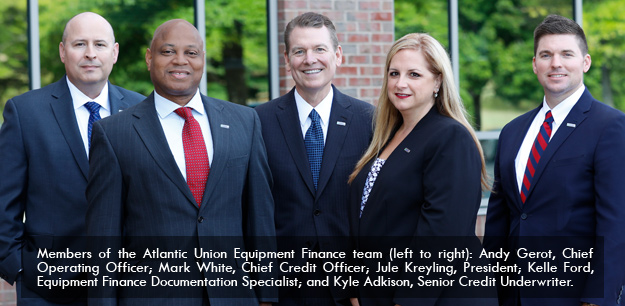
By December 2019, Kreyling described a nine-person team. It included credit leadership and underwriters, operations, documentation, capital markets and direct origination. The launch photograph captures five colleagues, with Kreyling in the middle. The job descriptions do much of the storytelling: a lending operation requires several kinds of judgment before money changes hands.
At that point, the proposed range for directly originated transactions centered on $1 million to $20 million, while existing bank relationships could call for smaller deals. Those were launch plans, tied to a particular moment. They reveal a business trying to accommodate both an outside market and the customers its parent bank already knew.
The distinction matters. A new division within a bank has colleagues as well as competitors. It must give relationship managers a reason to call and customers a reason to stay. The organization chart may be complicated, but the customer’s question can be quite simple: can this bank help finance the equipment?
The first customers arrive after the procedures
The early work at Atlantic Union included approvals, policies, procedures, lease-accounting software and document review. Kreyling later described getting these pieces in place during late 2019 and early 2020. Before funding accelerated in the second quarter of 2020, the young operation had financed approximately five customers, representing about $15 million in business.
That is a useful corrective to the ceremonial language of a launch. An announcement has a date. An operating business needs a sequence. Policies need approval before they can guide decisions. Software needs to be implemented before it can support the work. Documents need to be ready when the customer is ready. A ribbon is easier to cut than a workflow is to finish.
The sequence also makes the customer-experience promise more concrete. Ease is something an organization has to produce. Often, that requires people inside it to do difficult preparation. The customer sees the finished transaction; a leader has to remain interested in everything that makes completion possible.
A larger business, measured carefully
Atlantic Union Equipment Finance entered the 2021 Monitor 100 at No. 85, with a reported portfolio of $328.6 million. For a unit launched in late 2019, inclusion provided an early external marker of its scale. It also put the Alpharetta operation into a national industry comparison.
The 2025 edition placed the business at No. 51. Its figures for 2024 listed $1.515 billion in total assets, $595 million in new business volume and 35 employees. Those are separate measures: a balance-sheet figure, a measure of new activity and a headcount. Keeping the labels attached is more informative than treating every large number as interchangeable evidence of success.
The figures describe the organization Kreyling led, including the work of its employees. They belong beside the launch team photograph rather than replacing it. An asset total tells us about scale. The photograph reminds us that underwriting, operations and documentation are performed by people, including people whose names never appear in an appointment headline.
The bus needs financing, too
In February 2022, Atlantic Union described a specialty-vehicle group offering nationwide financing for new and used people-moving fleets. Motorcoaches, shuttles and school and transit buses were among the vehicles covered. Financing started at $50,000, and the offering included an application-only decision model intended to reduce the paperwork needed to begin.
The announcement named equipment-finance specialists Scott Baer, Garland Tillery and Dave Scoular. That detail connects the national promise to people with a particular market to serve. A bus operator has a vehicle, a budget and a working calendar. Seasonal payments were among the options described. The financing offer had to make sense in that customer’s business.
By February 2025, another personnel decision put direct origination in view. Brad Nott was promoted to national sales manager, with responsibility for developing equipment leases and loans through that channel. Kreyling connected the appointment to the unit’s customer focus and its national end-user business. Years after his own sales detour, sales remained central to the operation he led.
What he carries into the next beginning
Today, the bank’s equipment-finance offering describes nationwide service, with offices across several U.S. regions. The work includes loans and leasing for businesses acquiring equipment. Kreyling’s title remains tied to that specialist operation: President of Atlantic Union Equipment Finance. Its place within a larger bank is part of what makes the job interesting.
Away from the business, he enjoys history, golf and time with his family. Those details offer a quieter ending than a forecast. His career already supplies enough motion: legal practice, sales, leadership and repeated starts inside financial institutions. The missed management role belongs near the beginning because it shows how useful experience can arrive disguised as a disappointment.
There is a practical idea in that story for anyone hoping to lead. Spend enough time with another person’s work to understand its demands. Then carry that understanding into the decisions you make together. Kreyling’s three years in sales are a small piece of his résumé. They make the rest of it easier to read.