Joshua Baer’s first hosting customer had a perfectly reasonable ambition: he wanted his email to stop breaking. Baer, a student at Carnegie Mellon, knew how to fix the server. The customer proposed a different arrangement. For $50 a month, perhaps the student could simply run it himself. A small recurring payment, a small recurring nuisance removed. Somewhere inside that exchange was a business.
It was 1996. Baer had not arrived at college with a grand theory of email. He had wanted to experiment with web software, applied for beta programs, and ended up working with an email server called ListSTAR. He learned it, answered questions, and became useful to people who knew less about it. The invitation to take responsibility for somebody else’s problem followed.
Decades later, the founder of Capital Factory would put his professional purpose into a sentence about helping people leave their jobs and become entrepreneurs. The T-shirt version was shorter. It suited somebody whose career kept returning to the same practical question: what would help this person get going?
The $50 customer
The early internet offered a peculiar advantage to a curious student. Software was appearing so quickly that experience had a short shelf life. A person willing to learn could become the person other people asked. Baer read the documentation and spent time in the user forums. The unglamorous work of knowing how something functioned began to produce consulting requests.
His hosting business became SKYLIST. It grew while he was still studying, supported by customers rather than venture funding. By graduation, it was bringing in hundreds of thousands of dollars a year. The sums sound more impressive when one remembers that the starting point was a student figuring out what to do with software he had been allowed to test.
Baer finished at Carnegie Mellon in 1999 and joined Trilogy in Austin. The city became the place where he would build companies, teach, invest, and establish the relationships that occupied much of his working life. His interests extended beyond the keyboard. An archived biography lists live music, cars, and downhill longboarding. Sitting still was evidently one available option among several.
email-hosting customer
at Carnegie Mellon
begins in Austin
An inbox with two sides
Email gave Baer more than one business to work on. SKYLIST handled delivery. UnsubCentral addressed the management of unsubscribe requests. OtherInbox, which he founded in 2008, approached the inbox from the recipient’s side. Its software organized the messages that accumulate from shopping sites and social networks, leaving people a clearer view of what they wanted to read.
There is a pleasing symmetry in that progression. Having worked on getting messages to people, he also worked on making the arrival less burdensome. Receipts, reminders, and promotions could be useful without deserving the same attention as a personal note. OtherInbox tried to give those distinctions a working form.
In January 2012, Return Path announced that it had acquired OtherInbox. Baer continued leading it as a subsidiary in Austin. He had already sold SKYLIST and UnsubCentral to Datran Media in 2006. The exits gave him experience to bring to other founders, including experience of the awkward period when a business you built becomes somebody else’s property.
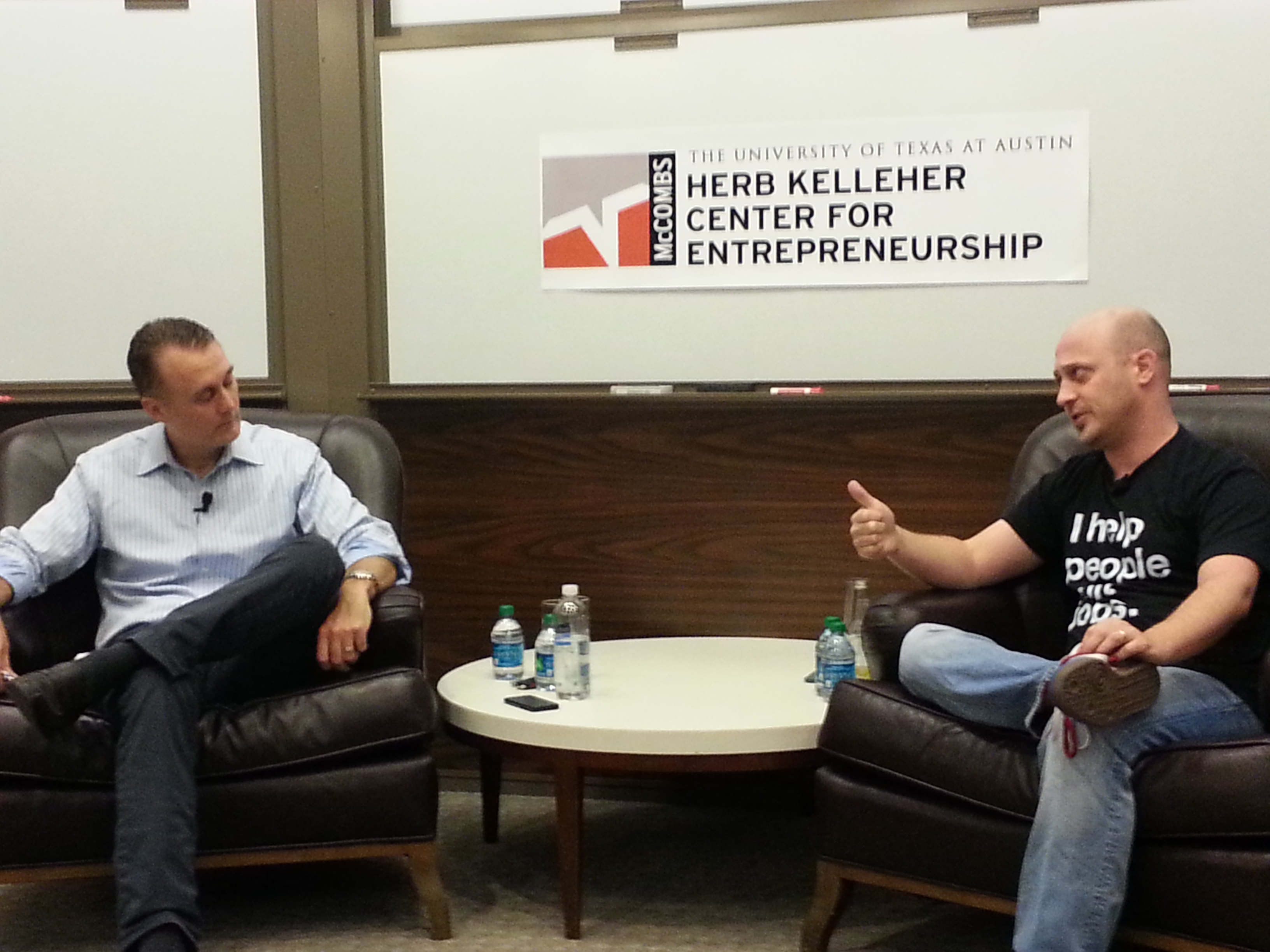
He could also discuss mistakes without pretending they belonged to a former species of entrepreneur. In a public conversation with Brett Hurt in 2013, Baer described becoming less punitive about errors as he learned to build better systems. The observation matters in someone who would spend years advising beginners. A mentor who remembers his own learning curve has something useful to offer before the advice even starts.
Room for one more founder
Capital Factory began in 2009, during a downturn, with an accelerator that worked with five companies a year. Its proposition was practical: mentorship from people who had built businesses, some seed capital, and help reaching the point where a young company could support itself or raise money. The first investors, customers, and employees were central to the purpose.
Baer had been asking questions about accelerators before he started one. In 2007, he visited Brad Feld in Boulder to talk about Techstars. Years later, Techstars’ Austin accelerator operated from Capital Factory’s space. Organizations with overlapping purposes could occupy the same building. The arrangement gave founders more people to learn from without requiring them to choose a side in a territorial dispute.
That willingness to make room helps explain the institution Baer built. Capital Factory combined investment with a place to meet, work, and encounter somebody relevant to the next problem. Money could help a company hire. A conversation could help it discover whom to hire. A founder might need both before the week was out.
In 2013, President Barack Obama visited Capital Factory and heard startup pitches. For a place devoted to introductions, it was a rather conspicuous meeting. Baer also spent time with people at a much earlier stage of public recognition: students. At UT Austin, he co-taught Longhorn Startup and served as Entrepreneur in Residence in the computer science department.
“You’re always thinking it’s about to fail, until it all works.”
Joshua Baer, speaking with Brett Hurt, 2013
Four cities, fewer closed doors
The next version of Baer’s argument required a larger map. His Texas Startup Manifesto, published in 2017 and expanded in 2021, proposed treating Austin, Dallas, Houston, and San Antonio as a connected entrepreneurial region. The premise was straightforward: a founder’s address should not determine the outer limit of their useful relationships.
Dallas could supply customers for an Austin company. Austin could offer connections to somebody building in Dallas. Houston and San Antonio belonged in the same conversation. Founders could travel to recruit, raise money, or sell, then return to the city where they wanted to live. Relocation did not have to be the price of meeting the right person.
Shared access to talent, customers, mentors, and capital.
Conceptual connections, not geographic distances.Capital Factory’s statewide roadshows put movement behind the idea. Its acquisition of Station Houston in 2020 gave the expansion another physical foothold. The ambition was broader than promoting Austin’s attractions. Baer was asking people to notice what they could accomplish together across cities that already had their own industries, institutions, and habits.
His writing about Austin also placed community participation inside the business story. He described people arriving with an interest in neighborhoods and civic life as well as careers. His version of a startup city had to accommodate the rest of a person’s life. Otherwise, persuading them to build there would be a rather incomplete achievement.
The art of the forward button
For all the talk of regions and investment, Baer’s method could become very specific. In 2016, he published instructions for requesting an email introduction. Send a fresh message for each person. Write it in your own voice. Explain the business, then explain why meeting you might benefit the recipient. Include a way to learn more without sending an avalanche.
He intended to forward the request and add his own words above it. The arrangement saved time and left the founder in control of the explanation. It also made a demand on the person asking: think about the other person’s interests. Access came with homework. Fortunately, the assignment was shorter than a pitch deck.
The guide offers a useful way to understand the larger enterprise. Connections require judgment, preparation, and follow-through. The person making the introduction is lending some credibility; the person requesting it should give that credibility somewhere sensible to go. Baer had built businesses around email, and he continued paying attention to what made an individual message worth opening.
A birthday by negotiation
Baer’s birthday supplied a different lesson in sharing attention. Born on December 25, 1975, he grew up in a Jewish family and later celebrated both Jewish and Christian holidays with his wife Amy and their children. In a personal essay, he explained the domestic scheduling: family gifts on Christmas Eve, Santa’s gifts in the morning, and a birthday dinner in the evening.
The day required bargaining. His parents had almost given him a different middle name, Chad, before choosing Dana. In his telling, they preferred to avoid the initials J.C. for their Christmas baby. The humor is affectionate and specific, a glimpse of somebody whose public calendar could otherwise make him appear permanently occupied by meetings.
He built learning into work, too. His 2024 chief-of-staff advertisement offered two years alongside him across Capital Factory’s operations and investment funds. Afterward, he promised help with the employee’s next step: a company, a fund, or a leadership role. The opening warning involved rocket-powered shopping carts. Even the recruitment copy allowed for a little entertainment.
The email that ended with Yeehaw
Baer died on June 16, 2026, in a plane crash near Laredo, Texas. He was 50. Capital Factory’s leadership said the organization remained operational and would continue the mission he had helped establish. The work now belonged to the colleagues, founders, and collaborators who had been part of it.
Feld remembered cheerful emails about new founders and ideas, signed with a Yeehaw and a small robot. Their recent work together included Texas Votes, an open-source ballot tool. After years of investing and organizing, Baer was still interested in sitting down with software and seeing what it could do.
The $50 customer had asked him to make one thing easier. Over the following three decades, Baer kept finding people with something they wanted to attempt and a practical obstacle in front of them. Sometimes he supplied software. Sometimes space, advice, or an introduction. The next person could then get on with the interesting part.