Joel Wishkovsky’s father had a condition attached to new presents. “I’ll only give this to you if you promise not to take it apart,” he would joke. The child wanted to know what was inside. Years later, the adult would describe entrepreneurship in much the same terms: making things, understanding how they work, trying something for himself. A gift could be enjoyed intact, of course. It could also surrender a few secrets.
That small domestic negotiation offers a useful beginning for a career that is difficult to fit onto a business card. There was GE. There was a greeting-card company in Boulder. There were other startups, a program to draw experienced people into climate work, and an incubation role in geothermal energy. Today, Wishkovsky uses the name Joel Wish and leads Bright Harbor, a company building technology for disaster recovery.
The company names can make the journey look like a series of changes of subject. Follow the work more closely and a recurring interest appears: the awkward process between someone wanting something and actually getting it done. He has kept choosing businesses where that process deserves attention.
The beach, the cards and the postage
Before the startups came a corporate education. Wishkovsky studied Information Systems and Economics at Case Western Reserve University, attending from 2001 to 2005. At General Electric, he went through its information management leadership program and worked on the Corporate Audit Staff. His responsibilities included technology implementations, financial and operational audits, and acquisition integrations. These are jobs in which a promising plan must eventually survive contact with the accounts.
GE also supplied a future business partner, Chad McGimpsey. The two remained in touch, and a visit to Panama became part of their origin story. Sitting on a beach, they discussed starting a company. An early idea involved organizing group expenses. The idea that eventually became Card Gnome took them into the considerably more sentimental business of sending people paper greetings.
They moved to Boulder and built an online marketplace for independent card designers. Customers could choose a design and add a message; printing and mailing completed the journey. The artists gained a way to sell their work. The customer gained a route around the stationery aisle and the errand afterward. Romance, in this arrangement, still required someone to remember the date.
By February 2011, the business was preparing a Valentine’s Day launch with more than 100 designs. Wishkovsky said building the site had taken about six months. He credited Boulder’s startup community for helping the pair find their footing. An online company, it turned out, benefited from having useful people nearby.
A business can teach several lessons at once
Card Gnome also made room for an argument about who should earn money from a creative product. In October 2011, a card cost $4.99 including postage, with 75 cents going to its designer. The catalogue had grown to more than 4,500 designs. Scheduling and personalization were part of the offer. Those details put the company somewhere between a marketplace, a printing operation and a reminder to be thoughtful.
Wishkovsky liked the setting around it, too. He described Boulder as a place where advice from other entrepreneurs could change an idea, and where getting away on the weekend helped him return with a clearer head. In a separate interview that year, he described himself as innovative, outgoing and ambitious. His off-duty interests included friends, mountaineering and travel. The laptop did occasionally have competition.
His later biography still made room for backpacking and mountaineering, alongside travel to more than 40 countries. These details add some texture to the operational résumé. A person can be interested in how a system works and still prefer, when the week permits, to walk somewhere with fewer systems.
Other companies followed, including SOLS, where he was a co-founder and chief operating officer, and Simple Contacts. The sequence gave him experience across different products and teams. One of the habits he chose to pass on to younger founders was wonderfully unglamorous: write the email.
The weekly email as a management tool
In the summer of 2018, Wishkovsky visited the MIT delta v teams at the accelerator’s New York studio. He talked about a weekly company update sent to investors, advisors and employees. Performance figures belonged in it. So did new hires, deals and other developments that would help the people around the company understand its progress.
Candor mattered. When something went wrong, the email could explain the obstacle and the response. A request for an introduction or a particular kind of expertise gave recipients something concrete to do. Regular contact meant a meeting could begin with the issue at hand, with less time spent retelling the company’s recent history.
There was a quieter benefit for the writer: a weekly deadline created accountability. A founder had to look back at the promises and explain the results. Including employees helped keep the team oriented around the same short-term goals. The practice fitted an operator who understood that a network becomes more useful when people know what is happening.
“a conversation that starts at what matters”
Joel Wishkovsky, on keeping investors informed
An entrance into climate work
In 2021, the question became how to help experienced technology workers find a place in climate companies. Wishkovsky and Jonathan Strauss had encountered both interested people and startups needing operational talent. Capital was flowing into the sector. Finding an accessible route into the work was another problem.
They announced Climate Draft on October 7. Its inaugural cohort would bring together 50 participants for education, curated events and introductions to startups from participating investors’ portfolios. A participant might eventually contribute as an advisor, angel investor or executive. The program gave curiosity a schedule and a set of people to meet.
The launch was explicitly an experiment. The ambition was to learn from the first group and eventually create a broader entrance for people across disciplines and countries. The idea suited someone whose own career had crossed industries: existing skills could travel, provided people could see where to put them.
- 2010Card Gnome
- 2021Climate Draft
- 2022Bedrock Energy
- 2024Bright Harbor
Selected starting points. Roles overlap.
Bedrock Energy followed in 2022. His current description of that position is precise: co-founder, incubation. A European patent application published in December 2023 names Joel Aaron Wishkovsky alongside Joselyn Anly Lai and Silviu Livescu as inventors on geothermal well construction for heating and cooling operations. It is a concrete entry in a career often summarized in the softer language of entrepreneurship.
The precision matters. Incubating a company, running it, advising it and investing in it are different kinds of participation. His current work includes several of them. At Bright Harbor, the responsibility is straightforward: founder and chief executive.
The work after the weather
Bright Harbor began with a friend’s experience. Bill lost his house in the Marshall Fire, and Wish saw the difficult recovery that followed. The next company would focus on the work left after the immediate emergency: understanding options, coordinating help and making the path through recovery easier to follow.
Bright Harbor dates from 2024. In August 2025, Wish announced a $10.1 million seed round co-led by Congruent Ventures and Lowercarbon Capital. The funding supported a business working with survivors, employers and governments. It also put him in familiar company: Everywhere Ventures, whose co-founder Jenny Fielding had known him for a decade, participated in the round.
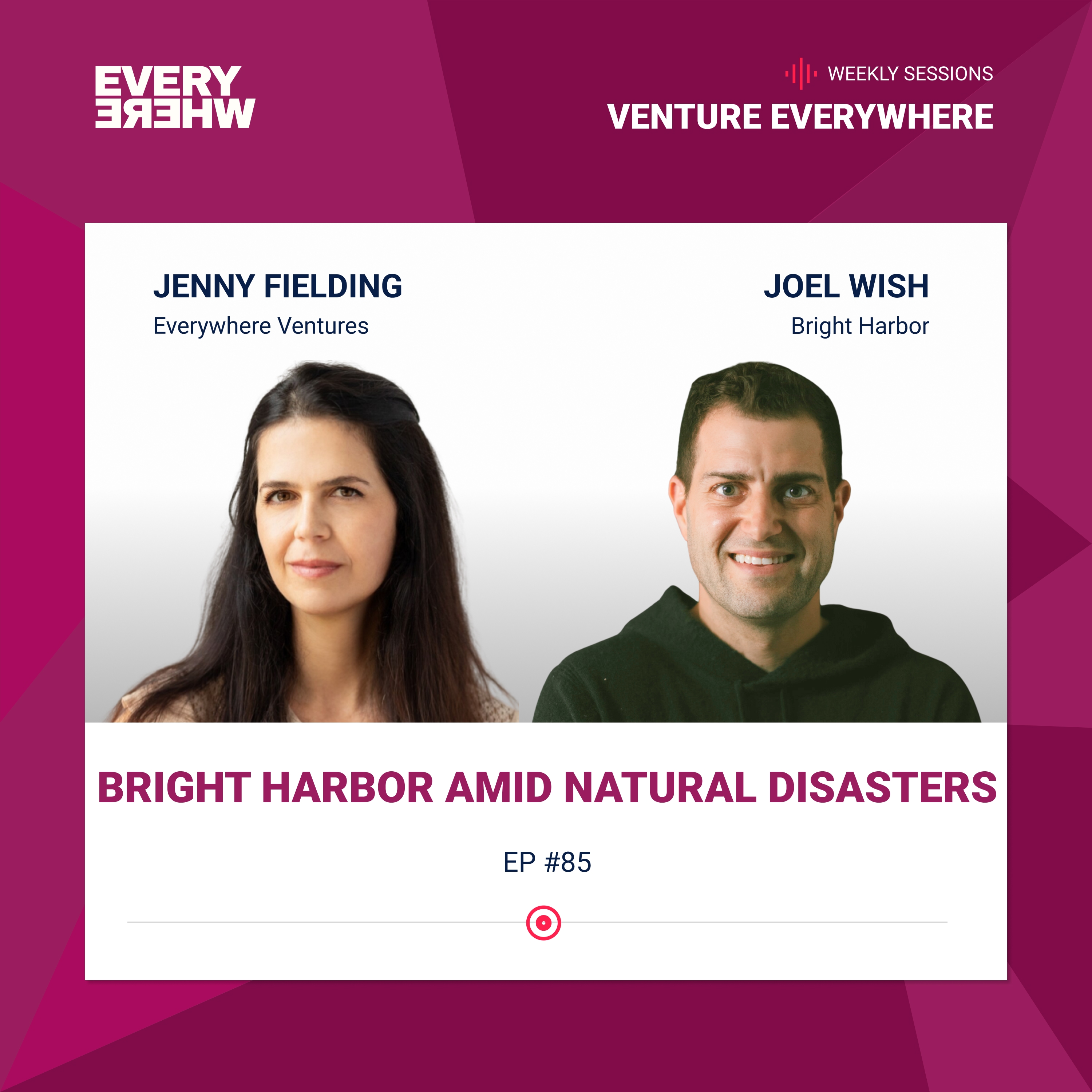
Fielding interviewed him that summer about the business. The conversation covered the practical difficulties of rebuilding and the challenge of growing a service where people need to trust the person helping them. That requirement gives the work a different tempo from a software demo. A faster interface is useful; the decisions behind it still have consequences.
The team combines people from technology companies with experience in public service and recovery. Gavin Blair, the chief operating officer, previously led customer operations at Lemonade. Dinh Lai’s background includes the White House and National Security Council. Chief technology officer Erik Person previously worked at Corvus and Hudl. The work requires several kinds of knowledge in the same room.
Wish’s public role has widened with the company. In 2026, he moderated The New Emergency Playbook at Aspen Ideas: Climate, joining a discussion with Jeremy Greenberg, Jessica Wieder and Melissa Roberts. The subject was how communities and organizations could prepare infrastructure for disruption. His earlier work brought people into climate companies; this chapter places him in conversations about how those companies meet public needs.
The useful thing at the end of the process
In October 2026, Wish described a recent deployment that began with a state contacting Bright Harbor on Saturday. A contract followed on Sunday; the system was live on Monday. He said the first survivors entered it within 48 hours. It was his example of the speed he wanted the company to achieve.
There was a more domestic update, too. He is the father of twin daughters, and he said they had appeared in an H-E-B commercial featured during the previous year’s Super Bowl. In a biography containing startup titles and a geothermal patent application, the children briefly acquired the television credits.
His account of what keeps him building remains close to that childhood impulse: imagine something, make it real, discover that someone finds it useful. The objects have changed. A card needs to reach a mailbox. A career needs an entrance. A family needs a workable route home. Wishkovsky keeps returning to the practical work in between.
Follow the conversation
- Joel’s personal website · LinkedIn · Twitter / X · Instagram
- Bright Harbor · The original Climate Draft announcement
- The weekly company update, at MIT delta v
- Listen: Venture Everywhere, episode 85
- Watch: Joel Wish on WHHI-TV · Watch: The New Emergency Playbook
- The October 2026 founder interview · Card Gnome’s early Boulder chapter