Joseph Foran sold an oil company and then started another. The first half of that sentence is a respectable retirement plan. The second half explains why retirement was evidently going to have to wait. In June 2003, Matador Petroleum went to Tom Brown, Inc. in an all-cash transaction valued at about $388.5 million. By July, Foran and geophysicist Scott King had founded Matador Resources. The name survived. The work began again.
The new venture opened with $6 million in equity, followed by another $46.8 million. Much of the backing came from investors who had supported the previous business. That detail matters more than the familiar entrepreneurial image of a founder striking out alone. Foran had already spent twenty years asking people to put money behind his judgment. When the opportunity came to do something else, a number of them chose to do the same thing with him again.
Today he remains the Dallas company’s founder, chairman and chief executive. Matador trades on the New York Stock Exchange as MTDR. Its wells and infrastructure have become considerably more complicated than those early arrangements among acquaintances. Yet the question running through his career remains surprisingly personal: how do you make a growing business worth staying with?
A lawyer makes a list
Foran’s route into oil ran through accounting and law. He earned his accounting degree at the University of Kentucky in 1974, then graduated from SMU’s law school in 1977. He served as a briefing attorney for Texas Supreme Court Chief Justice Joe R. Greenhill. From 1980 to 1983, he was vice president and general counsel for the independent oil producers J. Cleo Thompson and James Cleo Thompson, Jr.
The industry was familiar territory. His family operated a pipeline construction business in Amarillo, where he grew up. But proximity is different from choosing a life. Faced with the question of what he actually wanted to do, Foran wrote down the people he most admired. The names belonged to people in oil and gas. It was a remarkably inexpensive piece of career counseling.
In 1983, he and Nancy, his wife, founded Foran Oil Company. Seventeen friends and neighbors supplied $270,000 in contributed capital. A startup financed by people you know comes with its own kind of accountability. The investors have names before they have account numbers. Foran’s subsequent history suggests that these relationships became part of the enterprise’s working structure, rather than a sentimental footnote to its beginnings.
The return invitation
Foran Oil became part of Matador Petroleum when he formed that company in 1988. The enterprise grew through acquiring and developing properties. Its later presentation materials recorded an average annual shareholder return of 21 percent over fifteen years before the 2003 sale. That is a historical result for the earlier company, a distinction worth keeping when the Matador name stretches across several corporate chapters.
The second Matador pursued unconventional reservoirs and growth through drilling. By April 2012, it described a shareholder group containing more than 400 friends and neighbors. A financing circle that began with seventeen people had acquired rather a lot of chairs.
The stock began trading on February 2, 2012. At the March 9 closing-bell ceremony, more than 100 shareholders joined directors, employees and management. The photograph shows a crowd, appropriately enough. Foran called the listing “another step forward for us.” The small word at the end does some work. Even at the exchange, the occasion was presented as a shared arrival.
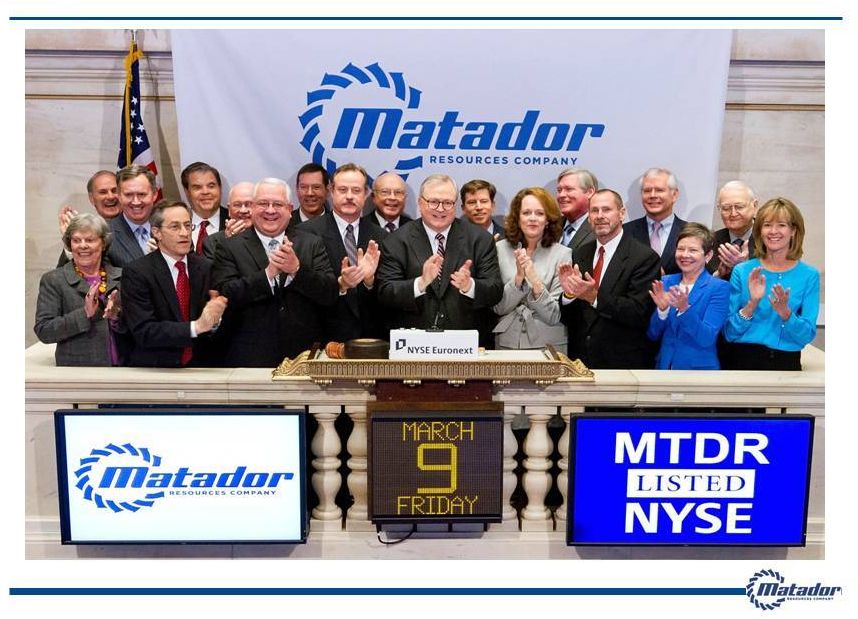
“It is another step forward for us.”Joseph Foran · March 2012
A captain with an accounting degree
Foran captained the rugby teams at Kentucky and SMU. Kentucky later inducted him into its Rugby Hall of Fame. A rugby captain with an accounting degree is a useful corrective to the usual oil-business caricature: the person keeping score has also spent time in the scrum.
The academic connection continued after graduation. He taught accounting at SMU and business law at the University of Texas at Dallas. Kentucky’s account of his work also describes scholarships for graduating students in Texas and Oklahoma, along with support for university scholarships and endowed chairs. Teaching and funding students create a different timetable from a quarterly earnings call. Their results arrive over years.
In 2019, SMU recognized him with its Distinguished Alumni Award for Corporate Service. Kentucky had inducted him into the Gatton College Alumni Hall of Fame in 2015. These honors connect the executive back to the institutions where he learned his first professions. They also make his eventual departure from legal practice look less like a discarded education. Contracts, accounts and judgment remained useful equipment.
The people you cannot simply replace
An oil company needs technical knowledge that no founder can carry alone. Foran has been unusually explicit about that dependence. In 2018, asked about his toughest challenge, he described the loss of experienced shareholders, directors and leaders, including Marlan Downey, Jack Sleeper and Charles Ling. The difficulty he identified was finding comparable judgment and skill.
That answer places an interesting limit on the founder story. Money can buy a property. It cannot instantly reproduce a colleague’s accumulated understanding of geology, negotiations or the moment when a promising idea should be left alone. Foran’s account of the business repeatedly returns to the people around the decision, as much as the person signing it.
By October 2025, more than 95 percent of Matador employees were participating in its Employee Share Purchase Plan. Directors and executive officers had also bought roughly 67,000 shares in the open market during that year. Ownership does not eliminate disagreements or commodity-price risk. It does put a concrete financial relationship underneath the language of working together.
Sometimes progress looks like a U-turn
In 2023, Matador tested a solution to an awkward land problem in its Wolf area in West Texas. A section could accommodate a one-mile lateral well, but the company wanted the reach of a two-mile lateral. Its teams drilled a U-shaped path, turning back underground within the available acreage. A boundary on the map became a question about the route.
The first two horseshoe wells went on production in October 2023. Matador subsequently reported about $10 million in savings compared with drilling four one-mile lateral wells. In the fourth quarter of 2024, it brought five more U-turn wells into production and estimated combined savings of $15 million against ten vertical wellbores and ten one-mile laterals.
The figures belong to specific wells and comparisons. They also provide a tangible example of the work Foran wants his teams to do. In a 2024 interview about productivity, he described giving people a target and letting them find better methods and equipment. The invention came from the engineers; the executive’s enthusiasm lay in what they could do with a constraint.
There is something pleasing about this episode in a career built around returning to familiar ground with a revised plan. A U-turn is usually an admission that the driver has missed something. Here, it was part of the design.
The business beyond the well
Matador’s principal operating focus is now the Delaware Basin in southeastern New Mexico and West Texas, especially the Wolfcamp and Bone Spring formations. It also has operations in northwestern Louisiana. Alongside exploration and production, it operates infrastructure that gathers, processes and transports the output of wells, including services for other producers.
This part of the business makes the childhood pipeline connection feel particularly apt. Finding hydrocarbons and getting them to a useful market are separate jobs. In June 2026, Matador announced agreements with Energy Transfer intended to improve natural-gas pricing and reduce exposure to the Waha Hub. Those arrangements were designed to bridge the period before contracted transportation on the Hugh Brinson Pipeline became effective.
The practical objective was better market access for gas already being produced. The vocabulary is less romantic than a discovery well: supply agreements, transportation and pricing netbacks. The commercial consequences can be substantial. Foran’s present responsibilities include keeping this less photogenic machinery moving alongside the drilling program.
Still making the next decision
In April 2026, Matador announced Christopher Calvert’s promotion to chief financial officer and Glenn Stetson’s promotion to chief operating officer, effective April 21. Foran remained chairman and CEO. On October 1, the company closed its Paloma Permian acquisition for $1.255 billion in cash, subject to customary adjustments. Starting again has long since become a matter of adding acreage, people and operating obligations to an established enterprise.
On October 21, the board raised its quarterly cash dividend from $0.375 to $0.4375 a share, a rounded 17 percent increase. The declared payment is due December 4 to shareholders of record November 10. Foran’s stated priorities were continued growth, free cash flow, debt repayment and returning value to shareholders. These are objectives to manage, with the price of oil and gas still capable of interrupting the schedule.
The appeal of the Foran story lies in its continuity through those changes. An accountant became a lawyer, then an independent producer. One company became the basis for another. The investors who helped establish the business became, in many cases, the people invited to back its next chapter. The scale changed; the need to earn another decision from another person persisted.
Foran could have treated the 2003 sale as a closing scene. Instead, he and his partners made it an opening. More than two decades into the second Matador, he is still occupied with the consequences of that choice: people to recruit, acreage to understand, gas to move and shareholders who expect the next step to be worth taking.