The decisive object in Jordan Edelstein's career was not a product brief, a game console or a cryptocurrency wallet. It was a magazine on an airplane. On a Thanksgiving flight from Detroit to Minnesota, the General Mills marketing manager read a Newsweek cover story about The Sims Online. The game let people invent characters and interact in a shared digital world. Edelstein, a self-described videogame guy, looked from that imagined society back toward his own professional reality. He was working on baking mix.
The contrast was comic enough to stick and uncomfortable enough to act on. Edelstein was doing well. He had learned consumer research, product management and the discipline of selling things people could find on a grocery shelf. Yet the article showed him a product that was also a culture. He wanted to feel inspired by the thing he marketed, so he called a friend at Electronic Arts and asked to hear about openings.
Two weeks later, the phone rang. EA needed a senior product manager for Madden NFL and NCAA Football. The opportunity was almost suspiciously exact. The hiring process was less merciful: 12 interviews in Orlando, then 14 more at headquarters in Redwood City. Edelstein had little technology experience and no professional gaming history. He had to persuade a procession of people that packaged-goods technique could travel, and that his affection for games was more than interview decoration.
“This was my dream job.”Jordan Edelstein, recalling the EA opening
A resume with a secret level
His resume carried one delightfully targeted proof point. At the bottom, Edelstein noted that he had guided Rutgers to back-to-back championships in EA's own NCAA Football. The executive who hired him later cited his track record and transferable skills. The tiny Rutgers flourish did something credentials alone could not. It showed that Edelstein knew who was on the other side of the table.
He joined EA in 2003, six weeks before the E3 trade show, while everyone around him was in launch-season flight. Edelstein later joked that his colleagues were racing to finish the work while he was asking where to find the coffee maker. There was little time to remain new. NCAA Football 2004 and Madden NFL 2004 followed in quick order; six months and two launches later, he finally felt normal.
Over the next decade, the assignments grew. He worked across professional football, basketball, baseball and hockey, then became global vice president of marketing for Maxis. Public credits connect him with NBA Jam, NHL, SSX, SimCity and numerous The Sims releases. These were not interchangeable boxes. Sports fans police authenticity with the fervor of appellate judges; simulation players want systems deep enough to produce their own stories. The marketer must respect both the franchise and the player who knows every seam in it.
In 2014, Kabam hired Edelstein as vice president of marketing for its internal studios. His remit included customer acquisition and marketing the company's first-party games. When FoxNext acquired the former Kabam team at Aftershock in 2017, he continued with the studio leadership group and ultimately served as chief marketing officer. His credit on the Marvel Strike Force campaign sits beside a 2019 Webby People's Voice award. By then, the marketer who once lacked gaming experience had spent roughly 15 years bringing games to market.
Leaving entertainment for infrastructure
The next turn looks abrupt on a company list: FoxNext to the Stellar Development Foundation in 2019. In practice, it preserved the hard part of the job. Both games and blockchain ask a marketer to explain a system before its meaning becomes obvious. Games can at least show a superhero punching another superhero. A blockchain network is mostly plumbing, incentives and possibilities. The technology attracts a fluent inner circle, while everyone else reasonably asks what it does.
Edelstein arrived as Stellar rounded out its executive team. The foundation supports an open network designed for moving and storing value. He described the marketing function at the time as one and a half people doing everything. Over five and a half years, that fractional beginning became a specialized team capable of brand work, events, performance marketing, social media, grants and field stories.
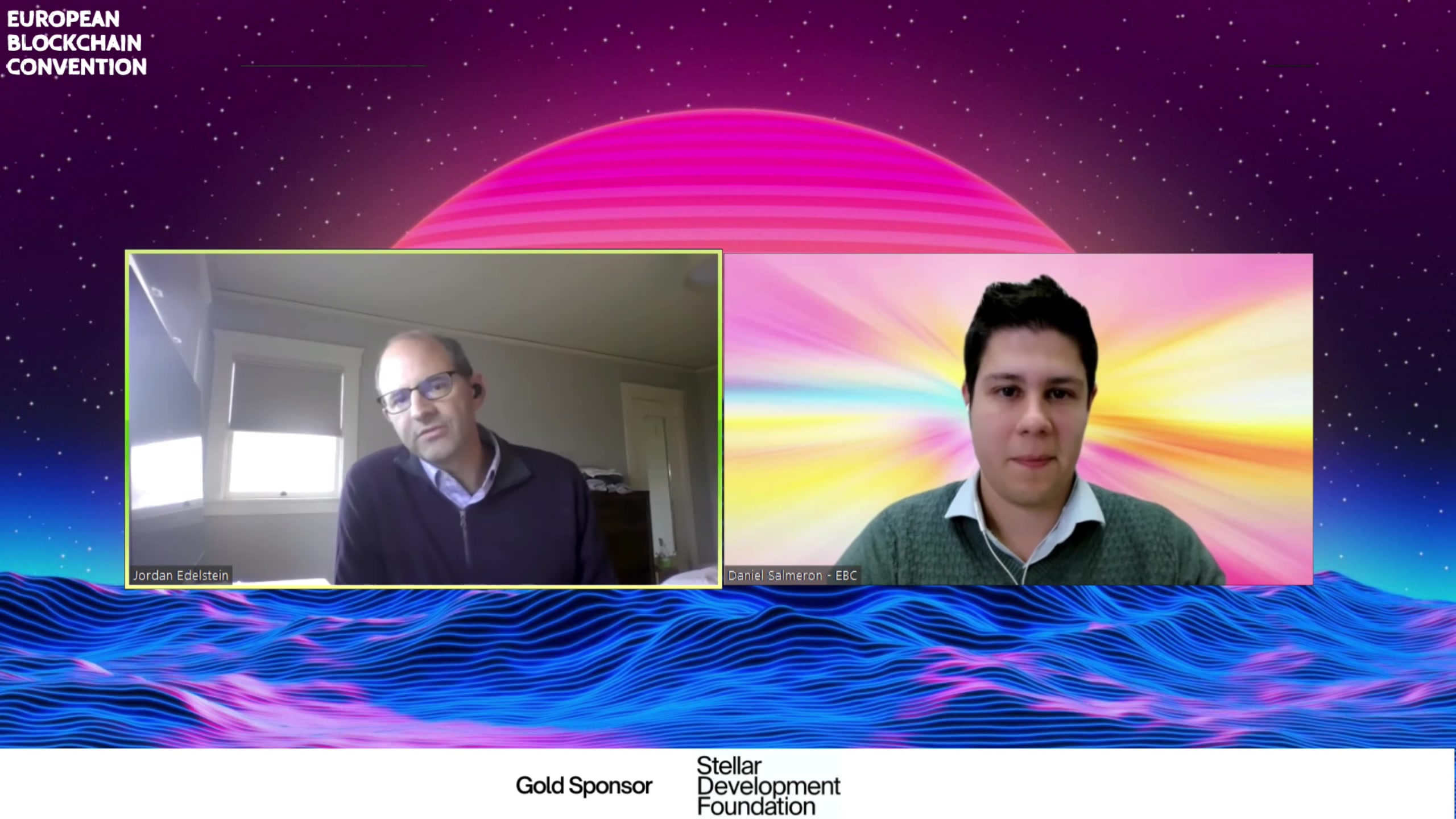
The visible projects included a reset of Stellar's brand and positioning, Meridian conferences, work with Idris Elba and full-page advertisements in The New York Times and Financial Times for Stellar Aid Assist. Yet Edelstein's own retrospective gives equal billing to smaller operating milestones: the first A/B tests, the first marketing-support grant and an early video case study filmed in Nigeria and France. That shoot was directed over Zoom, in the middle of the Pacific night, during the pandemic. Strategy, in the end, is often somebody staying awake to make the practical thing happen.
His preferred proof was what builders put into the world. He pointed to companies and projects such as Blend, Decaf, Arf, Franklin Templeton and MoneyGram, all using the network in concrete financial products. In a 2024 community conversation, he pushed back on the idea that marketing could be judged mainly by a stream of social posts. The toolkit also included case studies, live events, email, editorial placements, search, grants and paid media. His compact defense was memorable: the team did a lot more than tweet.
“The most rewarding work for me personally was when we featured what builders are doing on Stellar.”Edelstein on the work he valued at the foundation
That answer reveals an old packaged-goods instinct hiding inside an emerging-technology career. A claim becomes credible when a customer can find it on the shelf, or in this case, use it to move money. Edelstein had left grocery marketing because the product no longer stirred him. He did not leave behind its insistence on observable utility.
The portfolio chapter
Edelstein left Stellar in May 2025. His farewell was proud but not airbrushed. He thanked CEO Denelle Dixon for being unusually supportive of marketing, credited the people and agencies who had built the department, and admitted that he needed head space to consider what came next. After a career of large organizations and established franchises, the next phase moved closer to beginnings.
Through JE23 Consulting, he began working with founders preparing to launch. His public offer is unromantic in the useful way: positioning and product narrative, go-to-market plans tied to revenue, paid and organic growth, choices between in-house staff and agencies, budgets tied to returns. The language favors a marketing engine over a marketing aura. It is the kind of counsel one might expect from someone who has seen both giant launch calendars and a department that began as one and a half people.
In January 2026, Next Generation NGPES named him fractional chief marketing officer. The French fintech group was preparing regulated payment infrastructure, including a euro-pegged stablecoin. The assignment joined familiar themes: a technical product, a regulated environment and a need to state the customer benefit without pretending the complexity has vanished.
Then came Retool. Edelstein announced in May that he had joined the San Francisco developer-tools company as interim CMO a few weeks earlier. He was also reuniting with Michael Blank, a former colleague. Retool's problem appealed to him because it contains a productive contradiction. AI lets more people create software quickly; enterprises still need authentication, permissions, audit trails and control over data. Speed is attractive. Unsupervised speed is a meeting with the security team.
Edelstein described Retool's position as helping organizations move faster while giving technical leaders peace of mind that software built across a company follows security and data policies. The sentence is less theatrical than much AI marketing. It acknowledges the enthusiasm and the adult supervision in the same breath. Retool's mission, “Bring good software to everyone,” gave him something else he could publicly say he believed in.
The useful sentence in the middle
There is an easy version of this career in which Edelstein is simply attracted to novelty: online worlds, mobile games, blockchain and AI. The chronology suggests a more durable appetite. He gravitates toward products caught between passionate insiders and skeptical outsiders. His work is to locate the useful sentence between them.
The technique depends on respect. The insider deserves language that does not betray the product. The outsider deserves an explanation that does not require joining a club. At EA, credibility could hide in a Rutgers dynasty built on a console. At Stellar, it lived in the businesses using the network and the people they served. At Retool, it sits in software that can move quickly without misplacing the guardrails.
Edelstein's career began conventionally enough: Amherst College, a consulting analyst role, Kellogg, a General Mills internship and a return offer. It became distinctive when he admitted that competence and inspiration were not the same thing. The airplane epiphany did not provide a plan. It provided a direction, followed by a phone call and 26 chances to explain himself.
More than two decades later, he is still explaining. The products have become less visible, the stakes more institutional and the vocabulary more technical. The basic bargain remains refreshingly human: show people what the thing lets them do, make the promise specific, and stay awake for the shoot if that is what the story requires.