A cardboard box arrives with an ambitious assignment: get something to your door. Once emptied, it becomes a domestic nuisance, leaning against a kitchen wall until someone remembers recycling day. Jonathan Strimling helped build a business around what happens next. At CleanFiber, yesterday's packaging became insulation for the walls and attics of buildings. The box acquired a second career, and a rather more permanent address.
There is an appealing neatness to that description. The work behind it was considerably less tidy. Strimling was recruited to help commercialize the technology in 2012. He later described the development effort as involving “literally thousands of experiments.” Those four words do useful damage to the idea that a good invention naturally becomes a good business. They leave room for the trials, adjustments and bills that a finished product politely conceals.
By 2024, CleanFiber ranked 48th overall on the Inc. 5000 and first in its manufacturing category. In February 2025, Strimling stepped down as CEO after 12 years of leadership. Two months later, he joined InventWood as president. His new assignment involved another familiar material being given unfamiliar properties: wood. The sequence suggests a career organized around a particular question. How do you get something technically interesting out into the world, where somebody must manufacture it and somebody else must buy it?
Two degrees, several kinds of commerce
Strimling's preparation crossed the same boundary. He earned a mechanical engineering bachelor's degree at Northeastern University in 1992, then master's degrees in mechanical engineering and management at MIT in 1996. Engineering asks whether a thing works. Management introduces a roomful of people who would like to know when it will ship. His education gave him reasons to listen to both.
The MIT program was Leaders for Global Operations. That pairing of factory knowledge with business training helps explain the range of enterprises on his résumé. He led American Biomass from 2006 to 2011 and launched WoodPellets.com through his technology commercialization business, US Dynamics. Selling heating fuel online puts a physical product behind a digital storefront. Somewhere beyond the checkout button, an actual delivery still has to happen.
Then came email. He became CEO of SMTP in August 2013. In a 2014 video interview, his subjects included its acquisition of SharpSpring, the pending acquisition of GraphicMail, new offerings and a larger sales operation. This was commercial expansion by software and acquisition, rather than by another production line.
SMTP eventually became known as SharpSpring. The business later sold to Constant Contact for $240 million. That later transaction belongs in the company's history; it should not swallow the earlier chapter in which Strimling helped redirect it. His contribution was to the turnaround and the route to Nasdaq. The pattern was already visible: take an existing technical capability and organize a business that can reach more customers.
- 1996 MIT engineering + management
- 2006-11 American Biomass leadership
- 2013 SMTP CEO; CleanFiber founded
- 2025 CleanFiber handover; InventWood president
- 2026 InventWood President & COO
The installer gets a vote
CleanFiber demanded a different kind of patience. Its feedstock was recycled corrugated cardboard, a material that comes with a past. Packaging has been folded, taped, labelled and handled before it reaches a recycling facility. A manufacturer gets the material the world has used, rather than a pristine specimen prepared for a demonstration.
The company developed a proprietary route to cellulose insulation with less dust. In April 2024, Tokyu Construction announced its investment, pointing to recycled cardboard, production costs, product quality and mass production in New York. For a construction business to take an interest, the proposition had to survive beyond the recycling bin. It had to make sense at the other end of the supply chain.
Insulation is an especially instructive product for this sort of executive. Most people who pay for it hope never to admire it again. It disappears behind finishes or into an attic, earning its keep through performance. There is little opportunity for a buyer to fall in love with a handsome interface. The person installing it has a practical vote: can this material be put to work without making the job needlessly troublesome?
Strimling's involvement also extended into invention. A patent application published in 2018 for cellulose-based insulation names him as inventor. It describes a material whose fiber structures create voids, along with methods for making it. The record follows the business from UltraCell Insulation to CleanFiber. In this chapter, his name appears on the technical paperwork as well as the executive title.
The small cheque and the large number
CleanFiber's New Hampshire beginning was modest enough to put an address on it: 844 Elm Street in Manchester, a location later occupied by The Bookery. The company was founded in 2013 and received the Millworks Fund's first investment after winning $50,000 in the first TechOut competition. A bookshop makes a pleasing footnote to an insulation business. Both have found uses for cellulose; only one encourages you to browse.
A decade later, the numbers belonged to another scale. CleanFiber's 2024 announcement gave its three-year growth rate as 5,684 percent. The Inc. ranking put it first among manufacturing businesses on that year's list. The percentage measures company growth, rather than Strimling's personal wealth or the output of every factory. Its significance lies in how far the commercial operation had moved beyond its small beginning.
That kind of increase invites a quick success story. A longer view has room for the years before the chart becomes dramatic. An early competition win can help a company begin; it cannot do the experiments, qualify the product or manage production. The award cheque and the growth figure mark different stages of work, and the distance between them is the interesting part.
In 2024, the New Hampshire Tech Alliance named Strimling Entrepreneur of the Year. Recognition arrived from the state where he had built several ventures, even as CleanFiber's manufacturing identity was tied to the Buffalo area. His career had connected a local startup community to a business whose product was intended for a much wider construction market.
Reported three-year company growth
A factory needs more than enthusiasm
The 2024 expansion plans brought a different collection of numbers. In October, CleanFiber announced selection for $20 million in Department of Energy grants for proposed plants in Washington and Texas. It also reported a $31.5 million project financing facility and a $10 million tax credit allocation. These were different forms of support, each with its own purpose; treating them as one interchangeable pile of cash would miss the mechanics of building factories.
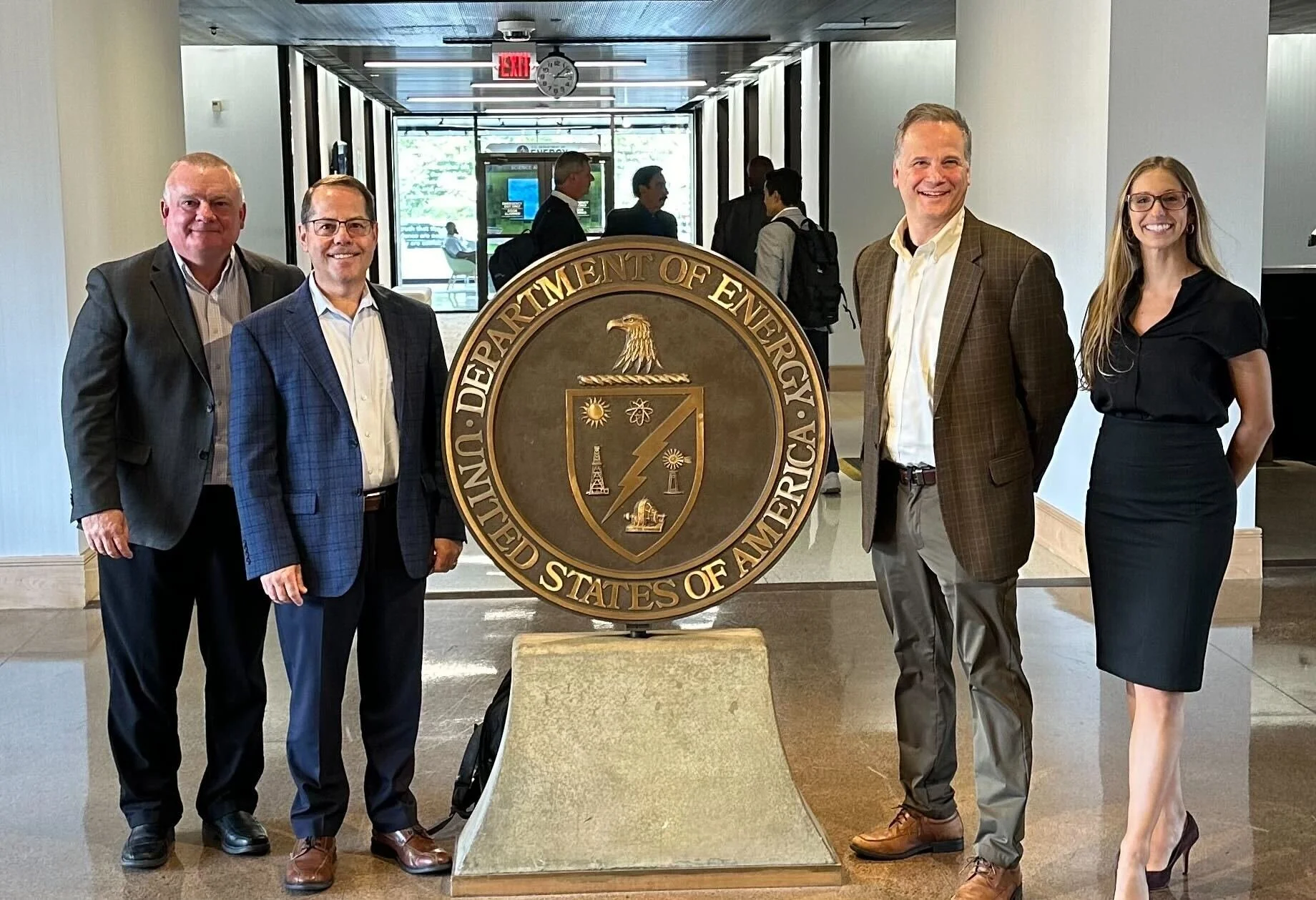
A photograph from the company's Department of Energy meetings captures Strimling alongside Tom Dorsch, Don Simoneau and Alexandra Harris. The group is standing around the department's large seal. It is an ordinary business photograph with an unusually useful point: commercialization involves colleagues, conversations and institutions as well as machinery. The founder cannot personally substitute for all of them.
He has described the eventual value of unexpected introductions when reflecting on his business network. It is a practical observation about a network. You meet someone before knowing which future problem that person might help solve.
Strimling has also served on industry and nonprofit boards, including the Biomass Thermal Energy Council and the Alliance for Green Heat, and on New Hampshire's Economic Strategy Commission. Those connections fit the territory his businesses occupy: fuel, buildings, commerce and manufacturing. The repeated concern is how an enterprise operates inside a larger economy.
The economics of staying nearby
At the end of 2024, Strimling discussed American manufacturing and tariffs. He argued that CleanFiber had a useful domestic position: bulky insulation was expensive to ship over long distances, and the company sourced its raw materials and much of what it needed within the United States. Some imported components, including electronics, could still become more expensive.
The nuance matters. A factory can have a local advantage while remaining connected to international supply chains. The cost of moving a finished product and the cost of buying a component are separate questions. Strimling's case for domestic manufacturing included both, rather than pretending that choosing an American location removes every external dependency.
For a reader trying to understand his choices, geography provides a clue. Heating fuel, insulation and engineered wood all require decisions about material, equipment and transport. They give an executive reasons to care about where a product is made. His software chapter added a different experience of reaching customers, but it did not erase that physical grounding.
“the random connections that wind up proving valuable in time.”
Jonathan Strimling, on the value of a network
Leaving the chair, keeping the assignment
CleanFiber's leadership change took effect on February 5, 2025. Eric Chapman became executive chairman and assumed the CEO's responsibilities on an interim basis. Sami Rahman, the recently hired president and general manager, continued leading day-to-day operations. Strimling was to remain available in an interim consulting role for several months to support the handover.
The arrangement divided responsibilities rather than leaving one vacant chair for another person to occupy. Strimling expressed gratitude to customers, suppliers and investors. For a company that had spent years getting a physical product into production, that was a fitting list: the people who buy it, the people who supply it, and the people who make the investment possible.
On April 23, InventWood announced him as president, working with CEO Alex Lau to commercialize SUPERWOOD, a material developed from University of Maryland research led by Liangbing Hu. By October 2026, the company listed his role as President and COO. The product was different, but the appointment returned him to the passage from research to manufacturing and customers.
There is a useful limit to the analogy. Turning cardboard into insulation and processing wood into a new building material are separate technical undertakings. Experience can transfer without making the next assignment easy. His value in the new role rests on having already spent years working through the commercial questions that a promising material brings with it.
A hill outside the business plan
Away from those questions, the New Hampshire chapter has its own geography. Strimling enjoys swimming at Glen Lake and cycling up Mount Uncanoonuc, as well as running and walking. These are pleasantly specific details in a career usually described by company names and financing amounts. A hill does not care whether your last venture reached Nasdaq.
In February 2026, he represented InventWood at a CONNECTpreneur showcase hosted by bwtech at UMBC. The appearance places him back in the familiar business of explaining a company to a room of potential connections. The material had changed again. The task of making an idea understandable, and then commercially useful, continued.
That is the thread through the retailer, the email business and the materials companies. Strimling has repeatedly taken jobs where invention needs an operating business around it. There are customers to persuade and teams to assemble, along with the less photogenic work that sits between an experiment and a shipment. His career gives that middle stretch a face. Somewhere along it, a discarded box stopped being rubbish and became part of a building.
Follow the next shipment
Companies, conversations and further reading.
- InventWood ↗
- CleanFiber ↗
- Jonathan on LinkedIn ↗
- Jonathan on X ↗
- Watch: FiRe 2018 FiReStarters ↗
- Listen: BizcastNH, episode 148 ↗
- Read: 2024 Entrepreneur of the Year ↗
- Read: CleanFiber’s leadership transition ↗
- Read: InventWood appointment ↗
- Read: CleanFiber growth ranking ↗
- Read: factory expansion plans ↗
- Read: manufacturing and tariffs ↗
- Explore: cellulose-insulation patent ↗
- Read: October 2026 InventWood filing ↗