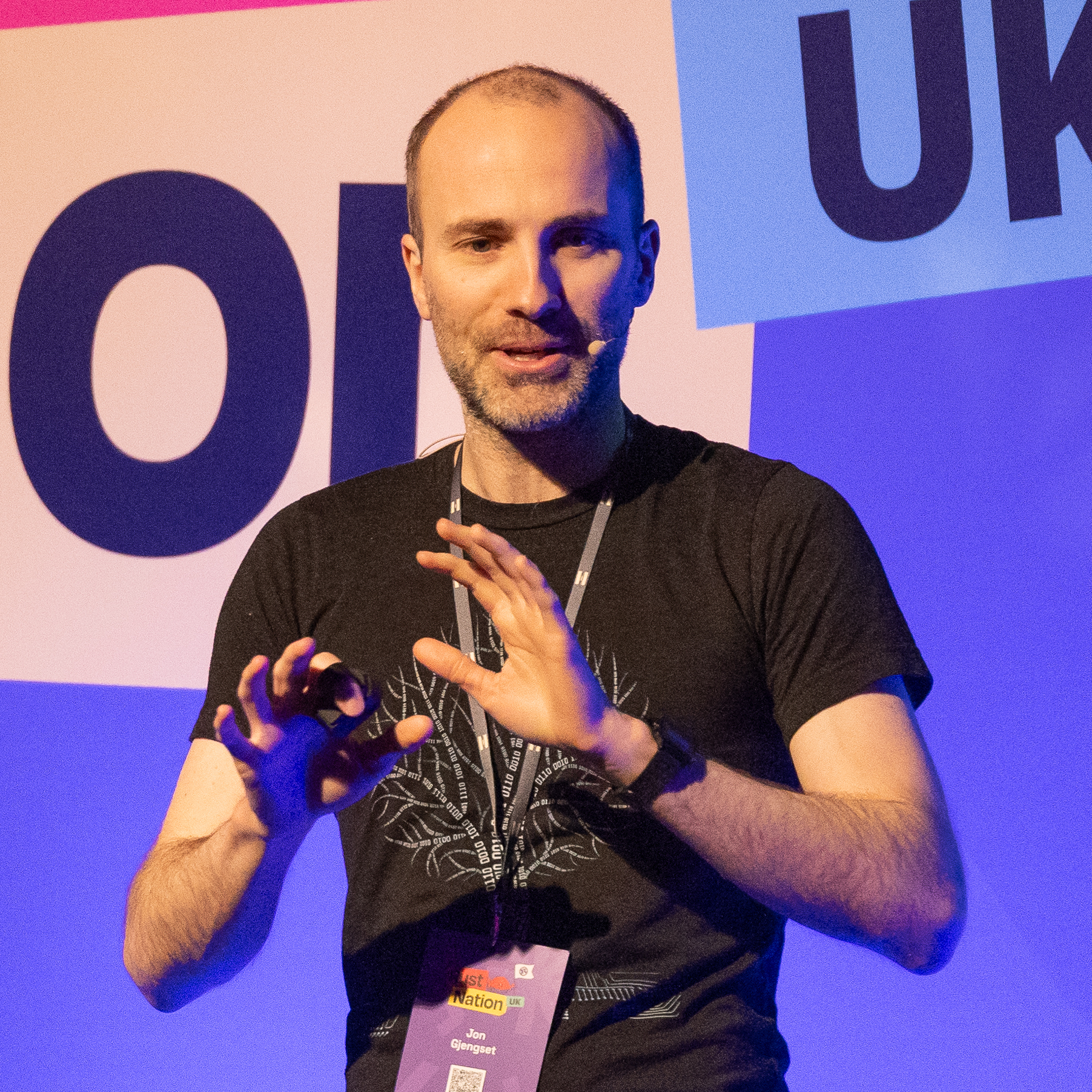
The Engineer Who Wrote the Book on Rust
Jon Gjengset does not explain Rust to you. He explains Rust with you - out loud, on camera, making mistakes, correcting himself, and rebuilding your mental model in the process. That's not an accident. It's a deliberate philosophy that has made him one of the most trusted figures in the systems programming world.
Today, Jon is a Principal Engineer at Helsing, a fast-growing European defense technology company building AI software for democratic nations. The role is serious. The stakes are serious. And Rust - with its compile-time memory safety guarantees and zero-cost abstractions - is exactly the right tool for the job. Jon arrived there in August 2023 after a career arc that took him from Oslo to Bond University in Australia, to University College London, to the hallways of MIT CSAIL, to AWS, and finally back home to Norway.
Along the way, he wrote a book, co-founded a startup, contributed to the Rust compiler ecosystem, ported FlameGraph to Rust, and convinced thousands of developers that the borrow checker is not the enemy. It is the point.
The best way to understand a language is to rebuild things you already know in it.
- Jon GjengsetNoria: A Database Born From a Thesis
At MIT CSAIL's Parallel and Distributed Operating Systems Group, Jon spent his PhD years solving a problem that every read-heavy web application faces: how do you serve fresh, aggregated data at scale without falling over? His answer was Noria, a streaming dataflow system that maintained materialized views in partial state - meaning it only computed what it actually needed.
The results were striking. Compared to MySQL, Noria achieved up to 20x better application throughput for read-heavy workloads. Compared to traditional fully-materialized approaches, it cut memory usage by up to two-thirds. His advisor was Robert Morris, the same Robert Morris who wrote the Morris Worm in 1988 and has since dedicated his career to building the systems that make the internet work.
Jon defended his thesis - "Partial State in Dataflow-Based Materialized Views" - in February 2021. Then, with co-founder Alana Marzoev, he took that research and built ReadySet around it. ReadySet raised $29 million in April 2022. That is the kind of outcome that makes people reconsider whether a PhD is worth it.
Crust of Rust: The Gap-Filler That Wasn't Supposed to Exist
The Rust ecosystem has a peculiar problem. The beginner documentation is excellent. The Rust Reference and Rustonomicon are comprehensive. But the middle - where working developers actually live, trying to understand why their async code doesn't compile or what Send and Sync actually mean for their specific use case - that was largely empty.
Jon started filling that gap in 2018, live-streaming on YouTube while building real libraries and tools in Rust. No scripts. No polished slides. Just a developer working through problems in real time and explaining the reasoning out loud. The "Crust of Rust" playlist became a landmark resource - covering iterators, lifetime annotations, collection types, smart pointers, and more by reimplementing standard library functionality from scratch.
His Discord community, affectionately called "Jay's Herd," now has over 2,600 members. He funds ongoing content through Patreon. And for those who want the systematic treatment, there is the book: "Rust for Rustaceans: Idiomatic Programming for Experienced Developers," published by No Starch Press in 2021. It covers type layout, trait coherence, async/await, unsafe code, API design, FFI, object safety, procedural macros, and no_std programming. It assumes you already know Rust. That assumption is itself a statement of respect.
He is also a co-instructor of MIT's Missing Semester course - originally called "Hacker Tools" when it launched in 2019. The course covers the practical computing knowledge that no formal curriculum teaches: Bash, Git, CI/CD, code quality, and the soft skills of shipping software. Jon joined the course with Anish Athalye and Jose Javier Gonzalez Ortiz for the 2026 IAP session, adding modules on agentic coding and modern packaging workflows.
Rust's ownership model isn't a limitation. It's the thing that lets you write fearless concurrent code.
- Jon GjengsetFrom AWS Infrastructure to Defense Systems
After ReadySet, Jon joined Amazon Web Services to work on Rust build infrastructure. He owned the internal Rust build tooling team, maintaining the systems that allow AWS engineers to write and ship Rust at scale. It is unglamorous work in the best possible way - the kind of foundational engineering that makes everything else possible.
Then came Helsing. The company was founded with a direct mission: build AI software to help democratic nations defend themselves. It is one of the more charged missions in European tech, operating in a space where the consequences of software failure are not abstract. Jon joined as a Principal Engineer in August 2023, and the move brought him back to Oslo, Norway - a homecoming of sorts for someone who had spent years bouncing between Cambridge, Los Angeles, and academic institutions on three continents.
Rust is central to Helsing's approach. In a June 2025 interview with Filtra.io, Jon described what "Defending Democracies with Rust" means in practice - the language's memory safety properties are not incidental in safety-critical systems. They are the primary feature. When the system has to work correctly because the alternative is unacceptable, you choose the language that makes the common mistakes impossible at compile time.
What He Has Actually Shipped
- PhD from MIT CSAIL on distributed systems and dataflow databases (February 2021) - thesis on partial state in materialized views
- Author of "Rust for Rustaceans: Idiomatic Programming for Experienced Developers" (No Starch Press, 2021) - the definitive intermediate-to-advanced Rust text
- Co-founded ReadySet with Alana Marzoev, commercializing Noria research - raised $29M in April 2022
- Created Noria streaming dataflow database: up to 20x throughput vs MySQL, up to 66% memory reduction vs traditional materialized views
- Created "inferno" - the Rust port of FlameGraph, now standard for Rust performance profiling
- Led Rust build infrastructure at AWS, owning internal tooling for Rust at scale
- Principal Engineer at Helsing since August 2023, applying Rust to safety-critical defense systems
- Co-host of Rustacean Station podcast, prominent voice in Rust community discourse
- Co-instructor of MIT Missing Semester (2019-present), reaching thousands of students annually
- Crust of Rust YouTube series - the bridge between Rust beginner and Rust practitioner for tens of thousands of developers
The Arc
Things Worth Knowing
One more thing: his book deliberately assumes the reader already knows Rust. That is a bet on the reader's sophistication that most publishers would not take. No Starch Press did. The book found its audience. The audience was, it turns out, large.