A wind turbine is a fairly conspicuous way to make a financial promise. It stands above the landscape, turns in public and has very little patience for a spreadsheet that assumes more wind than actually arrives. Years before John Pimentel became chief executive of the carbon-removal company 280 Earth, he was helping persuade people that these machines could lower their electricity bills. The promise had to survive contact with the meter.
At Foundation Windpower, the company he co-founded, that discipline was explicit. In 2013, Pimentel said the business would only bid on projects where it could offer electricity at a discount to existing and projected utility rates. Environmental benefit came with a price test. For the customer, the attraction could be as ordinary as a smaller bill.
There is a useful way into Pimentel’s otherwise crowded résumé. Freeways, wind turbines, water systems, community colleges and a machine that extracts carbon dioxide from air seem like unrelated subjects. Each involves the unglamorous distance between wanting something to happen and arranging for it to happen. His work has repeatedly occupied that distance.
A college route with a return ticket
Pimentel’s own education began at San Joaquin Delta College. He transferred to the University of California, Berkeley, and later earned an MBA at Harvard Business School. He was a first-generation college student. Before the business-school credential, there was a community-college classroom.
He also learned the machinery of representation there, serving as student body president and student trustee. Those are unusually relevant early jobs for someone who would eventually return to college governance. A student trustee gets an introduction to the fact that an institution’s ideals and its spending decisions have to share a meeting agenda.
Government followed. Pimentel began state service as an Assembly Fellow and worked as the governor’s higher education adviser, analyzing legislative and budget matters across California’s public university and community-college systems. The route from student representative to education policy was direct enough. His subsequent move into transportation widened the scale considerably.
As California’s deputy secretary for transportation in the 1990s, he helped manage the rapid rebuilding of Southern California freeways after the 1994 Northridge earthquake. He later worked at Bain & Company. Taken together, those experiences put public budgets, construction and business analysis on the same career path. A damaged freeway is a particularly forceful tutor in the difference between a plan and a working piece of infrastructure.
- Delta CollegeStudent president and student trustee
- UC BerkeleyBachelor’s degree
- California governmentEducation policy and transportation
- Harvard Business SchoolMBA, 1998
The electricity had to be cheaper
Pimentel’s environmental business career extended across biofuels, wind, solar, wastewater and recycling. He dates his start in the field to Pacific Ethanol in 2002. It is a portfolio of physical operations: equipment, feedstocks, sites, customers and the money needed to put them together.
Foundation Windpower provides a revealing example of the exposure involved. A 2013 account of the business reported that Pimentel and fellow co-founder Matt Wilson had offered personal guarantees totaling about $60 million to lenders and tax-equity partners. That figure described guarantees, rather than personal wealth or company revenue. It nevertheless gives the word “commitment” a rather specific financial meaning.
A proposed project at UC Davis showed another side of the job. Foundation Windpower wanted to develop two turbines and sell their electricity to the university under a long-term contract. Pimentel saw an educational opportunity as well: students could study how renewable-energy projects were conceived, permitted, financed, built and operated.
The campus had reservations. Its facilities leadership questioned the suitability of the wind resource and raised land, visual and bird-related concerns. The proposal was still under discussion when it was reported in 2013. That unfinished encounter belongs in his story because it captures the actual texture of development. The developer’s enthusiasm was one input. The site and the people responsible for it had their own requirements.
In this sort of work, persuasion has to accommodate an awkward possibility: the other party may have a perfectly reasonable objection. A turbine cannot be talked into a better location. A contract cannot manufacture a breeze.
“We will not bid a project unless we can offer a discount to existing and projected utility rates.”
John Pimentel on Foundation Windpower, 2013
A familiar argument about an unfamiliar machine
By April 2024, Pimentel was explaining another proposition that required considerable faith in future economics. He was CEO of 280 Earth, a direct air capture business built around technology developed at Alphabet’s X. Asked why he had moved from wind, solar and wastewater into carbon removal, he began with a small correction: “You even missed a couple.”
The reply suits the accumulated variety of his career. He had already worked in several industries whose early equipment was expensive and whose financial backers needed convincing. His argument for direct air capture was that it could travel a comparable development curve toward more familiar, financeable projects. That was his investment thesis, with the uncertainty that any such thesis carries.
The company’s origin also matters. Engineers, chemists and materials scientists at X began developing the technology in 2018. Their work included testing 70 approaches and 700 chemical combinations for the material that binds carbon dioxide. Jacques Gagne and his team developed the technology; Pimentel’s co-founder and executive role belonged to the work of building the business around it.
The process uses a solid material called a sorbent to collect CO₂ from air. The material then moves into a separate chamber, where heat and reduced pressure release the gas. The sorbent circulates back for another round. Keeping collection and release in separate chambers allows a continuous process, rather than repeatedly changing the conditions of one chamber.
The captured CO₂ then needs a verified destination for permanent removal.
Low-temperature operation opens up a useful industrial relationship. Heat discarded by another facility can help power the carbon-removal process. Data centers are one potential partner. The attraction runs both ways: a capture system can use their waste heat while providing supplemental cooling. It is an appealing piece of industrial housekeeping, provided the economics and performance hold.
The Dalles puts the proposition on site
In May 2024, 280 Earth announced that its first facility in The Dalles, Oregon, had begun operating. The initial phase was designed to capture up to 500 metric tons of CO₂ annually. The company also announced a $50 million Series B financing round, with Builders VC, Gideon Yu and Alphabet among its backers.
Those announcements described two different kinds of progress. One put machinery to work. The other supplied capital for further development. The plant’s stated capacity was a design figure, rather than a report that 500 tons had already been removed. For a young industrial company, those distinctions matter as much as the headline numbers.
Frontier buyers subsequently contracted for 61,571 tons of removal over 2024–2030. Frontier lists a total contract value of $39.5 million and describes it in rounded terms as $40 million. The agreement includes requirements around clean electricity, storage permitting and a community benefits plan. A purchase commitment creates demand; delivery still requires a chain of practical obligations.
That chain reaches beyond the capture machine. Carbon has to be measured, transported where necessary and stored permanently. Equipment vendors, construction partners, electricity providers and local authorities all enter the picture. Here the connection to Pimentel’s earlier work becomes easier to see: a climate technology becomes a project through arrangements among people who control different pieces of it.
The trustee who had been the student
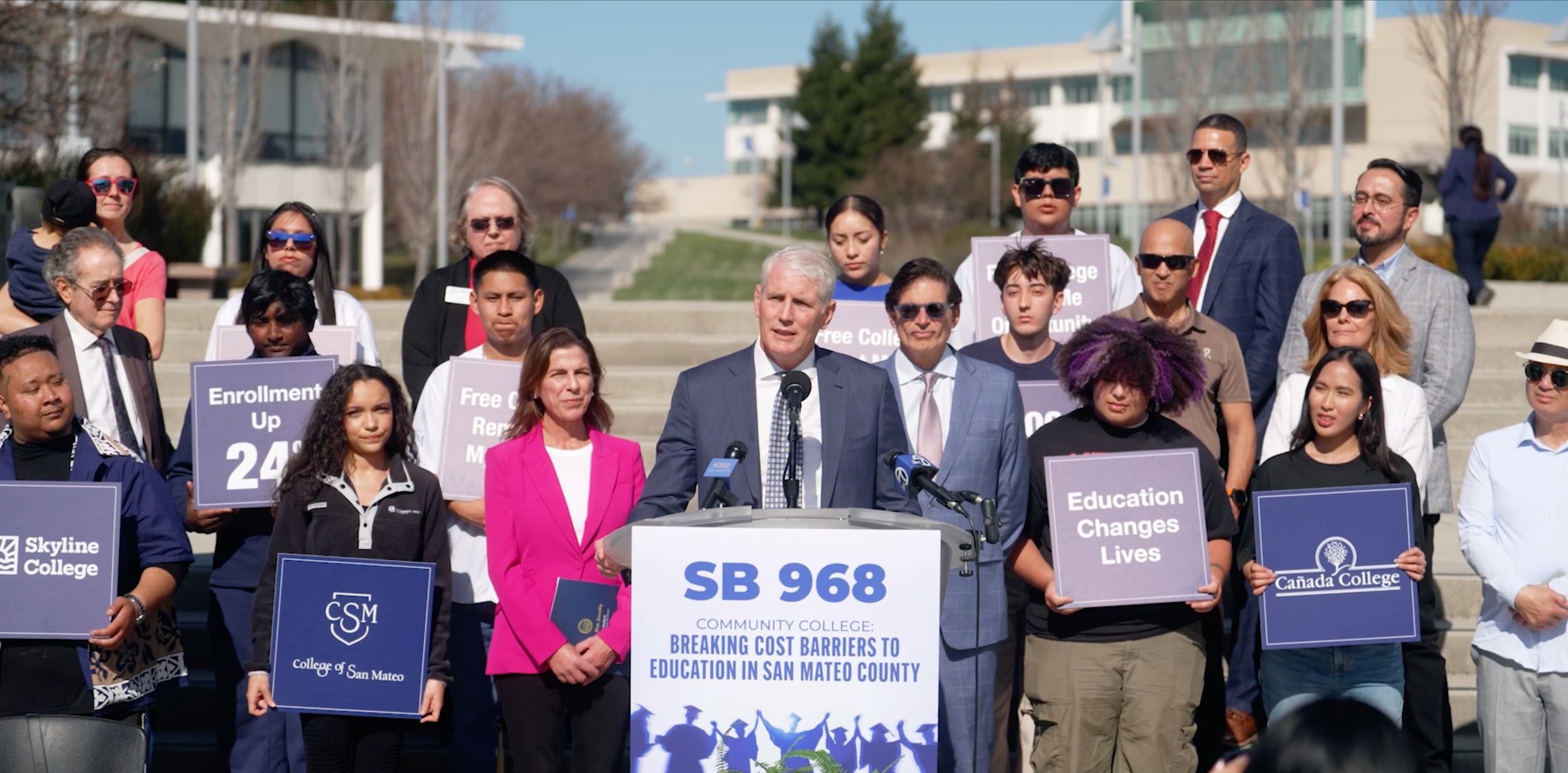
While that industrial story unfolded, Pimentel was also working on an institution that had a much earlier claim on his attention. Elected in 2020 to the San Mateo County Community College District board, he had campaigned on tuition-free college, student support and transparency. His district includes communities such as East Palo Alto, Redwood City and parts of Menlo Park.
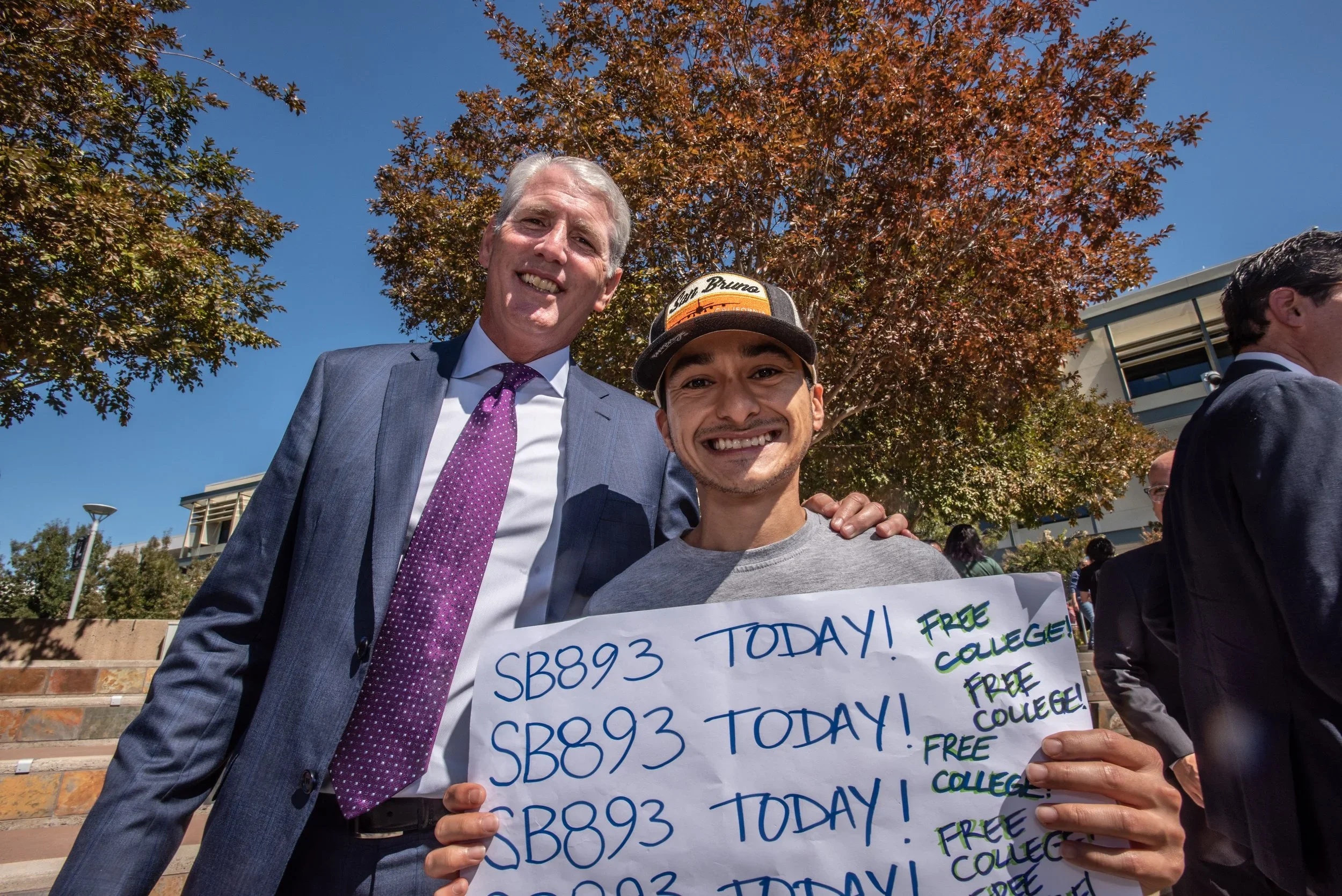
By December 2024, the college district reported a 24 percent enrollment increase linked to its Free College initiative. More than half of the students benefiting from the support were first-generation college students. Pimentel, then board president, was describing a program that reached people whose educational starting point resembled his own.
“Free College has changed the life trajectory for thousands of families in our county,” he said. The legislation enabling the program, SB 893, came through Senator Josh Becker, with Marc Berman and Kevin Mullin as co-authors. Its implementation was a collective undertaking across the district and state government. Pimentel’s return to college governance placed him inside that effort, decades after his own student leadership.
He was re-elected in 2024. His current trustee term runs through 2028. The work offers a useful counterweight to the scale of atmospheric carbon removal: a local institution, a defined budget and students deciding whether they can afford to enroll.
One more set of rules to question
Pimentel’s public work now includes a 2026 candidacy for California’s Board of Equalization, District 2. His campaign proposes more transparent administration, more consistent property-tax assessments and legislative action to extend the sales-tax exemption to prepared food. These are proposals he is campaigning on, rather than policies he has enacted.
There is also a pointed institutional question in his platform. He has said the board’s functions should continue while questioning whether its elected structure should. Running for an office whose architecture you are prepared to reconsider is an unusually literal way to invite scrutiny of the job description.
His career offers no single machine or policy that resolves every problem it touches. What it does offer is a recurring interest in the arrangements that allow useful work to proceed. Someone must sign the power agreement. Someone must approve the budget. Someone must determine whether a promising result can be repeated. For Pimentel, those obligations have supplied work enough, from a community-college boardroom to an Oregon carbon-capture plant.
Follow the work
- Personal website ↗
- LinkedIn ↗
- Instagram ↗
- Facebook ↗
- 280 Earth ↗
- The 2024 carbon-removal interview ↗
- Foundation Windpower’s financing story ↗
- The UC Davis turbine proposal ↗
- 280 Earth’s X project history ↗
- Frontier’s purchase agreement ↗
- The Oregon launch announcement ↗
- Free College’s December 2024 results ↗
- Trustee biography ↗
- Current trustee roster ↗
- 2026 candidate questionnaire ↗
- Bloomberg Green panel discussion ↗