John Friesen’s advice about selling a business begins years before anyone buys it. “The preparation starts years back,” he says. It is a wonderfully inconvenient observation. Entrepreneurs hoping for a clever move at the negotiating table are being asked to consider the much longer business of getting ready.
Friesen founded Direct Line, the Fremont, California, infrastructure business that became Direct Line Global. The company dates to 1997. In February 2018, while he was chief executive, Guardian Capital Partners invested alongside its management team. The owners wanted help expanding beyond their Silicon Valley roots. They were choosing a partner for the work ahead, with the business still very much in motion.
That decision is the hinge in Friesen’s story. Before it lies the building of a specialist services company. After it come new ownership, further expansion and, eventually, an acquisition by CBRE in June 2024. Between those events sits a founder’s practical question: who should help carry a company into its next stage?
Twenty-one years before the deal
Direct Line’s founding year places the business well before today’s enthusiasm for artificial intelligence. Its field was the physical infrastructure that lets computer systems connect: network cabling, fiber, installation and maintenance. There is a pleasing stubbornness to that sort of work. The language of technology can change every season; somebody still has to make the connections.
By the time Guardian invested, Direct Line’s offering included infrastructure and staffing for data centers and other environments where reliability mattered. Its headquarters were in Fremont, with satellite operations across the United States and a presence in Asia and Europe. Friesen was running a company whose work already extended beyond the Bay Area, even as its owners sought a larger platform for expansion.
His business occupied a particular place in the technology economy. Customers could buy computing equipment and commission buildings, but those purchases created another set of jobs: designing connections, installing them and keeping the infrastructure useful. Direct Line built a business around those requirements. An impressive equipment order still leaves someone with a fairly substantial to-do list.
There is no need to turn Friesen’s early career into a prophecy about AI. The more interesting chronology runs in the other direction. A company founded in 1997 developed a service that later waves of computing continued to require. Its work supplied a physical answer to an industry remarkably fond of airy nouns.
- 1997Direct Line is founded.
- 2018Guardian invests; Friesen is CEO.
- 2021Bill Nelligan becomes CEO.
- 2024CBRE acquires Direct Line Global.
Company milestones. The later chapters belong to subsequent leadership.
A partner, and a longer horizon
The investment closed on February 23, 2018. Guardian partnered with the existing management team, led by Friesen as chief executive and Ignacio del Rio as chief operating officer. The arrangement called for that team to continue operating the business. Ownership was changing while the people responsible for delivery remained at work.
The owners’ stated ambition was specific: scale beyond Silicon Valley. Northern Edge handled the sale process, which attracted both strategic and financial buyers. Those labels describe different kinds of counterparties. A strategic buyer brings an operating business of its own. A financial buyer brings an investment mandate. For an owner weighing the next chapter, the distinction reaches beyond the number on an offer.
Friesen and his fellow owner ultimately chose an investor group led by Guardian. At the time, Guardian’s stated approach involved providing growth capital to privately held businesses and working alongside their management teams. That matched the announced shape of this transaction: resources for expansion, coupled with continuity in the operating team.
The choice gives substance to an often vague word, partnership. Here it meant deciding how new capital and an existing business would work together. It also meant selecting from competing possibilities. A founder who has spent years building something must assess people who may have spent a much shorter time examining it. The paperwork records a transaction; the relationship has to survive ordinary working days.
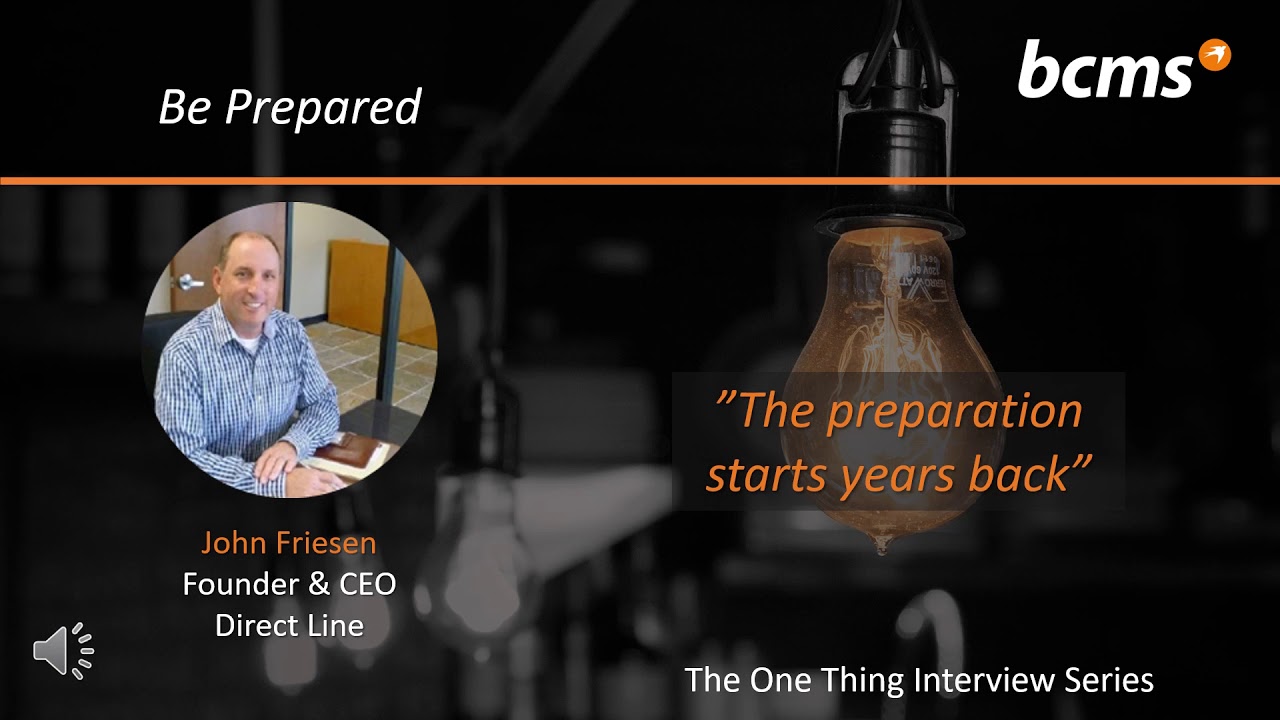
“The preparation starts years back.”
John Friesen · The One Thing interview, part one
The ambition also distinguishes this moment from the later CBRE acquisition. In 2018, the owners were seeking assistance to grow the company they would keep operating. In 2024, an established services organization bought the business from its financial sponsor. Those are different relationships, at different points in the company’s life. Keeping that distinction in view gives Friesen’s decision its proper setting: he was choosing support for a next phase of development, with the operating team continuing in place.
The advice fits on a small card
Friesen later appeared in two installments of The One Thing interview series. The first was presented around preparation. Its short quotation puts the emphasis on elapsed time, a useful corrective to the idea that selling begins when a buyer appears. A sale has a date. Readiness has a history.
That observation is especially interesting coming from an operator of an infrastructure services business. Much of the company’s value lay in its ability to organize and deliver work for customers. The transaction involved an established operating company, with management, geographic reach and specialist services already in place. The investor was buying into that accumulated capacity.
Read as a reflection on his own transaction, Friesen’s remark suggests a longer way of thinking about an exit. The years spent developing a business help determine what an eventual partner can join. It would be a mistake to turn those seven words into a detailed checklist he never supplied here. Their force comes from a simpler point: preparation belongs inside the years of ownership.
Know the people across the table
The second interview carries another compact line: “Know who you are working with.” Its presentation focuses on engaging financial buyers. Together, the two installments place time and people at the center of Friesen’s public advice. Neither idea requires an elaborate vocabulary. Both become more demanding when a company’s future is involved.
The 2018 process gave the owners competing routes to consider. They chose Guardian after interest from different types of buyers. Seen alongside the interview, that sequence makes the human question concrete. An offer introduces an organization, its expectations and its way of working. Choosing it starts a relationship that continues after the celebratory announcements have been filed away.
There is a modest humor in the scale of the advice. A business sale can produce formidable quantities of documentation, yet Friesen’s published takeaway concerns knowing the people involved. Documents are excellent at describing obligations. They have a more limited gift for telling you what a Tuesday together will feel like. His line keeps attention on the counterparties themselves.
The transaction received Private Equity Deal of the Year recognition in the $10 million to $50 million category at the 2018 M&A Advisor Awards. The recognition went to the Northern Edge-advised deal. For Friesen’s biography, its relevance is the transaction it marks: an established founder-led company selecting capital and an operating relationship for its next stage.
A recommendation, in ordinary words
A smaller piece of Friesen’s public record offers a different view of working relationships. In a recommendation for Brenda Purcell, he praised her care for Direct Line, punctuality, reliability and ability to get along with coworkers. He described her as having a “very high level of caring.”
Those are everyday qualities, expressed in everyday language. They also concern how someone behaves around other people and around the work. The recommendation does not establish a sweeping theory of his personality. It does show what he chose to recognize in a colleague: consistency, consideration and being someone others could work beside.
Placed next to his advice about knowing a buyer, the recommendation offers a useful echo. At very different scales, both concern the people on whom a business depends. One appears in the context of a company transaction; the other is a public endorsement of an individual’s work. Friesen’s words become most revealing when they stay close to those particulars.
The company keeps going
The next chapters require careful dates. Bill Nelligan became Direct Line Global’s CEO in 2021. When CBRE announced its acquisition on June 18, 2024, Nelligan was leading the business. Friesen’s place in that account is as founder and former chief executive, whose earlier company-building and ownership decision preceded the later sale.
During Guardian’s ownership, Direct Line invested in operations, service offerings, geographic expansion and customer relationships. By the 2024 acquisition announcement, it had more than 1,000 employees. Its footprint included Northern Virginia and operations in Hong Kong, the Philippines, Singapore and South Korea. Those figures describe the company at the time of the acquisition, under its later management.
CBRE’s interest lay in combining adjacent capabilities. Direct Line supplied technical infrastructure services inside data centers; CBRE already provided facilities management. Joining them brought more of the building and its computing environment within the same services organization. The business Friesen founded had reached a buyer with a reason to connect it to a much larger operation.
Friesen’s LinkedIn profile now lists Danville, California, and JRF Ventures, Inc. It also lists a CDCDP certification through CNet Training. These details place him beyond his old CEO title while retaining a visible connection to the technical field in which he built Direct Line.
His most useful public observations remain the short ones. Get ready over time. Understand the people involved. They suit a career whose pivotal transaction joined an existing operating team with a new financial partner. The company carried on through another chief executive and another owner. Friesen’s advice invites attention to the years and relationships that make such a handover possible.