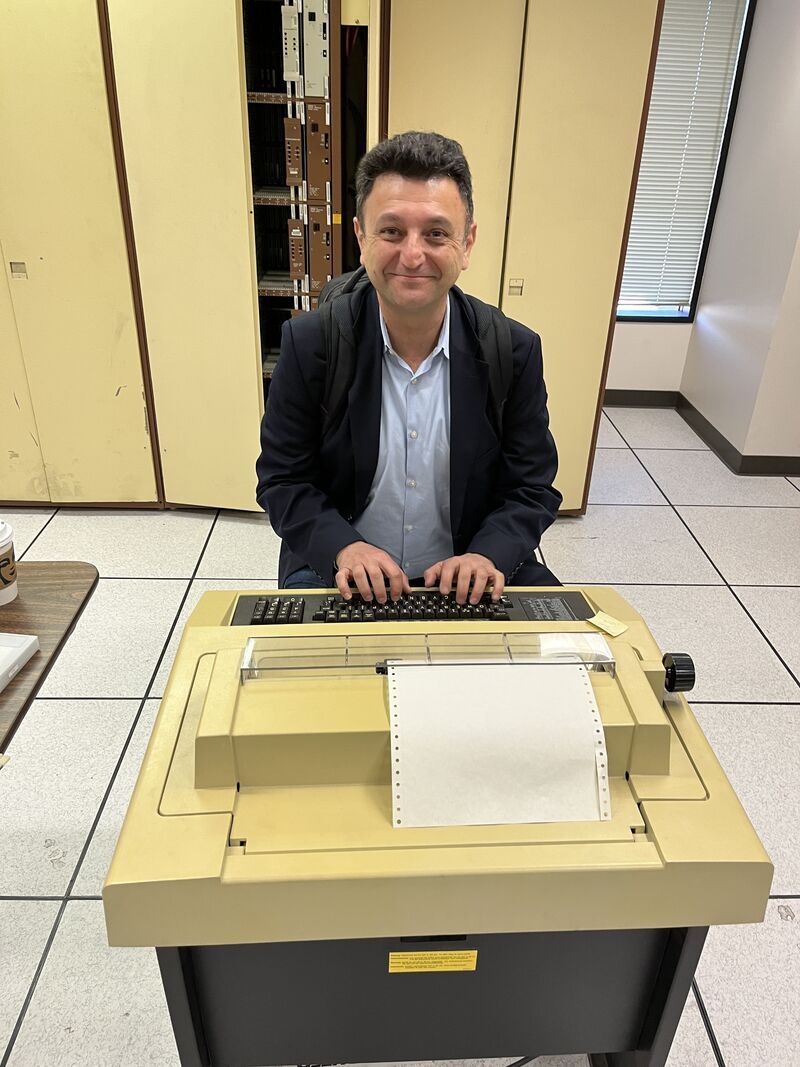
Arman Khalili sits at a keyboard attached to a machine large enough to require its own furniture. There is continuous-feed paper, a generous expanse of beige casing and a smile that suggests he understands the joke. In March 2022, his company posted the photograph with a caption announcing its new high-tech customer-management system. The apparatus looks admirably prepared to invoice someone in 1978.
The photograph makes a useful introduction. Khalili’s working life spans several generations of equipment that once represented the future. He co-founded an early Bay Area internet service provider, helped build secure email and online music businesses, and went on to assemble data center operations. By the time he handed over Evocative’s chief executive role in 2023, the business had expanded far beyond its initial regional footprint.
Much of that work concerns things internet users rarely picture: buildings, power supplies, cooling equipment, network connections and the people who keep them working. Khalili has moved between engineering, sales and finance, following the physical requirements of businesses whose products arrive on a screen. The beige terminal is good for a laugh. It also gives the cloud a refreshingly solid piece of furniture.
Four modems, then a much larger problem
Khalili’s account of Sirius Connections begins with four 14.4K modems and a 56K dedicated connection. The company belonged to the early commercial internet in the San Francisco Bay Area, when getting a customer online was itself a business. Its equipment list included NeXT and Sun machines. These are details with the pleasing specificity of someone who remembers what had to be plugged in.
Sirius eventually served more than 25,000 dial-up users, according to his professional history. That change in scale helps explain the range of responsibilities that followed. Selling access required understanding both the machinery and the customer. Network architecture and business development occupied the same small-company world, with little opportunity to regard either as somebody else’s concern.
His later work included consulting assignments with AT&T and Level 3, as well as founding NextLayer, a secure email business. He was also a co-founder and chief technology officer of MusicBank, an early online music venture. Across these businesses, the recurring problem was delivery: connecting people to services, protecting communications and making digital content available over a network.
There is a temptation to turn such a career into a procession of predictions. Its more interesting quality is the amount of practical work underneath. A service needs a route to its customer. Someone must arrange that route, pay for it and keep it available. Khalili kept working in the space where those obligations meet.
A room with rather demanding tenants
UnitedLayer, which he co-founded in 2001, brought those obligations into the data center. Colocation gives customers a place for their own computing equipment, together with the electricity, cooling and connectivity it needs. The tenants are unusually fussy about temperature and remarkably uninterested in the view. Their owners tend to notice immediately when the accommodation disappoints.
Khalili remained with UnitedLayer through its sale in 2010. His responsibilities had included recruiting teams, dealing with vendors and managing the company’s finances. That combination matters to the subsequent story. Building an infrastructure business involves assembling people and commercial agreements alongside the technical systems. An attractive floor plan does little on its own.
He later led Black Lotus, a business focused on mitigating distributed denial-of-service attacks. Such attacks attempt to overwhelm online services with traffic. Black Lotus was acquired by Level 3. He also founded CentralColo, subsequently known as Element Critical, and served as a principal at investment firm Industry Capital. By the time Evocative’s expansion began, he had worked with both the operators of infrastructure and the capital behind it.
The teaching ran alongside the operating. His older biography records instruction at UCLA Extension and California State University Fullerton. He was already translating technical work into lessons while still building companies. That detail becomes more revealing when, years later, he returns to his own university with a different reason to be on campus.
Two facilities become a network
In May 2017, Evocative announced the acquisition of two data centers from 365 Data Centers, in Emeryville and San Jose, and named Khalili chief executive and a director. The business had earlier history under the Evocative name; the platform he led took shape through this new period of investment and acquisitions. His announced plan combined buying businesses with growing the operations already in hand.
The geography soon changed. A January 2018 acquisition of data center operations in Reston, Virginia, gave the predominantly West Coast operator an East Coast presence. The initial site offered 25,000 square feet and 2.2 megawatts of capacity, with room to expand. Its value included the possibility of connecting facilities across the country and offering customers distributed infrastructure.
That is a different proposition from simply adding another building to a list. Customers could consider services spread across locations, including disaster recovery, private cloud and storage. A network gives individual facilities a relationship with one another. Khalili’s early experience selling connectivity had acquired a considerably larger real-estate component.
- 2017Emeryville + San Jose
Two acquisitions establish the growth platform. - 2018Reston, Virginia
An East Coast foothold. - 2019VPLS
More cloud and managed-services capabilities. - 2022Nine INAP data centers
A larger national portfolio. - 2023The boardroom
Khalili passes the CEO role to Derek Garnier.
The 2019 acquisition of VPLS added cloud and managed-services capabilities, and the group operated under the VPLS name before returning to Evocative. Other additions included assets from Wave Broadband, Hawaiian managed-services provider ZR Systems and Carrier-1 in Dallas. The acquisitions brought different services and customer relationships into the same organization.
Money arrived in stages. A $2.5 million seed investment spearheaded by Khalili was followed by Crestline Investors’ involvement in 2019. In April 2022, Evocative announced another $30 million equity investment led by Crestline. Its expansion depended on that continuing relationship between an operating team and investors willing to finance the next acquisition.
The arithmetic of putting it together
September 2022 compressed the strategy into a few busy weeks. Evocative announced the consolidation of its affiliate brands under a single name. Later that month, it closed the purchase of nine INAP data centers, adding Boston, Atlanta and Seattle to its markets. The transaction also increased its employee count by 30 percent.
The closing announcement put the resulting US portfolio at 20 facilities, 1.08 million square feet and 108 megawatts of available power. Those measurements describe different parts of the same undertaking: where the equipment can sit, how much electricity is available and how widely the operator can serve its customers. They belong to that September 2022 snapshot.
Three measures of an infrastructure business: locations, space and electrical capacity.
There was also the less photogenic business of integration. Unifying the brands was meant to make the group’s capabilities easier for customers to understand and access. A collection of acquisitions can arrive with a collection of names. Evocative was trying to turn that collection into a company with a coherent offer.
Khalili’s eventual farewell acknowledged the accumulated effort and thanked colleagues and investors. It included a wish of good luck to Derek Garnier, his successor. The public transition announcement came on February 27, 2023. Garnier had been president and chief operating officer; Khalili would continue on the board.
“I am privileged to have founded and led Evocative through its first five years.”
Arman Khalili · February 2023
The change gave an executive already involved in operations responsibility for the next phase. For Khalili, it changed his relationship to the business he had helped assemble. Founder and board member remained accurate descriptions. Running the company day to day became Garnier’s job.
Back on campus, facing the room
Later in 2023, Khalili announced a return to San Francisco State University, where he had studied computer science. This time he would teach a Thursday class in strategic management and entrepreneurship at the Lam Family College of Business. His invitation to people around campus to catch up gave the announcement a pleasantly ordinary ending.
He had also spoken publicly about opening technology careers to younger people. In September 2022, Evocative became a sponsor of the Nomad Futurist Foundation, established by Nabeel Mahmood and Phillip Koblence. Khalili connected that support to educational opportunities and narrowing the digital divide. The concern extended beyond recruiting for the next vacant position.
Teaching offers a different setting for experience accumulated through sales calls, technical decisions and acquisitions. Students can examine a strategic choice without inheriting its electricity bill. A founder, in turn, has to make the reasoning clear enough to be questioned. His return brings the operating career into a room where explaining the decision is part of the work.
Another foundation, another power requirement
Khalili’s current venture is Foundation Data Centers, which lists him as founder and chief executive. Its published development plans include high-density computing facilities and a proposed campus in McAllen, Texas, using enhanced geothermal energy. These are development ambitions, with project schedules and statuses attached, rather than a list of completed operating facilities.
His work continues to reach into other infrastructure ventures. An October 5, 2026 report identified him as a partner at Blackstart Digital in coverage of the former IBM Almaden research campus in San Jose. The contemporary project sizes are a long way from a handful of modems. The requirements still include power, property, connectivity and people able to make them work together.
The career has taken Khalili from selling an internet connection to finding room for the equipment behind thousands of them. Along the way, he has sold businesses, returned to the classroom and started again. Somewhere in that history sits a photograph of a smiling executive at a beige terminal. Technology keeps promising to get smaller. His work keeps finding reasons it needs another building.