At scientific conferences, John C. Martin and Norbert Bischofberger liked the poster sessions. Young researchers stood beside their work, ready to explain it to whoever stopped. The two executives would join the conversation. Sometimes the researchers only discovered who their visitors were when business cards changed hands at the end. For a while, everyone could concentrate on the experiment.
It is a pleasing arrangement for an introvert: something interesting to discuss, no obligation to manufacture charm, and a diagram available if conversation falters. Bischofberger remembered that both he and Martin were introverts. Science gave them common ground. Business cards could wait.
Martin was chief executive of Gilead Sciences from 1996 to 2016, a stretch long enough to make his name part of the company’s institutional memory. He became chairman in 2008 and remained in that role until 2019. Yet the conference anecdote brings him into focus more clearly than the titles. A senior executive, with every reason to be recognized, was happy to begin as an interested stranger.
Three degrees, two chemists at home
John Charles Martin was born in Easton, Pennsylvania, on May 7, 1951, and grew up in Evansville, Indiana. His parents, Tellis Alexander Martin and Janet Sacks Martin, had both trained as chemists. He was the eldest of four children. His first job was picking strawberries, an occupation with an uncomplicated relationship between effort and output.
Chemistry was already close to home. His education added other ways of thinking. He graduated with honors in chemical engineering from Purdue University in 1973, then earned a doctorate in organic chemistry at the University of Chicago in 1977. In Josef Fried’s laboratory, he worked on demanding problems in molecular synthesis. The engineering degree and the doctorate put construction and inquiry beside each other.
A molecule is a useful corrective to confident speech. It does not become the desired molecule because the presentation went well. Martin’s early training required him to work with structures, sequences, and results. Later, when his responsibilities included organizations as well as experiments, he still spoke about judgment in the language of a scientist.
He joined Syntex in Palo Alto and advanced to a section leadership role. At the same time, he took evening classes at Golden Gate University, earning an MBA in 1984. The combination is distinctive: engineering, organic chemistry, then business. His route into management ran through classrooms as well as laboratories.
The evening student remembers
The MBA eventually became more than a credential on Martin’s own biography. At Gilead, he helped establish an onsite, subsidized MBA program for employees. A working person’s difficulty in finding time and money for another degree was something he had experienced himself.
There is a practical generosity in that choice. Advice to keep learning is cheap. An arrangement that makes learning fit around a job requires somebody to deal with the schedule and the bill. Martin’s own years of evening study supplied a concrete example of what employees might need.
It also complicates the familiar picture of the scientist who becomes an executive and leaves the earlier identity behind. Martin kept adding to his education, then helped colleagues add to theirs. The organization could benefit from people who understood more than the work immediately in front of them. An employee could acquire a new vocabulary without first having to leave.
In 1984, he moved to Bristol-Myers, leading research in Syracuse, New York. By 1990, he was ready to join Gilead as vice president of research and development. He brought experience from established companies to an organization that was still young enough for its future to be unsettled.
A company small enough to change its mind
Martin later recalled that Gilead had about thirty scientists when he arrived. The company was three years old. Its original scientific approach had come into question. The people doing the research were capable; the direction of the research needed reconsideration. His account gives the early company the scale of a group of people who could still know one another.
That distinction matters in an organization built around specialized knowledge. A change of direction can be treated as an admission of failure, or as the consequence of paying attention. Martin described a company with good scientists confronting uncertainty about its founding technology. The problem called for scientific judgment before it called for a polished corporate story.
In his 2007 oral history, he described himself and fellow Gilead board member Gordon Moore as “scientists with scientific judgment.” Moore, the Intel co-founder, had a scientific background too. Martin emphasized the ability to inspect data, consider another interpretation, and decide whether a difference was significant.
The comparison connected two businesses through a habit of thought. Semiconductor manufacturing and molecular research involve different materials, but both punish assumptions that survive only because nobody has tested them. Martin valued that questioning mind in the boardroom. A title did not retire the obligation to examine the evidence.
“Does that make sense? Is there another interpretation?”
John C. Martin · 2007 oral history
Prague, Leuven, Foster City
Martin’s working world extended across the Atlantic. His relationships with Antonín Holý in Prague and Erik De Clercq in Leuven began during his Bristol-Myers years and continued at Gilead. Chemistry supplied the subject; the relationships supplied continuity between institutions and employers.
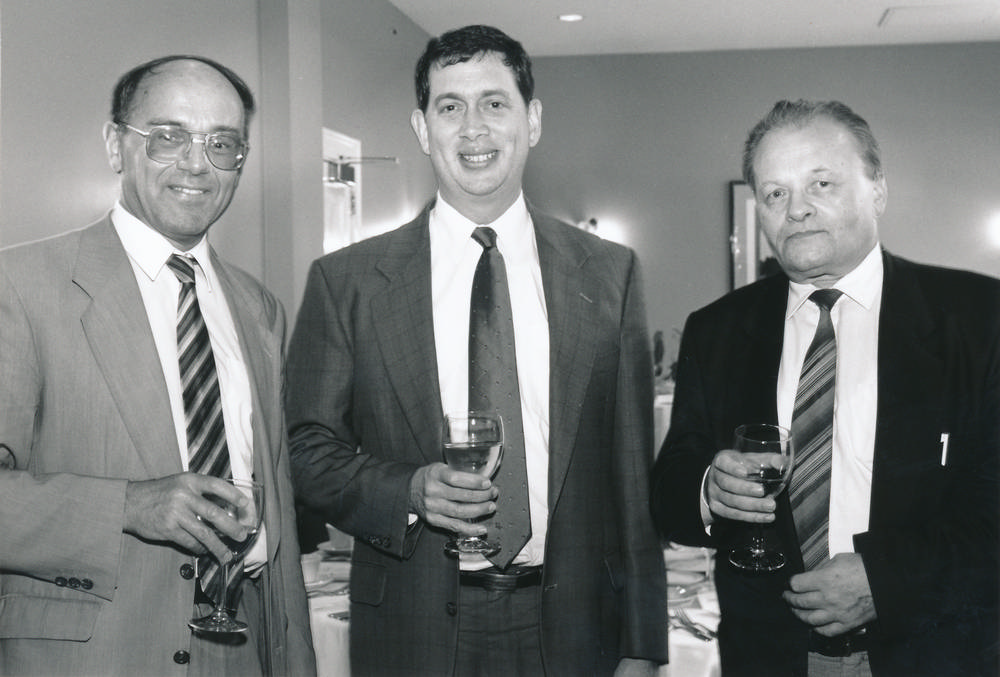
A photograph from April 1996 puts the three together at Gilead. De Clercq stands on the left, Holý on the right, Martin between them. The image records a collaboration that crossed countries. It is also simply a group photograph, with glasses in hand and no attempt to make scientific partnership look less sociable than it was.
The Prague connection produced an unusually brisk conversation about research funding. Zdeněk Havlas, a former director of the institute, remembered driving Martin from a hotel to the airport at four in the morning. He asked whether Gilead might support research groups, including Holý’s team. Martin considered it and proposed a million dollars a year, with a hundred thousand allocated to Holý.
The exchange helped establish the IOCB-Gilead Research Centre. The setting is almost comically inconvenient for institution building: an airport journey before dawn. But it illustrates the value of a relationship in which a request could be made plainly and receive a concrete answer. The conversation had somewhere to go.
Twenty years, a yellow pad
Martin became Gilead’s CEO in 1996. His former colleague Chris Garabedian remembered an office with an uncluttered desk, group photographs, and a yellow legal pad for questions and tasks. The pad offered an ordinary physical counterpart to a large responsibility: things to ask, things to do, things to revisit.
There was room for an awkward joke, too. On the morning of a company picnic at Half Moon Bay, Garabedian found Martin working in the office. Asked whether he was excited about the picnic, Martin said, “I’d rather be spending the day working, but I guess people are expecting me to be there.” He went.
Garabedian also remembered an exchange of philosophy books: Martin gave him Nietzsche’s Beyond Good and Evil; Garabedian responded with Hobbes’s Leviathan. Their discussions returned to authority and the management of a growing organization. A yellow pad and political philosophy make an amusing pair of office supplies.
20 years as chief executive · 1996-2016
Preparing somebody else to take the chair
Bischofberger joined Gilead in 1990 too. Martin brought him into responsibilities beyond research, including press releases, personnel matters, and the building of a commercial organization. Years later, Bischofberger credited that exposure with helping him approach his first CEO position at Kronos Bio.
“He was always delegating things to me,” Bischofberger recalled. That is a revealing description of mentorship. The instruction arrived through work that actually needed doing. A future executive could experience decisions while an experienced colleague remained close enough to guide him.
Martin joined the Kronos Bio board in 2018, continuing a relationship that had begun nearly three decades earlier. It is tempting to describe corporate succession entirely through the person who gets the top job. This part of Martin’s story concerns what colleagues carried into other organizations: experience, confidence, and a working example they could consult.
The work after the title
Recognition accumulated: election to the National Academy of Engineering in 2008, the Biotechnology Heritage Award in 2017, and the National Academy of Sciences Award for Chemistry in Service to Society in 2019. KU Leuven awarded him an honorary doctorate in 2017. Different institutions recognized different parts of a career that connected research, engineering, and enterprise.
He joined the Scripps Research board in 2018. Peter Schultz, the institute’s president and CEO, remembered his wisdom, wit, and humility. Those qualities sit comfortably beside the conference story: the accomplished visitor willing to spend time discussing a young researcher’s poster.
Before his death on March 30, 2021, Martin also co-founded Bitterroot Bio. The company identifies him in memoriam as a co-founder and former Gilead chairman and CEO. It gives his biography another beginning after the long Gilead chapter.
The poster session remains a useful place to leave him. There is a researcher explaining an idea, an executive attending to it, and a business card still in a pocket. For those few minutes, an established career makes room for a conversation about somebody else’s work.