Long before Rick Klausner helped assemble a research company with three billion dollars in starting capital, he walked into someone else's office with a question. He had read a paper by Harvard scientist Morris Karnovsky and wanted to talk about it. The conversation lasted until three in the afternoon. A week later, Klausner was working in Karnovsky's laboratory. He recalled the encounter to an NIH writer in 1988, years after it happened. It is a compact account of a scientific career beginning with the rare luxury of an unscheduled afternoon.
That detail matters because Klausner's later career can look, from a distance, like a parade of large institutions and large numbers. He directed the National Cancer Institute. He held an executive role at the Gates Foundation. He helped start Juno Therapeutics, GRAIL and Altos Labs. His current Altos biography lists more than 300 scientific articles. A résumé can carry all of that neatly. It has less room for the long conversation that opened a laboratory door.
Klausner has spent much of his working life moving between those two scales. One is small enough for a question across a desk. The other involves budgets, boards and buildings. His story is about what happens when a scientist becomes interested not only in an experiment, but in the setting that gives experiments a chance.
The laboratory as an invitation
Klausner graduated from Yale in 1973 and earned his medical degree at Duke in 1976. The NIH's account of his early career describes his undergraduate research on the physical properties of viruses and his later work on the movement of materials inside cells. He trained at Massachusetts General Hospital, then followed the questions that took him to Karnovsky's lab at Harvard. In 1979, he joined the National Institutes of Health.
At the NIH, a question became a program of work. Klausner and his colleagues studied how cells receive and route signals, and how the parts of a cell sort themselves. A 1985 NIH profile reached for an unexpectedly lively comparison: the Pony Express. Molecules carried messages inward, delivered them and returned for another trip. The analogy had its limits, as all useful analogies do, but it made the laboratory's subject legible to a reader who had never seen the inside of a cell.
By 1984, Klausner was chief of a new Cell Biology and Metabolism Branch. An NIH article from 1991 described research spanning signaling, cellular traffic and regulation of molecular processes. These are different questions, yet all require attention to relationships: how one part of a system informs another, and what happens when the signal is delayed, altered or misread. The young lab chief was already working at the meeting point between detailed mechanisms and larger arrangements.
The work earned him election to the National Academy of Sciences in 1993. That honor is personal, but the NIH records also make clear that his research was collective. Colleagues appear by name, experiments by team and ideas by the conversations that joined one inquiry to the next. The solitary genius makes a tidy illustration. It is rarely a useful floor plan for a laboratory.
A larger room
In 1995, Klausner took over the National Cancer Institute, becoming its eleventh director. His work suddenly included an entirely different kind of experiment: how to lead an organization of thousands while keeping a scientist's attention on ideas. He held the job until September 2001, crossing two presidential administrations. The NIH's record of his departure noted new programs and a substantial expansion of the institute's budget during those years.
An administrator can easily become a person who attends meetings about other meetings. Klausner had arrived from the bench, and that background shaped the tension of his new role. He was no longer the one following a receptor through a cell. He was responsible for an institution in which many groups needed the means to pursue their own questions. The scale changed; the puzzle of arranging people and resources remained.
His departure in 2001 led first to the Case Institute of Health, Science and Technology, launched by the Case Foundation. He later served as executive director for global health at the Bill & Melinda Gates Foundation. These moves can look abrupt if one files work by sector: government, philanthropy, industry. They look more continuous if one notices the recurring task of joining research, funding and people around a shared purpose.
A 1994 NIH account caught that habit in miniature. Discussing a cell biology interest group on campus, Klausner wanted researchers to know who else was nearby. At a large institution, even that simple awareness required work. The proposed directory was a modest tool, yet the instinct behind it was large: useful conversations are more likely when people can find one another.
“To think bigger together than we can think alone.”Rick Klausner, quoted by a 2024 Nucleate Summit attendee
The company as a research instrument
Klausner's next chapters brought him firmly into biotechnology. He held senior roles at Illumina and helped found Juno Therapeutics and GRAIL. His Altos biography also lists leadership connections to Lyell Immunopharma, Sonoma Biotherapeutics and LifeMine Therapeutics. These organizations have different histories and different aims. What they share in Klausner's career is a willingness to make a new institution when an existing one seems too narrow for the work at hand.
There is a small, telling episode from this period. Bit.bio recounts Klausner's first meeting with its founder, Mark Kotter, at Lyell. Kotter showed him data. Klausner said he asked his assistant to clear the morning, and the conversation ran four hours. An investment followed. One can debate any investment years later; the revealing part here is the sequence. The data earned more time. The people stayed in the room. A decision came after a conversation that refused to fit into a calendar slot.
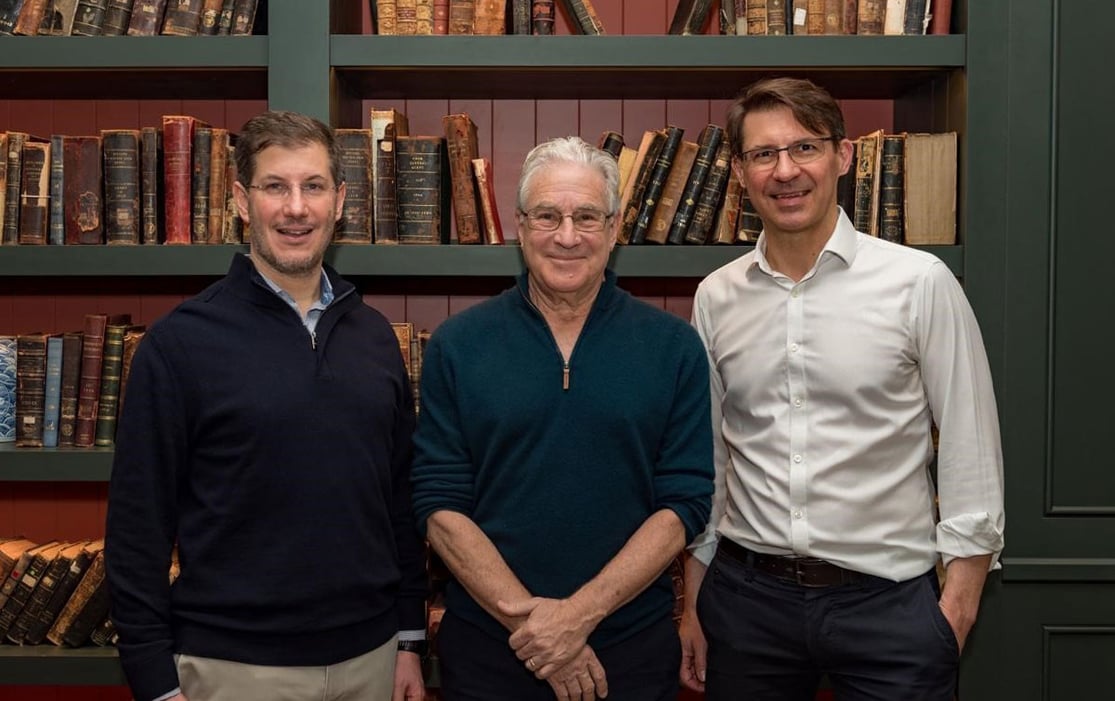
The photograph of Klausner with Kotter and bit.bio co-founder Florian Schuster has a curious setting for a modern biotechnology story: a wall of old books. It offers a fitting image for the way Klausner has crossed eras of research. The tools change. The question of whom to trust with a difficult idea does not go away. Neither does the value of making enough time to hear an explanation all the way through.
That is also why his company history resists the easy label of serial founder. The label counts startups. It misses the labor between the first proposal and a functioning scientific group: choosing colleagues, agreeing on questions, finding the right mix of freedom and accountability, and keeping the institution useful when the early excitement fades. Founding is a verb with a long middle.
Leads a new cell biology branch at NIH.
Becomes director of the National Cancer Institute.
Helps found Juno Therapeutics.
Helps found GRAIL.
Altos Labs publicly launches.
Another model, another question
Altos Labs is the largest stage yet for Klausner's institution-building instinct. The company was organized in 2021 and publicly launched in January 2022 with $3 billion in initial financing. Its co-founders are Klausner, Hans Bishop and Hal Barron. Its operations span the San Francisco Bay Area, San Diego and Cambridge in the United Kingdom. That geographic spread is part of the design: a research organization large enough to gather different kinds of expertise while asking them to work on connected problems.
At launch, Klausner described Altos as the realization of years of thinking about different models for doing science. The remark is revealing. The company itself was an answer to an organizational question, not merely a new letterhead for an old one. By its own account, Altos brings together scientists, clinicians and people with industry experience. A team that broad creates opportunities, and it creates the ordinary frictions of any large group. Its success depends on whether people can continue to talk across those differences.
Klausner initially served as chief scientist. Altos now lists him as chief scientific advisor and founder, and as a co-chair of its board. Titles are useful for locating a person on an organization chart. They cannot tell us what a decade of work will produce. Altos remains a company in motion, with its own research program, colleagues and decisions ahead of it. What can be said today is narrower and more interesting: the person who once spent a whole afternoon following a scientific question is still involved in building places where other people can do the same.
At a Nucleate gathering in 2024, an attendee remembered Klausner urging people to think bigger together than they could think alone. It is a sentiment common enough to sound decorative until set beside the details of his career. The Karnovsky visit, the NIH interest group, the long Kotter meeting, the founding teams: each is a different version of the same social act. Someone opens a door; someone else arrives with a question; a larger piece of work becomes possible.
There is no shortage of grand language around biotechnology. Klausner's own archive offers a quieter image. A scientist reads a paper, crosses a hallway and loses an afternoon in conversation. Years later, the rooms are bigger, the budgets more complicated and the company names more familiar. The habit that started it all remains almost comically simple: listen long enough to find out what another person has seen.