Before Perceptyx had hundreds of employees, it had a birthday ritual. Everyone went out together. The choice was Mexican or Indian food near the office on Jefferson Avenue in Temecula. Picking Indian meant crossing a busy street, which the group did in pairs. Even a company selling insight could appreciate the occasional practical precaution.
Bradley Wilson, who joined as employee number nine, remembered those lunches when John Borland stepped down as CEO in April 2025. In that earlier business, Borland was the sole project manager. The two worked together to support each client. A customer problem had very few places to hide, and almost certainly knew somebody’s first name.
That recollection supplies a useful entrance to Borland’s career. His later work involved acquisitions, large employers and software intended to influence thousands of working relationships. His earlier work involved making sure individual projects happened. The distance between those responsibilities is considerable. The underlying question is familiar to anyone who has promised a customer something: who is going to do the work?
Borland’s story follows that question from a small operation to the boardroom. Perceptyx built tools for gathering employee feedback. Over time, he became increasingly explicit about the obligation that came with collecting it. Asking people to talk was only the beginning of the job.
Sixteen years before the outside cheque
In 2003, Borland founded Perceptyx with Jack Morehouse, Dave Belcher and Greg La Bonte. Their stated purpose was to help organizations listen to employees. Borland later described building the business as the most rewarding experience of his career. The founding ambition sounds straightforward. Carrying it into a large employer, with its departments, reporting lines and competing priorities, is rather less so.
His route through the company was operational. He served as chief operating officer before becoming CEO in 2017. That background matters to this story because a survey business has to deliver as well as persuade: questions must reach people, results must be usable, and clients must decide what comes next. Borland had worked close to those demands before he inherited the chief executive’s title.
Outside investment arrived in August 2019, when TCV backed Perceptyx. At the time, the company described itself as profitable and entirely self-funded since inception, with client retention above 95 percent. Sixteen years had passed between founding and the first external investment. In a business culture that often measures a young company by its financing announcements, this was a longer opening act.
The figures describe Perceptyx at that moment, rather than a permanent guarantee of its economics. Still, they give the career a distinctive rhythm. Borland became CEO of a business that had already spent years earning its way forward. Capital would support further growth and product development; customers had financed the preceding chapter by continuing to buy.
- 2003Co-founds Perceptyx
- 2017Becomes CEO
- 2019First outside investment
- 2025Moves to the board
The survey came home
A revealing episode occurred inside Perceptyx itself. In late 2017, employees gave a low score to communication across the company. For an employee listening company, this was an inconvenient result of exactly the sort it asked customers to examine. Selling the mirror did not confer immunity from the reflection.
Borland described the response in a 2019 essay. Perceptyx increased communication between departments and broadened executive updates. Within twelve months, he reported, scores relating to communication from senior leadership had risen by 36 points. The measure was a company-reported change in survey scores. Its interest lies in the sequence: an unwelcome answer, a specific response, another measurement.
He also explained that departmental survey discussions fed into quarterly and annual objectives. This is an unglamorous detail with real weight. An employee suggestion has a better chance of surviving when it reaches a team’s actual commitments. Otherwise, it must compete with the many excellent intentions already gathering dust beside the printer.
The episode makes his management argument tangible. Employees can judge whether a company has listened by watching what happens afterward. A carefully worded invitation to provide feedback is easy to distribute. A change in the way executives communicate requires those executives to behave differently. Borland’s account placed that responsibility inside his own organization.
Even the values were open to revision
By 2021, Borland was describing another internal revision. Employee feedback had indicated that Perceptyx’s values needed updating. Acquisitions of Waggl and CultureIQ brought more colleagues and perspectives into the business, adding another reason to reconsider language that had suited an earlier company.
The original five values included “We Are a Family” and “We Live For Mic Drop Moments.” The company used focus groups, surveys and other conversations to develop six replacements. The new set gave more explicit space to shared success, differences, purposeful action and customer outcomes. A business that sold listening had allowed its own vocabulary to be questioned.
There is a modest comedy in a company revising the phrases meant to explain who it is. The coffee mugs may have to wait for the humans to catch up. But the episode offers a serious distinction: values can be treated as instructions handed down once, or as language people are allowed to examine as the organization changes.
Borland chose to describe the revision publicly, including the employee feedback behind it. That decision fits the operator visible elsewhere in his career. A system that worked at one size could need adjustment at another. The same possibility applied to the words the company used about itself.
A bigger room, a recurring question
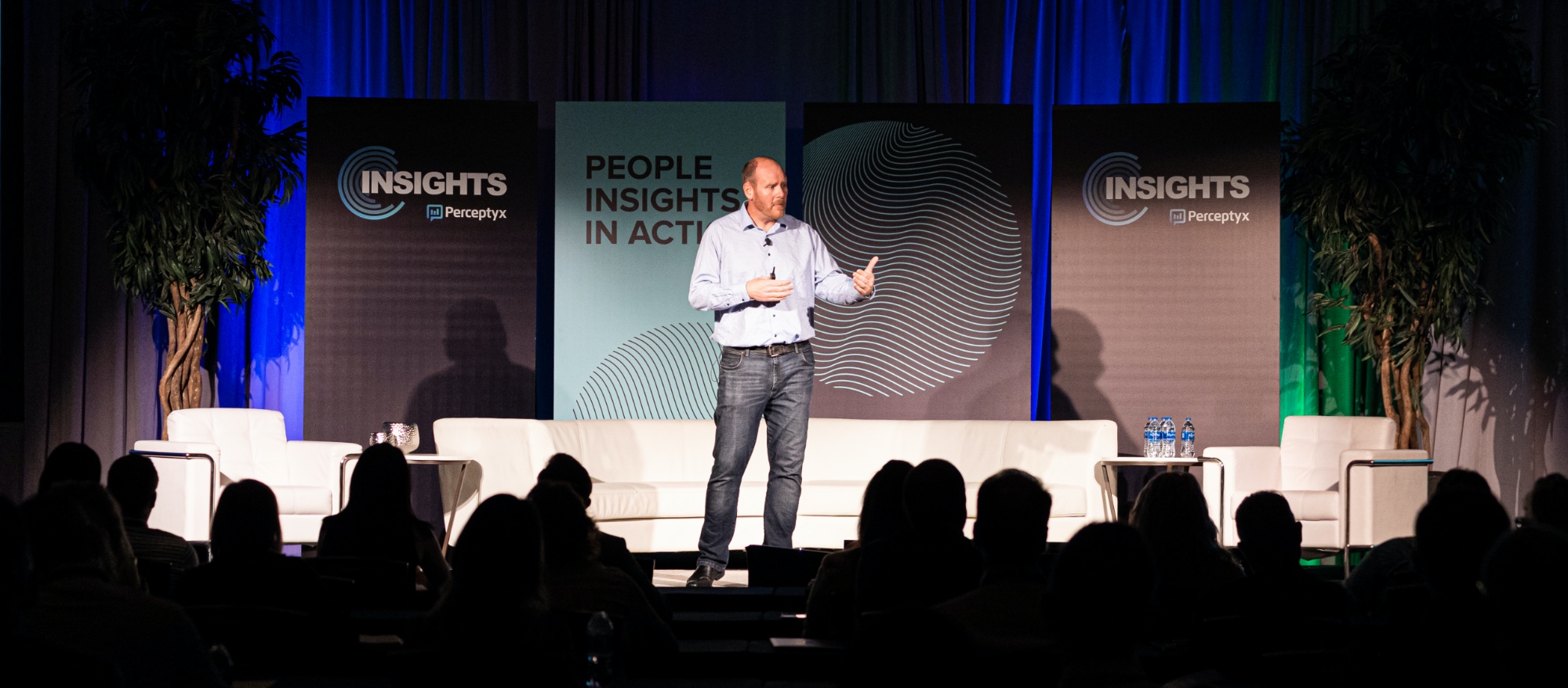
The setting grew. At Perceptyx’s 2022 INSIGHTS conference, Borland described a business that had expanded over three years from 150 employees and 250 customers to 400 employees and 625 customers. CultureIQ, Waggl and Cultivate were being integrated into a company with multiple software products. Those were dated snapshots of a changing organization, rather than interchangeable figures for every year.
His remarks also addressed how companies should listen. “There is no one-size-fits-all model for a listening strategy,” he said. Large employers have different workforces and different questions. An annual survey can offer a useful view, but it cannot be assumed to suit every conversation or every point in a person’s working life.
In his 2021 writing about the People Insights Platform, Borland had explained the value of bringing different channels together: periodic surveys, ongoing feedback and crowdsourced ideas. He also kept a place for consultants who could help clients interpret the results. More information created a need for judgment about what deserved attention.
This is where the project manager’s old problem returns at a different scale. A company can gather thousands of comments and still leave a manager uncertain about Monday morning. The room has grown. The obligation to turn an answer into useful work has followed him into it.
The manager’s Monday morning
In August 2023, Perceptyx acquired Humu, whose technology used behavioral prompts, or nudges, to encourage changes at work. The deal added a way to reach people after the survey results had arrived. It addressed the everyday gap between knowing that something should improve and remembering to do something about it.
Activate followed in April 2024, incorporating Humu’s technology. Its announced functions included suggesting areas for managers to prioritize, helping draft action plans and delivering prompts through tools such as Teams, Slack and email. A development concern raised by a team could lead to guidance for a manager’s next conversation. The product’s proposition depended on fitting into work already happening.
“The challenge facing organizations is not a lack of more insights,” Borland said at the launch. It was a pointed observation from someone whose business had spent years producing them. By then, his public argument was that organizations needed help converting what they knew into repeatable behavior.
The appeal is easy to understand without treating a reminder as magic. A prompt can bring a commitment back into view; a manager still has to follow through. Borland’s shift toward action placed more of the product’s attention on that moment. The survey result could travel beyond a presentation and into a conversation between two people.
“The challenge facing organizations is not a lack of more insights.”John Borland · Activate launch, April 2024
An editorial illustration of the listening-to-action sequence.
Keeping the history, handing over the job
On April 10, 2025, Perceptyx announced Ross Wainwright as CEO. Borland remained on the board. Wainwright brought experience from Alida, SAP and Dimension Data/NTT. In welcoming him, Borland emphasized his ability to support customers and employees, and to help guide the company’s next period of growth.
Borland’s own announcement looked back across twenty-two years. He thanked employees, customers and partners, named his fellow founders and explained that he was leaving the day-to-day CEO role. A founding story often compresses a company into one person. His account explicitly made room for the people who had built it with him.
One earlier colleague supplied another view of that working environment. In the acknowledgments to her 2018 book, Engaging the Workplace, Sarah Rassenfoss Johnson thanked Borland, Morehouse and Belcher for giving her the freedom to concentrate on the consulting work she most enjoyed. It is a specific kind of appreciation: permission to spend time doing useful work well.
Today, Perceptyx describes Borland as a board member and its historian. The word suits someone whose memory includes both client projects and the birthday lunch arrangements. Outside work, he enjoys time on the water with family and friends and making things in his workshop. There is something apt about the workshop: a place where an idea eventually has to become an object that works.
He no longer runs the daily operation he helped establish. He remains connected to its direction, carrying a history that predates the larger rooms and the acquisition announcements. The question running through that history remains small enough to ask across a desk: you have heard what someone needs. What happens next?